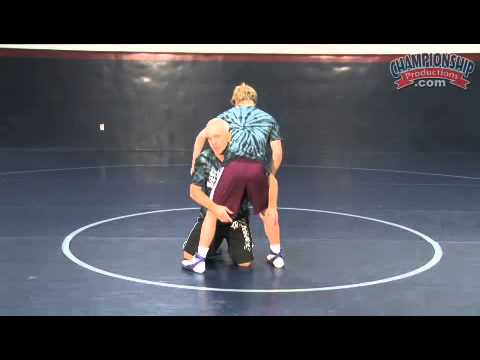
Youth Wrestling: Takedown Fundamentals
0
Wrestling Takedown·Championship Productions
Four-time All American Eric Akin was a top level athlete at Iowa State University. Now as a youth coach he has developed…
Translation: Wrestling takedown
The Wrestling Takedown family covers takedown techniques originating from competitive wrestling — freestyle, Greco-Roman, and folkstyle — the most battle-tested and highest-percentage takedown system in combat sports. [1] These include the single-leg takedown (attacking one leg with head position inside or outside), double-leg takedown (driving through both legs), high crotch (attacking the inner thigh crease), fireman's carry (ducking under and loading the opponent), ankle pick, and duck-under — each with multiple entries and finishes refined through over a century of Olympic and collegiate competition. [1],[2] Wrestling takedowns are defined by the penetration step (an explosive forward lunge that closes distance) and the level change (dropping the hips below the opponent's hips) — two movements that make wrestling takedowns the most efficient standing-to-ground transitions in martial arts. [2],[3] Every elite MMA wrestler (Khabib, GSP, Cormier, Cejudo) relies on this family as their primary method of controlling where fights take place. [3]
Wrestling takedowns have been refined through over a century of Olympic freestyle wrestling (since 1904), American folkstyle (NCAA since 1928), and their integration into sambo and MMA. [1] The penetration step was systematised in American wrestling programs. [1],[2] The adoption of wrestling takedowns into MMA in the 1990s-2000s established the takedown as the most important skill for fight control. [2],[3]
No images yet for this technique.
Sign in to suggest an image.
Four-time All American Eric Akin was a top level athlete at Iowa State University. Now as a youth coach he has developed…
No instructional courses yet for this technique.
Sign in to suggest a course.
Risk of injury to the person this technique is applied to
Takedowns carry impact risk on landing; failed shots expose the neck to guillotines and front headlocks; knee injuries from shooting on hard surfaces are common in training
Skill level needed to execute this technique reliably
Whether this technique is allowed under major competition rule sets
Takedown (Ben Askren, 2019)
Description sources — [1] Wrestling Physical Conditioning Encyclopedia (Jesse, 1974) [2] Takedown (Askren, 2019) [3] UFC fight analysis
Description sources — [1] Wrestling Physical Conditioning Encyclopedia (Jesse, 1974) [2] Takedown (Askren, 2019) [3] UFC fight analysis
explosive hips (penetration step), strong neck (head position), leg strength (level change and driving)
low centre of gravity, explosive speed, strong posterior chain
quadriceps (level change), glutes (hip explosion), hamstrings (finishing), core (posture), neck (head position)
Every move, in any martial art, shares a few universal traits. Mix and match below to pinpoint the right tool — or compare equivalents across styles.
Lock around the opponent's knees rather than higher up on the body. Championship Productions emphasizes treating your arms like a rope to tie them up at the knees, which prevents them from walking away and gives you better control to finish the takedown.
Control their hips by corkscrewing them down onto their hip rather than leaving them belly-down. The instructor describes this as putting them 'on their hip like a mermaid,' which gets them into a position where you can quickly take top control.
Practice the fundamental mechanics so you can complete the move from any position. This ensures you won't get stuck in a bad position if you accidentally find yourself in a takedown setup during training.
The Wrestling Takedown family covers takedown techniques originating from competitive wrestling — freestyle, Greco-Roman, and folkstyle — the most battle-tested and highest-percentage takedown system in combat sports. These include the single-leg takedown (attacking one leg with head position inside or outside), double-leg takedown (driving through both legs), high crotch (attacking the inner thigh crease), fireman's carry (ducking under and loading the opponent), ankle pick, and duck-under — each with multiple entries and finishes refined through over a century of Olympic and collegiate competition.
Wrestling takedowns have been refined through over a century of Olympic freestyle wrestling (since 1904), American folkstyle (NCAA since 1928), and their integration into sambo and MMA. The penetration step was systematised in American wrestling programs.
IJF: legal — Legal takedown technique; IBJJF: legal — Legal at all belt levels, scored as takedown (2 points); UWW: legal — Legal in freestyle, may be restricted in Greco-Roman depending on technique; Unified MMA: legal — Legal takedown technique; ADCC: legal — Legal, scored 2-4 points in second half of match; FIAS Sport Sambo: legal — Legal — all takedowns permitted; FIAS Combat Sambo: legal — Legal; NCAA Folkstyle: legal — Legal, scored as takedown (2 points)
Danger rating 5/10. Moderate — takedowns carry impact risk on landing; failed shots expose the neck to guillotines and front headlocks; knee injuries from shooting on hard surfaces are common in training
The standard setup chain: Create Reaction → Level Change → Penetration Step → Secure Contact → Finish → Establish Top.
Standard counters include: Sprawl — driving hips back to push the attacker's head down / Whizzer — overhook with hip pressure against single leg / Crossface — forearm across the face to redirect / Underhook — securing underhook to prevent leg access.
Common variants: Double leg (attacking both legs simultaneously; the most common wrest…); Single leg (attacking one leg; versatile with many finishes (run the …); High crotch (hybrid single-double; attacking the inner thigh crease); Ankle pick (reaching for the ankle while controlling the head; a prec…); Fireman's carry (ducking under and loading the opponent across the shoulders); Duck under (swimming under the arm to get behind the opponent [2]); Snap-down to front headlock (pulling the head down to establish front headlock control); Low single (shooting from distance to grab one ankle; a surprise attack).
The double leg is the most commonly scored takedown in NCAA wrestling. In MMA, takedown accuracy is one of the most tracked metrics.
Top errors to watch for: Shooting without a setup — telegraphed takedowns are easily sprawled / Head down on the shot — dropping the forehead exposes the neck to guillotines; keep head up, eyes forward / Reaching with arms only — the whole body (level change, penetration, hip drive) must commit / Over-committing to a failed shot — continuing to drive into a sprawl wastes energy; learn to abort and reset.
The Wrestling Takedown is also known as Resuringu Teikudaun, Wrestling Takedown, Folkstyle Takedown, Freestyle Takedown.