How to Finish a Single Leg Takedown | The School of Wrestling Technique
0
TKD Single Leg from Clinch·The School of Wrestling
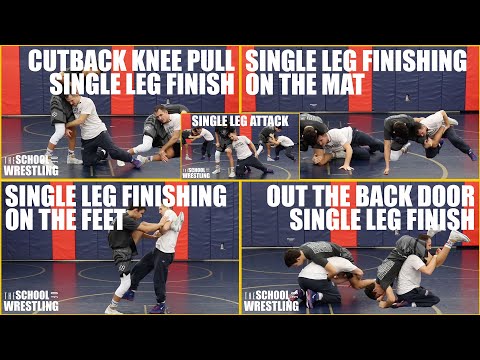
Here are a variety of finishing options for the single leg position.
Translation: Taekwondo single leg from clinch
Cross-style technique adapted for modern combat sports. [1]
Effective in modern MMA and cross-style competition. [1]
Cross-style martial arts. [1]
Used in modern MMA and combat sports
No images yet for this technique.
Sign in to suggest an image.
Not yet documented
Here are a variety of finishing options for the single leg position.
In this Technique Tuesday breakdown, Iowa Hawkeye Drake Ayala shows how to create clean scoring opportunities using his …
The TKD single leg from clinch is executed by first establishing control from an over-collar tie or clinch position, then shooting the leg with precise hand and body placement. Both The School of Wrestling and FloWrestling emphasize that the shooting hand must be positioned above the knee—a critical detail both instructors stress heavily, as placement below the knee invites sprawl counters like the wizard. Once on the leg, the shooter's shoulder placement differs slightly between instructors: The School of Wrestling drives the shoulder into the thigh with head up in the gut, while FloWrestling positions the shoulder nearly on top of the hip/thigh area with deliberate downward pressure to control the opponent's body weight. Both agree on elevating the leg by lifting the thigh and driving through the feet. Finishing sequences vary: The School of Wrestling describes multiple finishes including the trip finish (elevating the knee and ankle), the rotation finish (rotating the knee to ground and climbing the leg), and adjustments when the opponent sprawls, such as pulling the back hand through to the ankle. FloWrestling focuses on the balance-control finish, where the shooter maintains heavy shoulder pressure while hopping and circling to trip the standing leg. Both instructors emphasize that controlling the opponent's balance through footwork and continuous pressure is essential to avoid stalling mid-technique.
Synthesized from 2 instructors
No instructional courses yet for this technique.
Sign in to suggest a course.
Risk of injury to the person this technique is applied to
Technique varies by application
Skill level needed to execute this technique reliably
Whether this technique is allowed under major competition rule sets
Lukasz, T. Taekwondo Grappling Techniques: Hone Your Competitive Edge for Mixed Martial Arts.
[1] Lukasz, Taekwondo Grappling Techniques — technique description and application
Good timing
Explosive movement
The TKD single leg from clinch is documented in Lukasz's Taekwondo Grappling Techniques — adapting the single leg takedown for TKD practitioners in MMA contexts. (Lukasz, Taekwondo Grappling Techniques)
Your shooting hand must be above the knee. Drake Ayala emphasizes this is critical—if your hand is below the knee, you risk getting wizarded, sprawled on, or stepped over. Moving your hand up just 4-6 inches eliminates these defensive options.
Place your shoulder into the opponent's thigh-hip area, pressing into them rather than staying to the side. Drake Ayala notes that this shoulder pressure, combined with head pressure, directs the opponent's body weight in the direction you want them to go, which is essential for finishing.
The School of Wrestling demonstrates several finishes: you can pop your knee over the opponent's leg, control their ankle and pull them into position, or drop to their butt, hook the leg, and drive your head into their hip to finish on top.
Drake Ayala prefers grabbing and pulling the elbow to bring himself over top of the opponent, rather than pushing it, while maintaining head position by pulling their ear toward him.
The TKD Single Leg from Clinch transitions from a taekwondo-style clinch directly into a single-leg takedown.
Cross-style technique adapted for modern combat sports.
IJF: banned — Banned since 2010 leg grab prohibition — direct hansoku-make for touching opp…; IBJJF: legal — Legal at all belt levels, scored as takedown (2 points); UWW: restricted — Legal in freestyle (2-4 points), banned in Greco-Roman (no attacks below waist); Unified MMA: legal — Legal takedown technique; ADCC: legal — Legal, scored 2-4 points in second half of match; FIAS Sport Sambo: legal — Legal — all takedowns permitted; FIAS Combat Sambo: legal — Legal; NCAA Folkstyle: legal — Legal, scored as takedown (2 points)
Danger rating 4/10. Technique varies by application
The standard setup chain: Engagement → TKD Single Leg from Clinch → Follow-up.
Standard counters include: Sprawl / Block / Counter-attack.
Used in modern MMA and combat sports
Top errors to watch for: Poor timing / Over-committing.
The TKD Single Leg from Clinch is also known as Tekondō Kataashi Takkuru, TKD Clinch Single, Taekwondo Single Leg.