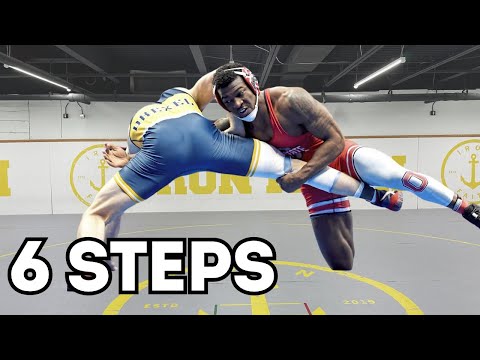
CHAIN WRESTLING: SHOT RECOVERY - JORDAN BURROUGHS | FCA Wrestling TECHNIQUE
0
Shooting to Cage to Takedown·FCA Wrestling
Translation: shooting to cage to takedown
MMA takedown technique. [1]
Core MMA takedown. [1]
MMA wrestling methodology. [1]
Used in UFC and professional MMA competition
No images yet for this technique.
Sign in to suggest an image.
Iron Faith Merch ➡️ https://amptstudio.chipply.com/ifwc/ Join the #1 Online Wrestling Academy in the world ➡️ https://w…
Try out these 5 wrestling tricks to win more wrestling matches! Use this Purler Wrestling course to accomplish your goa…
Shooting to cage to takedown in MMA represents a specialized application of wrestling fundamentals adapted for octagon fighting. Iron Faith Wrestling emphasizes the foundational six-step framework applicable across contexts: establishing proper stance and contact before engagement, hand-fighting to a preferred tie-up position, setting up the shot through push-pull-fake mechanics that read opponent pressure, executing the chosen technique, and critically finishing with full commitment to the mat. Cayden Henschel builds on these basics with specific tricks for match situations, including mirroring (reacting to opponent's hand positioning), head rolls (creating angles by repositioning head control), hand drags (grabbing opponent's reaching hand to transition), happy feet (circular footwork to generate pressure), and pause fakes (stopping motion to provoke opponent reactions). FCA Wrestling's Jordan Burroughs addresses shot recovery when initial takedown attempts encounter resistance, emphasizing head-chest positioning, posting with the free hand, and driving through opponent hips to salvage points. All three instructors converge on the importance of footwork, pressure management, and maintaining control throughout the transition—Iron Faith Wrestling stresses finishing accuracy to prevent roll-throughs or ankle grabs, while Henschel and Burroughs highlight adaptability when the initial shot doesn't yield immediate success. The cage environment adds wrinkle-specific considerations around boundary positioning that traditional mat wrestling may not prioritize as heavily.
Synthesized from 3 instructors
No instructional courses yet for this technique.
Sign in to suggest a course.
Risk of injury to the person this technique is applied to
Takedown technique
Skill level needed to execute this technique reliably
Whether this technique is allowed under major competition rule sets
Mixed Martial Arts: The Book of Knowledge (Penn, Cordoza & Krauss, 2007)
description, historyOrigin: sourced from Penn, B
description, historyOrigin: sourced from Penn, B
Explosive legs
Good base
Shooting to the cage combines a level change with driving the opponent against the wall — the cage prevents them from retreating. The wall then assists the takedown. One of the most common takedown sequences in UFC competition. (MMA training manuals; UFC fight analysis)
Iron Faith Wrestling emphasizes starting in a good stance first without touching your partner, then making contact the right way—either at the wrist, starting low and climbing up, or by making contact with your head first while keeping your hands down.
According to Iron Faith Wrestling, you should build pressure and attack once you feel that pressure returned to you. You can also shoot on a pull—when your opponent starts to stand up against your collar tie pressure, release and shoot as they pop up.
Iron Faith Wrestling identifies several key finishing errors: not finishing properly or all the way through, failing to hide your ankles on leg finishes, and not keeping your shoulder tight throughout the motion. Proper finishing technique is critical to actually securing the takedown.
Cayden Henschel demonstrates the 'pause fake'—stop your shot motion and stay put, which will often cause your opponent to make a defensive mistake by standing up, allowing you to react and capitalize on their poor positioning.
Shooting to Cage to Takedown involves driving the opponent backward into the cage during a takedown attempt, using the wall to prevent backward movement and complete the takedown.
MMA takedown technique.
IJF: legal — Legal takedown technique; IBJJF: legal — Legal at all belt levels, scored as takedown (2 points); UWW: legal — Legal in freestyle, may be restricted in Greco-Roman depending on technique; Unified MMA: legal — Legal takedown technique; ADCC: legal — Legal, scored 2-4 points in second half of match; FIAS Sport Sambo: legal — Legal — all takedowns permitted; FIAS Combat Sambo: legal — Legal; NCAA Folkstyle: legal — Legal, scored as takedown (2 points)
Danger rating 4/10. Takedown technique
The standard setup chain: Strike → Level change → Shooting to Cage to Takedown.
Standard counters include: Sprawl / Whizzer / Underhook.
Common variants: Standard Shooting to Cage to Takedown.
Used in UFC and professional MMA competition
Top errors to watch for: Poor level change / Over-extending.
The Shooting to Cage to Takedown is also known as Shooting to Cage to Takedown, Drive to Cage Takedown, Wall Drive.