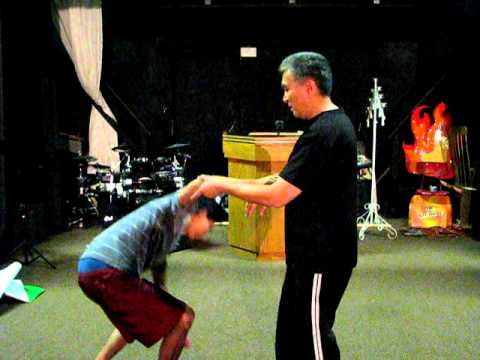
Small Hand Wrap Chin Na Wrist Locking
0
Small Wrap Hand·Gary Gee
Translation: small wrap/coil hand (小 small + 纏 to coil/wrap + 手 hand)
Small Wrap Hand (小纏手, Xiǎo Chán Shǒu — "small wrap/coil hand") is an outward-rotating wrist lock from Chinese Qin Na (擒拿, the joint-locking art embedded across Chinese martial styles), documented by Dr. Yang Jwing-Ming as a White Crane (Bai He) technique. [1] The practitioner covers the opponent's grabbing hand and locks the index finger so it cannot open, raises the captured hand to set the locking angle, then wraps the hand around the outside of the opponent's wrist and presses down with the fingers pointing downward — keeping the opponent's elbow bent and lower than the wrist so they cannot turn the body and escape. [1] Yang classifies it under "Dividing the Muscle/Tendon" (Fen Jin, 分筋) applied at the wrist, and describes the finish as a form of "crane wing dropping" that drives the opponent face-down to the ground. [1] Mechanically it is the coiling, two-handed counterpart of Japanese kote gaeshi: the same outward wrist rotation, but named for the wrapping grip (纏, "to coil/entwine") rather than the reversal. The two are convergent techniques — no source derives one from the other. [1],[2]
Small Wrap Hand is a wrist technique of Chinese Qin Na (擒拿, "seize and control"), the joint-locking art that Dr. Yang Jwing-Ming notes is embedded in almost every Chinese martial style. [1] Yang documents it as a White Crane (Bai He, 白鶴) technique — "a form of crane wing dropping" — in Comprehensive Applications of Shaolin Chin Na and Analysis of Shaolin Chin Na, classing it under "Dividing the Muscle/Tendon" (Fen Jin) applied at the wrist. [1] Qin Na wrist reversals of this "wrap/coil" (纏) family — Small Wrap Hand (小纏手), Large Wrap Hand (大纏手) and Back Wrap Hand (反纏手) — are core close-range control tools in southern Chinese hand-fighting styles. [1] The technique shares its outward-rotation mechanics with Japanese kote gaeshi (小手返し) but is a distinct, independently named technique; mainstream scholarship on aiki's origins (Pranin, Erard) finds no documented derivation between the Chinese and Japanese wrist-reversal traditions, and none is claimed here — the resemblance is best understood as convergent joint-locking. [2]
As a control-and-takedown technique Small Wrap Hand is effective against a committed wrist or sleeve grab: locking the index finger removes the escape, the coil traps the wrist, and the downward press drops the opponent face-first with little strength once the angle is set. [1] Like all wrist locks it is harder to impose on a relaxed, well-postured opponent who can rotate with the coil before it loads, which is why Qin Na trains it as a sudden response to a grab rather than a technique to be forced. Its natural home is self-defence and close-range control rather than sport competition.
Chinese Qin Na (擒拿) wrist-locking, documented in the White Crane (Bai He) and Shaolin traditions by Dr. Yang Jwing-Ming; part of the 纏 ("wrap/coil") wrist-lock family alongside Large Wrap Hand and Back Wrap Hand.
Traditional Qin Na self-defence and control technique; not a sport-competition move. The equivalent standing wrist-wrap lock is legal in submission grappling (e.g. IBJJF adult wrist locks) but outside competitive judo (wrist excluded from kansetsu-waza).
No images yet for this technique.
Sign in to suggest an image.
No instructional courses yet for this technique.
Sign in to suggest a course.
Risk of injury to the person this technique is applied to
Coiling outward wrist torsion loads the small radiocarpal joint; effective at low force and capable of ligament damage or fracture if pressed explosively, with a face-down takedown that adds impact risk
Skill level needed to execute this technique reliably
Whether this technique is allowed under major competition rule sets
Chinese Qin Na (擒拿) / White Crane (Bai He) — Small Wrap Hand (小纏手, Xiǎo Chán Shǒu), per Dr. Yang Jwing-Ming
[1] Yang, Jwing-Ming, Comprehensive Applications of Shaolin Chin Na (YMAA Publication Center, 1995) — Ch. 6, "Small Wrap Hand" (小纏手, Xiao Chan Shou), pp. 254–288; theory "Dividing the Muscle/Tendon (wrist)," described as a White Crane "crane wing dropping." Cf. Analysis of Shaolin Chin Na, 2nd ed. (2004), Wrist Chin Na chapter (腕擒拿)
[2] Pranin, Stanley, "The Elusive Chinese Influence on Aikido" (Aikido Journal, 2012) and Erard, Guillaume, "A Thorough Look into the Secret Scrolls of Daitō-ryū" (guillaumeerard.com) — mainstream scholarship traces kote gaeshi to Japanese Daitō-ryū lineage and finds no documented derivation between the Chinese and Japanese wrist-reversal traditions; the relationship is convergent
Aikido technique naming conventions
[1] Yang, Jwing-Ming, Comprehensive Applications of Shaolin Chin Na (YMAA Publication Center, 1995) — Ch. 6, "Small Wrap Hand" (小纏手, Xiao Chan Shou), pp. 254–288; theory "Dividing the Muscle/Tendon (wrist)," described as a White Crane "crane wing dropping." Cf. Analysis of Shaolin Chin Na, 2nd ed. (2004), Wrist Chin Na chapter (腕擒拿)
[2] Pranin, Stanley, "The Elusive Chinese Influence on Aikido" (Aikido Journal, 2012) and Erard, Guillaume, "A Thorough Look into the Secret Scrolls of Daitō-ryū" (guillaumeerard.com) — mainstream scholarship traces kote gaeshi to Japanese Daitō-ryū lineage and finds no documented derivation between the Chinese and Japanese wrist-reversal traditions; the relationship is convergent
angle control, finger/wrist sensitivity, footwork (rear-leg step)
precise coiling grip and body positioning over hand strength
forearm flexors and pronators, intrinsic hand muscles, grip
According to Gary Gee, the small hand wrap requires the arm to be bent; if the arm is stiff or straight, the technique won't be effective. You need to first create a bend in the arm before applying the wrap and turning it downward.
Gary Gee emphasizes stepping back, hooking the wrist, and creating a bend in the opponent's arm before turning and bringing the arm down. This Tai Chi concept of creating the proper angle is essential for the technique to function.
Small Wrap Hand (小纏手, Xiǎo Chán Shǒu — "small wrap/coil hand") is an outward-rotating wrist lock from Chinese Qin Na (擒拿, the joint-locking art embedded across Chinese martial styles), documented by Dr. Yang Jwing-Ming as a White Crane (Bai He) technique.
Small Wrap Hand is a wrist technique of Chinese Qin Na (擒拿, "seize and control"), the joint-locking art that Dr. Yang Jwing-Ming notes is embedded in almost every Chinese martial style.
IBJJF: legal — the equivalent standing wrist-wrap lock is permitted at adult levels (wrist l…; IJF Judo: banned — wrist locks are outside kansetsu-waza (elbow only)
Danger rating 6/10. Coiling outward wrist torsion loads the small radiocarpal joint; effective at low force and capable of ligament damage or fracture if pressed explosively, with a face-down takedown that adds impact risk
The standard setup chain: Meet the grab → Lock the fingers → Set the angle → Wrap the wrist → Press down and step back.
Standard counters include: Open the hand before the index finger is locked — deny the wrap / Straighten and raise the elbow above the wrist — turn the body out of the coil / Follow the rotation and step in to collapse the locking angle / Strip the covering hand before the wrist is wrapped.
Common variants: Large Wrap Hand (大纏手, Dà Chán Shǒu) (the large-circle version of the same wrapping wrist lock); Back Wrap Hand (反纏手, Fǎn Chán Shǒu) (reverse-direction wrap); Same-side vs. opposite-side grabbing entries; Sleeve-grab application; Crane-wing-dropping finish into a face-down takedown.
Traditional Qin Na self-defence and control technique; not a sport-competition move. The equivalent standing wrist-wrap lock is legal in submission grappling (e.
Top errors to watch for: Not locking the index finger first — the opponent opens his hand and slips the wrap / Letting the elbow stay high — if the elbow is above the wrist the opponent turns his body and escapes / Muscling the wrap instead of finding the angle — extend the arm and drop the fingers to set the lock / Standing square — failing to step the rear leg back leaves you in range of the free hand and weakens the press.
The Small Wrap Hand is also known as 小纏手, Xiao Chan Shou, Xiǎo Chán Shǒu, Small Coil Hand, Wrist wrap (Qin Na).