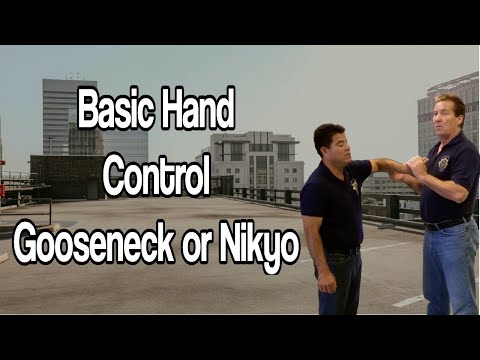
Gooseneck Wrist Lock (Nikyo): Ultimate Self-Defense Technique #aikido #hapkido #martialarts
0
Extension·Weapons Defense Academy
Gooseneck Wrist Lock (Nikyo): Ultimate Self-Defense Technique #aikido #hapkido #martialarts Advance your weapons defen…
Translation: extension
Wrist extension locks force the hand backward (dorsiflexion), hyperextending the wrist joint and stressing the palmar ligaments and flexor tendons. [1],[2] The gooseneck is the classic wrist extension lock — the attacker bends the opponent's hand backward toward the forearm. Figure-four wrist extensions use a two-on-one grip for additional leverage. Kote-gaeshi in aikido is a throwing technique that uses wrist extension with rotation. [3],[4]
Extension-based arm locks hyperextend the elbow joint by straightening the arm against its natural range of motion. [1]
Extension armlocks are fundamental to judo's juji-gatame system and BJJ's armbar family. [1]
Extension armlocks (juji-gatame/armbar) are one of the most commonly finished submissions in all grappling competitions. [1]
No images yet for this technique.
Sign in to suggest an image.
Gooseneck Wrist Lock (Nikyo): Ultimate Self-Defense Technique #aikido #hapkido #martialarts Advance your weapons defen…
No instructional courses yet for this technique.
Sign in to suggest a course.
Risk of injury to the person this technique is applied to
Wrist extension locks force the hand backward, compressing the carpal bones and risking fracture
Skill level needed to execute this technique reliably
Whether this technique is allowed under major competition rule sets
Aikido — Kote Gaeshi; Kodokan Goshin Jutsu kata
Japanese terminology sourced from Aikido — Kote Gaeshi; Kodokan Goshin Jutsu kata
Aikido technique naming conventions
Standard Japanese martial arts terminology (kanji/hiragana)
Established Japanese martial arts naming convention — native Japanese term (和語/漢語)
Japanese terminology sourced from Aikido — Kote Gaeshi; Kodokan Goshin Jutsu kata
fine motor control, grip sensitivity, quick hand transitions
dexterous hands with strong fingers
forearm flexors and extensors, intrinsic hand muscles
Every move, in any martial art, shares a few universal traits. Mix and match below to pinpoint the right tool — or compare equivalents across styles.
The figure-four extension wrist lock uses a figure-four grip configuration to hyperextend the opponent's wrist — bending it backward beyond its natural range of motion. [1,2] The attacker grips the opponent's hand with one hand and reinforces with a figure-four by gripping their own wrist, then presses the back of the opponent's hand toward the forearm. [1] The figure-four provides mechanical advantage that makes the lock extremely difficult to resist with wrist strength alone. [1] This is commonly applied when the opponent grips a collar or sleeve in gi grappling. [1,2]
The gooseneck extension wrist lock bends the wrist backward while curling the fingers downward, creating a shape resembling a goose's neck. [1,2] The attacker grips the back of the opponent's hand and pushes it toward the forearm while simultaneously curling the fingers, compounding the extension pressure on the wrist with flexion pressure on the finger joints. [1,3] This double-action makes the gooseneck particularly painful and difficult to resist. [1] It is commonly applied from wrist control positions in standing or from top positions in ground grappling. [1,4]
Your hands should be positioned absolutely vertical, like in a prayer position, with the opponent's hands held between yours. According to Weapons Defense Academy, avoid taking the hand on an angle or all the way over—keep it strictly vertical for proper technique execution.
You should pull the opponent's hand toward you while pushing their fingers toward their body (toward their nose), and push downward—not upward or sideways. Weapons Defense Academy emphasizes that pushing up or to the side produces no effect; the downward pulling-and-pushing motion is what creates the lock.
Don't let their elbow rise, because lifting the elbow allows them to spin and turn out of the lock. Weapons Defense Academy recommends keeping your hands over the top to control their arm and applying pain if they try to bring their hand up to escape.
Wrist extension locks force the hand backward (dorsiflexion), hyperextending the wrist joint and stressing the palmar ligaments and flexor tendons. The gooseneck is the classic wrist extension lock — the attacker bends the opponent's hand backward toward the forearm.
Wrist extension techniques (kote-gaeshi, 小手返し) are foundational in aikido and Daito-ryū Aiki-jūjutsu, where they are used for both throwing and control. In judo, wrist locks appear in the Kodokan Goshin Jutsu self-defense kata.
IBJJF: legal — Legal at all belt levels; IJF: banned — Only elbow joint locks (kansetsu-waza) permitted in judo — all other joint lo…; ADCC: legal — Legal — all submissions legal in ADCC; Unified MMA: legal — Legal submission technique; FIAS Sport Sambo: legal — Legal; FIAS Combat Sambo: legal — Legal
Danger rating 5/10. Wrist extension locks force the hand backward, compressing the carpal bones and risking fracture
The standard setup chain: Establish Position → Create the Threat → Secure the Hold → Finish.
Standard counters include: Early Recognition — identify the submission attempt early and begin defence immediately / Posture and Base — maintain strong posture and base to prevent submission setups / Grip Fight — deny the attacker their preferred gripping configuration.
Common variants: Standard wrist lock (kote gaeshi) (two-handed rotational lock on the wrist); Gooseneck wrist lock (flexion lock bending the wrist down toward the forearm); Standing wrist lock (applied during grip fighting or a standing exchange); Ground wrist lock (catching the opponent's posted hand from mount, side cont…).
Extension armlocks (juji-gatame/armbar) are one of the most commonly finished submissions in all grappling competitions.
Top errors to watch for: Pushing the fingers instead of the back of the hand — the force must be applied to the metacarpals (back of hand), no… / Not stabilising the forearm — the forearm must be anchored; if it moves with the hand, no extension occurs / Using finger strength — the extension requires the palm of the attacker's hand against the back of the opponent's han… / Applying when the opponent makes a fist — the fist position strengthens the wrist; wait for or create an open hand.
The Extension is also known as Nobashi, Wrist Extension Lock, Dorsal Flexion Lock.