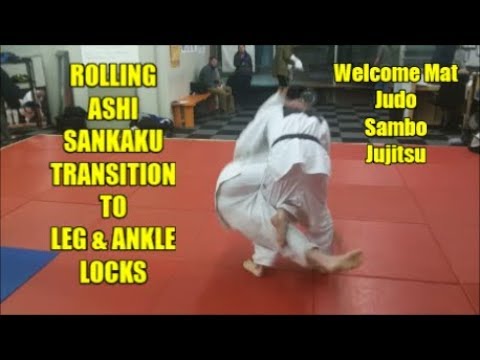
ROLLING ASHI SANKAKU TO LEGLOCKS
0
Ashi-Gatame From Standing·welcomematstevescott
This video shows a Rolling Transition from standing to a variety of leg and ankle locks using a Leg Triangle. Coaching b…
Translation: leg hold from standing
Ashi-gatame from standing is a standing armbar where the attacker traps the opponent's extended arm and uses the foot or shin placed against the opponent's body as a fulcrum point, then hyperextends the elbow joint by levering the arm over the leg. [1],[2] The standing application requires the attacker to maintain balance while isolating the arm, typically off a wrist grab, sleeve grip, or arm-drag setup. [1] The technique can finish standing or transition to a ground-based armbar if the opponent does not submit from the initial standing pressure. [1],[2]
Ashi-gatame (足固, foot hold/lock) is classified in Kodokan judo's kansetsu-waza (joint lock techniques) curriculum as a standing elbow lock using the foot as a brace. [1],[2] The technique appears in classical judo kata and was part of the self-defense applications taught alongside competitive techniques. [1] Standing arm locks from this family are also found in aikido, traditional jujutsu, and various self-defense systems that emphasize joint manipulation from a standing clinch. [1],[2]
Standing ashi-gatame applies the arm lock from an upright position, often during a scramble or failed takedown attempt. [1]
Standing armlocks appear in judo's tachi-waza submissions and catch wrestling. [1]
Standing armlocks occasionally appear in judo and MMA competition. [1]
No images yet for this technique.
Sign in to suggest an image.
This video shows a Rolling Transition from standing to a variety of leg and ankle locks using a Leg Triangle. Coaching b…
No instructional courses yet for this technique.
Sign in to suggest a course.
Risk of injury to the person this technique is applied to
Ashi-gatame (leg-assisted armlock) uses the leg as a fulcrum against the elbow joint
Skill level needed to execute this technique reliably
Whether this technique is allowed under major competition rule sets
Kodokan Judo — Official Katame-waza Classification
Kodokan ashi-gatame + positional modifier
Standard Japanese martial arts terminology (kanji/hiragana)
Established Japanese martial arts naming convention — native Japanese term (和語/漢語)
Kodokan ashi-gatame + positional modifier
hip flexibility, hip bridge power, leg clamping strength
long legs for controlling the opponent's torso
hip extensors (glutes), adductors, quadriceps, hamstrings
Standing ashi gatame applies the leg arm lock while standing — the attacker raises their leg to trap and lock the opponent's arm. An uncommon standing submission requiring flexibility. (Kano, Kodokan Judo)
As you pop up from the position, slide your leg around back to apply the leg triangle, then slide underneath and grab the far angle to secure the submission.
Your opponent needs to believe the throw is actually going to work in order for the transition to succeed. Like all throw-to-submission transitions, you need that genuine reaction from your opponent.
You don't need to catch in or use leg entanglement—simply leaving your leg in place makes the setup easier and more straightforward.
Ashi-gatame from standing is a standing armbar where the attacker traps the opponent's extended arm and uses the foot or shin placed against the opponent's body as a fulcrum point, then hyperextends the elbow joint by levering the arm over the leg. The standing application requires the attacker to maintain balance while isolating the arm, typically off a wrist grab, sleeve grip, or arm-drag setup.
Ashi-gatame (足固, foot hold/lock) is classified in Kodokan judo's kansetsu-waza (joint lock techniques) curriculum as a standing elbow lock using the foot as a brace. The technique appears in classical judo kata and was part of the self-defense applications taught alongside competitive techniques.
IBJJF: legal — Legal at all belt levels; IJF: banned — Only elbow joint locks (kansetsu-waza) permitted in judo — all other joint lo…; ADCC: legal — Legal — all submissions legal in ADCC; Unified MMA: legal — Legal submission technique; FIAS Sport Sambo: legal — Legal; FIAS Combat Sambo: legal — Legal
Danger rating 7/10. Ashi-gatame (leg-assisted armlock) uses the leg as a fulcrum against the elbow joint
The standard setup chain: Control the Arm → Position the Hips → Pinch Knees → Extend for the Finish.
Standard counters include: Clasp Hands — grip own wrist to prevent arm extension / Stack — drive forward to compress the attacker and relieve elbow pressure / Hitchhiker Escape — rotate the thumb toward the mat and roll to extract the arm.
Common variants: Standard armbar (hips drive upward against the extended arm with legs clam…); Belly-down armbar (rolling to face the mat to prevent the opponent from stac…); S-mount armbar (transitioned from S-mount position for tighter control be…); Spinning armbar (rapid pivot from guard or side to catch the arm during tr…).
Standing armlocks occasionally appear in judo and MMA competition.
Top errors to watch for: Attempting without secure wrist control — the arm will retract if the wrist isn't firmly controlled before the weight… / Dropping too slowly — the standing entry must be explosive; a slow transition gives the opponent time to retract the arm / Not positioning the leg correctly before dropping — the leg must be across the arm at the elbow level before the weig… / Landing in a weak position — plan the ground position; dropping randomly creates a scramble rather than a controlled ….
The Ashi-Gatame From Standing is also known as Ashi-gatame (Tachi kara), Standing Ashi-Gatame, Standing Leg Armlock.