How to Spladle Wrestling Tips
0
Spladle Execution·Myosource Kinetic Bands·Added by Admin
http://myosource.com/wrestling/ How to Spladle Wrestling Tips
Translation: spladle
The spladle is a wrestling pinning combination and submission where the attacker traps and splits the opponent's legs (forcing them toward a split position) while controlling from behind, creating extreme pressure on the hamstrings, groin, back, and neck. [1] Created by Wade Schalles (NCAA Division I champion, 1960s), the name is a portmanteau of 'split scissors' and 'cradle,' coined by Schalles himself. [2] It is primarily executed as a counter to a single leg takedown attempt, functioning simultaneously as a pin, a submission, and a takedown counter. The position compromises the opponent's breathing due to the folded position.
Highly effective counter to single leg takedowns in both wrestling and MMA. Functions as a pin in wrestling and a submission in grappling/MMA due to the extreme pressure on groin, hamstrings, and breathing. [1]
Created by Wade Schalles (NCAA Division I champion, 1960s). Crossed into MMA through Nate Diaz, JJ Holmes, and Zabit Magomedsharipov.
Nate Diaz vs. Joe Stevenson (UFC, 2009) — ground strikes from spladle. JJ Holmes submitted Andre Cavanaugh via spladle (2009). Zabit Magomedsharipov used variations in UFC. Wade Schalles: NCAA Division I champion.
No images yet for this technique.
Sign in to suggest an image.
http://myosource.com/wrestling/ How to Spladle Wrestling Tips
http://www.myosource.com/buy-kinetic-bands/. http://coachttd.com/. Three ways to Spladle your wrestling opponent from t…
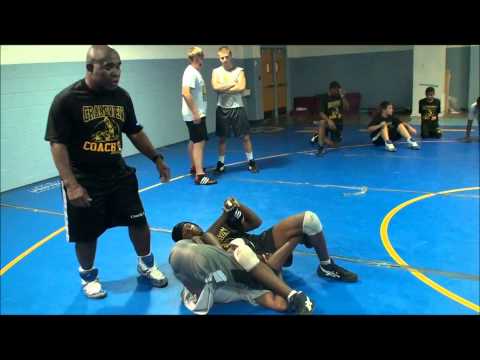
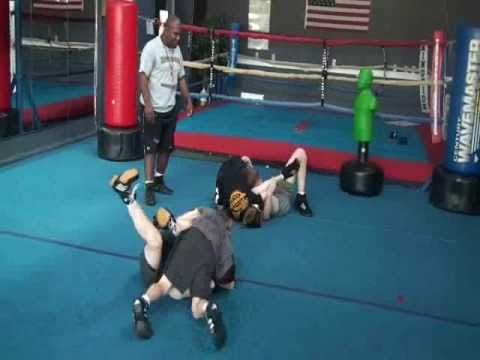
The spladle execution involves securing an opponent's legs in a compressed lock configuration through coordinated arm and leg positioning. Both Myosource Kinetic Bands instructors emphasize the critical importance of maintaining the opponent's knee tight against their chest to prevent escape and ensure control. The fundamental mechanics require establishing a two-on-one grip structure: one arm threads behind the knee while the second arm secures behind the Achilles tendon, creating dual leverage points. Execution positioning demands the attacker remain on their side with shoulders up, driving stomach pressure into the opponent's head while simultaneously bringing their legs together, forcing the opponent's head into hyperflexion as they attempt to kiss their own body. Both instructors stress foot placement on the mat for balance and stability, with reinforcement through the top leg positioned behind the Achilles. The technique permits multiple rolling directions—forward, backward, or sideways—before securing the final position. Coach Greg Thomas (Myosource Kinetic Bands, Standing Spladle video) additionally demonstrates inside and outside hook variations from standing single-leg defense, whereas the first Myosource instructor (Wrestling Tips video) emphasizes positional adjustments when initial leg hooks prove unavailable, focusing on maintaining control appearance for referee recognition. Both sources agree that once properly secured with appropriate pressure application, the submission becomes extremely painful and difficult to escape.
Synthesized from 2 instructors
No instructional courses yet for this technique.
Sign in to suggest a course.
Risk of injury to the person this technique is applied to
Significant strain on hamstrings, groin (adductors), lower back, and cervical spine; can cause injury if applied forcefully against inflexible opponents; breathing compromised by the folded position
Skill level needed to execute this technique reliably
Whether this technique is allowed under major competition rule sets
Evolve MMA — What Is The Spladle Move in MMA
Evolve MMA — What Is The Spladle Move In MMA (evolve-mma.com) || BJJ World — Wrestling Spladle: The Ultimate Single Leg Counter (bjj-world.com) || Fanatic Wrestling — Spladle Wrestling Move (fanaticwrestling.com)
Standard katakana transliteration of Western martial arts terminology (外来語) — used in Japanese MMA, boxing, and BJJ communities
[1] Wade Schalles — inventor and name creator (NCAA Division I champion, 1960s)
[2] Evolve MMA and BJJ World — MMA crossover documentation and technique breakdown
precise timing on the entry (usually off a sprawl), controlled execution
hip flexors, shoulders, core, grip strength
Both of your feet should be on the mat for balance and stability, with your body positioned on your side. Your knee should be positioned behind the opponent's Achilles tendon, and you secure it by placing that foot on the mat as well.
Once you have the leg security and both feet planted, you drive your hips into your opponent while bringing their legs toward you, and simultaneously apply stomach pressure to drive their head in the opposite direction, creating a two-on-one control situation.
In an outside spladle, you hook your hands on the outside rather than on the inside. From either position, you can execute the technique by rolling your opponent forward or backwards.
The spladle is a wrestling pinning combination and submission where the attacker traps and splits the opponent's legs (forcing them toward a split position) while controlling from behind, creating extreme pressure on the hamstrings, groin, back, and neck. Created by Wade Schalles (NCAA Division I champion, 1960s), the name is a portmanteau of 'split scissors' and 'cradle,' coined by Schalles himself.
Created by Wade Schalles, NCAA Division I champion in the 1960s. The name is a portmanteau of 'split scissors' and 'cradle,' coined by Schalles himself.
IBJJF: restricted — Brown and black belt only; IJF: banned — Only elbow joint locks permitted in judo — compression locks prohibited; ADCC: legal — Legal; Unified MMA: legal — Legal; FIAS Sport Sambo: legal — Legal; FIAS Combat Sambo: legal — Legal
Danger rating 6/10. High — significant strain on hamstrings, groin (adductors), lower back, and cervical spine; can cause injury if applied forcefully against inflexible opponents; breathing compromised by the folded position
The standard setup chain: Opponent shoots single leg → Sprawl and control the hips → Thread far-side arm around opponent's far leg → Lock gable grip → Step behind same-side leg → Fall back and roll to the side → Pull far leg toward chest, push near leg away → Force the split for pin or submission.
Standard counters include: Don't shoot deep single legs — keep the hips back / Hand-fight to prevent the gable grip / Tuck the far leg tight — don't let it be reached / Roll with the spladle — go with the rotation rather than resisting.
Common variants: Standard spladle from single leg defense (the classic counter); Spladle from front headlock (convert head control to leg split); Spladle with ground strikes (MMA application (Nate Diaz style)); Standing spladle (rare, applied from standing clinch); Catch wrestling spladle (used as a submission rather than just a pin).
Nate Diaz vs. Joe Stevenson (UFC, 2009) — ground strikes from spladle.
Top errors to watch for: Not securing the gable grip before falling back — the grip must be locked / Falling straight back instead of to the side — must roll to control the finish / Not splitting the legs actively — must push one leg while pulling the other / Applying too forcefully against inflexible opponents — risk of groin and hamstring tears.
The Spladle Execution is also known as Supuradoru, Standard Spladle, Spladle, Split Scissors Cradle, Leg Split Pin.