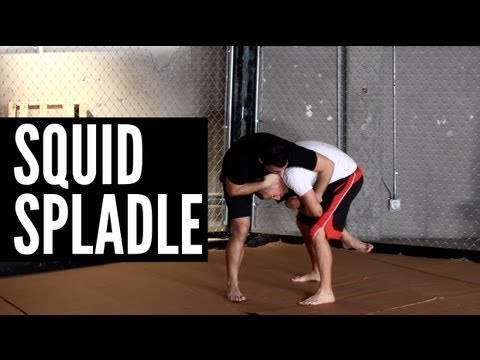
spladle.MP4
0
Spladle·One fightgirl
jeff spladles a kid for the pin
Not yet documented
The Spladle is a unique submission hold that originates from wrestling and functions as a compression lock/stretch submission — the attacker traps the opponent's head and one leg together, then forces the other leg apart, creating a painful split that attacks the groin, hip, and lower back. [1] In wrestling, the spladle is primarily used as a pinning combination (trapping the head and leg together while driving the opponent's shoulders to the mat), but in submission grappling and MMA, it has been adapted as a submission hold where the forced split creates enough pain and joint stress to force a tap. [1],[2] The spladle is entered from front headlock position or when the opponent attempts a single-leg takedown — the attacker threads their arm between the opponent's legs to capture the far leg while maintaining head control, creating the head-and-leg trap. [2],[3] While not a common submission in modern competition, the spladle has a dedicated following and has been used successfully in MMA by fighters like Ben Askren. [3]
The spladle originated in American folkstyle wrestling as a pinning combination, particularly popular in high school and college wrestling. [1] The technique was adapted for submission grappling and MMA as fighters recognised the submission potential of the forced split. [1],[2] Ben Askren (former Bellator and ONE Championship welterweight champion, Olympic alternate in wrestling) is the most notable MMA fighter to use the spladle, bringing attention to the technique through his MMA career. [2],[3]
The spladle is a niche but effective submission when applied correctly — the forced split creates intense pain that most opponents cannot withstand. [1] In wrestling, the spladle is a legitimate pinning technique used at the high school and college level. [2] In MMA, Ben Askren has demonstrated the spladle's effectiveness against opponents with limited flexibility. [3]
No images yet for this technique.
Sign in to suggest an image.
jeff spladles a kid for the pin
If you're a wrestler or if you just want to improve your mixed martial arts game, pay attention. Because today MMA Surge…
No instructional courses yet for this technique.
Sign in to suggest a course.
Risk of injury to the person this technique is applied to
High — the forced split can cause groin tears (adductor strains), hip injuries, and lower back injuries; the submission should be applied gradually to allow the opponent time to tap; some people have naturally limited flexibility and are more vulnerable to this technique
Skill level needed to execute this technique reliably
Whether this technique is allowed under major competition rule sets
Coaching Wrestling Successfully (Dan Gable, 1999)
Description sources — [1] Wrestling pinning traditions [2] Ben Askren's MMA career analysis [3] Submission grappling adaptation
Standard katakana transliteration of Western martial arts terminology (外来語) — used in Japanese MMA, boxing, and BJJ communities
Description sources — [1] Wrestling pinning traditions [2] Ben Askren's MMA career analysis [3] Submission grappling adaptation
front headlock control, arm-threading dexterity, upper body strength for maintaining the position
wrestling background (front headlock familiarity), upper body strength, long arms (easier to thread between the legs)
shoulders (maintaining the headlock), biceps (arm threading and pulling), core (driving the pin), hip flexors (controlling the split)
According to mahalodotcom, you should fight the single leg first and apply pressure with an overhook to make your opponent settle before transitioning to the spladle. Don't let the opponent know you're going for the move right away, because he will hold onto his leg tighter, making it harder to execute.
Many people execute the spladle too fast, which allows the opponent to pop out. According to mahalodotcom, you need to perform the move slowly, settle your opponent back, and keep the lock tight—'when you lock a lock you know you need a key'—to secure the pin or submission.
Keep your head up and don't allow your opponent to grab it. One fightgirl emphasizes actively wiping off or clearing head control attempts during the setup.
According to mahalodotcom, you can bait your opponent into grabbing your leg by offering it or even kicking toward the groin, then transition into the spladle once they commit to holding the leg. This was the modified approach mahalodotcom developed after spraining his ankle in high school.
The Spladle is a unique submission hold that originates from wrestling and functions as a compression lock/stretch submission — the attacker traps the opponent's head and one leg together, then forces the other leg apart, creating a painful split that attacks the groin, hip, and lower back. In wrestling, the spladle is primarily used as a pinning combination (trapping the head and leg together while driving the opponent's shoulders to the mat), but in submission grappling and MMA, it has been adapted as a submission hold where the forced split creates enough pain and joint stress to force a tap.
The spladle originated in American folkstyle wrestling as a pinning combination, particularly popular in high school and college wrestling. The technique was adapted for submission grappling and MMA as fighters recognised the submission potential of the forced split.
IBJJF: restricted — Brown and black belt only; IJF: banned — Only elbow joint locks permitted in judo — compression locks prohibited; ADCC: legal — Legal; Unified MMA: legal — Legal; FIAS Sport Sambo: legal — Legal; FIAS Combat Sambo: legal — Legal
Danger rating 6/10. Moderate-high — the forced split can cause groin tears (adductor strains), hip injuries, and lower back injuries; the submission should be applied gradually to allow the opponent time to tap; some people have naturally limited flexibility and are more vulnerable to this technique
The standard setup chain: Establish Front Headlock → Thread the Arm → Trap Head and Leg → Roll to Position → Apply Split → Finish.
Standard counters include: Posture Up — driving upward from the front headlock prevents the spladle entry / Keep Legs Together — clamping the legs together prevents the arm threading / Roll — rolling away from the spladle can relieve the split pressure / Grip Fight — stripping the headlock grip prevents the technique.
Common variants: Standard spladle (wrestling pin) (trapping head and leg together, driving the shoulders to …); Submission spladle (applying the split stretch as a submission hold (tapping …); Standing spladle entry (entering the spladle from a standing front headlock when …); Rolling spladle (rolling from the front headlock to establish the spladle …); Banana split from Truck (a related technique from the 10th Planet system where bot…).
The spladle is used as a pinning technique in folkstyle wrestling and has been used as a submission in MMA. Ben Askren is the most notable MMA practitioner of the technique.
Top errors to watch for: Failing to secure the head control — the spladle requires the head to be trapped with the leg; without head control, … / Not threading the arm deep enough — the arm must pass fully between the legs to capture the far thigh; a shallow thre… / Applying the split too fast — explosive splitting can cause groin tears; apply gradually / Attempting the spladle without a front headlock — the entry point is the front headlock; without it, the position is ….
The Spladle is also known as Spladle Pin, Banana Split, Leg Split Submission.