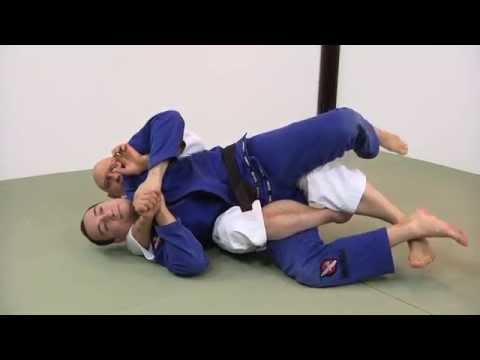
The Easiest Way to do the Twister
0
Standard Twister·Stephan Kesting
How to do the Twister Submission the easiest way. By Stephan Kesting from http://www.grapplearts.com
Translation: Twister (katakana loanword)
The standard twister from truck is the signature cervical rotation submission of the 10th Planet Jiu-Jitsu system, applied from the truck position by rotating the opponent's spine along its longitudinal axis. [1] From truck — where the attacker's legs are threaded through and controlling the opponent's lower body — one arm threads behind the opponent's head while the other grips the far leg, then the attacker rotates the upper body in the opposite direction from the lower body. [1],[2] This counter-rotation creates extreme torsional stress on the entire spinal column, particularly the cervical and thoracic segments. [2] The standard twister is one of the most dramatic and dangerous spinal submissions in grappling, capable of causing serious injury if applied without control. [2],[3]
Eddie Bravo popularised the twister as a centrepiece of his 10th Planet Jiu-Jitsu system beginning in the early 2000s, crediting the technique's origins to professional wrestling's guillotine hold. [1] The twister gained mainstream recognition when Bravo's students, including Chan Sung Jung ('The Korean Zombie'), applied it in UFC competition. [2],[3]
The standard twister is a devastating rotational spinal lock that attacks the entire spine — when fully applied, it creates rotation in the thoracic and cervical spine that is nearly impossible to resist [1]
Created by Eddie Bravo as an evolution of the wrestler's guillotine. First codified in the 10th Planet Jiu-Jitsu system in the early 2000s. Named 'twister' by Bravo for the rotational spinal mechanic [1]
The most famous twister finish in combat sports is Chan Sung Jung vs. Leonard Garcia (UFC, 2011). Regular feature at 10th Planet invitational events. Rare at ADCC/IBJJF [1]
No images yet for this technique.
Sign in to suggest an image.
How to do the Twister Submission the easiest way. By Stephan Kesting from http://www.grapplearts.com
No instructional courses yet for this technique.
Sign in to suggest a course.
Risk of injury to the person this technique is applied to
Rotation cranks twist the cervical spine; among the highest-risk submission categories
Skill level needed to execute this technique reliably
Whether this technique is allowed under major competition rule sets
note.com BJJ articles; Eddie Bravo 'Grappling Technique' Japanese edition (trans. 中井祐樹); JBJJF rules
Official Japanese BJJ federation — competition rules and terminology
Translated by 中井祐樹 (Nakai Yūki, 2007)
Japanese BJJ community writing platform
Standard katakana transliteration of Western martial arts terminology (外来語) — used in Japanese MMA, boxing, and BJJ communities
Japanese terminology sourced from note.com BJJ articles; Eddie Bravo 'Grappling Technique' Japanese edition (trans. 中井祐樹); JBJJF rules
grip or squeeze strength, positional control
strong upper body for sustained compression
forearms, biceps, pectorals, core stabilisers
Stephan Kesting suggests transitioning from full rear mount to half back control to maintain position rather than lose it entirely, especially if your opponent removes a hook or begins escaping.
Stephan Kesting emphasizes being especially careful when training with higher-level partners, as the Twister can cause paralysis and serious injury if not controlled properly.
The standard twister from truck is the signature cervical rotation submission of the 10th Planet Jiu-Jitsu system, applied from the truck position by rotating the opponent's spine along its longitudinal axis. From truck — where the attacker's legs are threaded through and controlling the opponent's lower body — one arm threads behind the opponent's head while the other grips the far leg, then the attacker rotates the upper body in the opposite direction from the lower body.
Eddie Bravo popularised the twister as a centrepiece of his 10th Planet Jiu-Jitsu system beginning in the early 2000s, crediting the technique's origins to professional wrestling's guillotine hold. The twister gained mainstream recognition when Bravo's students, including Chan Sung Jung ('The Korean Zombie'), applied it in UFC competition.
IBJJF: legal — Legal at all belt levels, gi and no-gi — chokes are the safest submission cat…; IJF: legal — Legal (shime-waza) — strangulation techniques are one of three permitted subm…; ADCC: legal — Legal; Unified MMA: legal — Legal — choke submissions are among the most common finishes in MMA; FIAS Sport Sambo: banned — All chokes prohibited in Sport Sambo; FIAS Combat Sambo: legal — Legal
Danger rating 9/10. Rotation cranks twist the cervical spine; among the highest-risk submission categories
The standard setup chain: Establish Position → Create the Threat → Secure the Hold → Finish.
Standard counters include: Early Recognition — identify the submission attempt early and begin defence immediately / Posture and Base — maintain strong posture and base to prevent submission setups / Grip Fight — deny the attacker their preferred gripping configuration.
Common variants: Standard grip variation (primary hand configuration for maximum choking pressure); Gi variation (uses the lapel or collar as an anchor for additional fric…); No-gi variation (adapted grip and positioning for submission grappling wit…); Transition finish (applied during a positional change to catch the opponent …).
The most famous twister finish in combat sports is Chan Sung Jung vs. Leonard Garcia (UFC, 2011).
Top errors to watch for: Attempting the twist without the truck established — the truck position (leg entanglement + partial back control) mus… / Not controlling the far hip with the leg entanglement — the entanglement must prevent hip rotation; if the opponent c… / Reaching for the head before the truck is locked — establish the leg control first; reaching for the head from an unl… / Applying explosive rotation — the standard twister is the most commonly applied version; progressive application prev….
The Standard Twister is also known as Tsuisutā, Classic Twister, Truck-Position Twister, Eddie Bravo Twister.