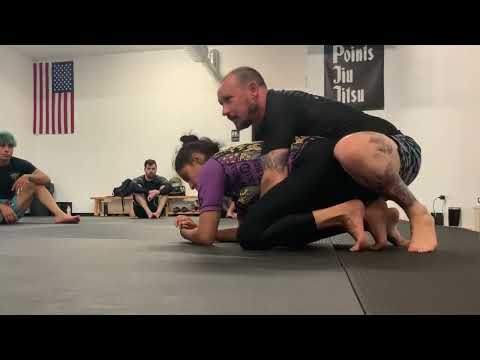
Breaking down the Turtle using the Power Half/half-Nelson
0
Three-Quarter Nelson Crank·Five Points Jiu Jitsu
Using wrestling for jiu jitsu. The Power Half or half-Nelson is a very strong wrestling hold that is under utilized in j…
Translation: Nelson (katakana loanword); cervical extension neck crank
The three-quarter nelson crank from turtle applies a nelson variant where the attacker controls approximately three-quarters of the neck-cranking pathway — more than a half nelson but less than a full nelson. [1] Against a turtled opponent, the attacker threads one arm deep behind the neck while the second arm controls the near shoulder or arm, creating an asymmetric nelson hold. [1],[2] The three-quarter configuration generates rotational torque on the cervical spine while the turtle position limits the opponent's ability to roll or posture away. [2] This technique bridges the gap between wrestling control holds and submission-oriented neck cranks, serving dual purposes of positioning and submission threat. [2],[3]
Three-quarter nelson holds originated in folkstyle and Greco-Roman wrestling as turning techniques designed to expose the opponent's back to the mat. [1] The adaptation for submission cranking purposes emerged as wrestlers transitioned into grappling formats where neck cranks could end the match. [2],[3]
The three-quarter Nelson provides significant cervical pressure while maintaining superior control; less power than the full Nelson but easier to secure from top position [1]
A foundational wrestling technique adapted to submission grappling; the three-quarter Nelson has been part of wrestling curriculum for over a century [1]
Used in catch wrestling and MMA competition; the three-quarter Nelson is more commonly seen as a control tool than a standalone submission [1]
No images yet for this technique.
Sign in to suggest an image.
Using wrestling for jiu jitsu. The Power Half or half-Nelson is a very strong wrestling hold that is under utilized in j…
No instructional courses yet for this technique.
Sign in to suggest a course.
Risk of injury to the person this technique is applied to
Extension cranks force the head backward; risk of vertebral disc and ligament damage
Skill level needed to execute this technique reliably
Whether this technique is allowed under major competition rule sets
Japanese pro wrestling/catch wrestling standard terminology
Japanese pro wrestling/catch wrestling standard terminology
Standard katakana transliteration of Western martial arts terminology (外来語) — used in Japanese MMA, boxing, and BJJ communities
Japanese terminology sourced from Japanese pro wrestling/catch wrestling standard terminology
grip or squeeze strength, positional control
strong upper body for sustained compression
forearms, biceps, pectorals, core stabilisers
Stay in control for a couple of seconds, then switch to a body trap, as this is far superior to staying in hooks alone. Five Points Jiu Jitsu emphasizes this sequence: get your points, put your hooks in, maintain control briefly, then transition to the body trap.
Grab on the opponent's hip and put your shoulder in front of their body—this shoulder pressure is what makes the grip tight as you rotate your arm around, creating pressure without needing to squeeze hard.
Yes, you can stay in position to keep pressure and punch your strangle in from the three-quarter nelson control without necessarily rolling your opponent over.
The three-quarter nelson crank from turtle applies a nelson variant where the attacker controls approximately three-quarters of the neck-cranking pathway — more than a half nelson but less than a full nelson. Against a turtled opponent, the attacker threads one arm deep behind the neck while the second arm controls the near shoulder or arm, creating an asymmetric nelson hold.
Three-quarter nelson holds originated in folkstyle and Greco-Roman wrestling as turning techniques designed to expose the opponent's back to the mat. The adaptation for submission cranking purposes emerged as wrestlers transitioned into grappling formats where neck cranks could end the match.
IBJJF: legal — Legal at all belt levels, gi and no-gi — chokes are the safest submission cat…; IJF: legal — Legal (shime-waza) — strangulation techniques are one of three permitted subm…; ADCC: legal — Legal; Unified MMA: legal — Legal — choke submissions are among the most common finishes in MMA; FIAS Sport Sambo: banned — All chokes prohibited in Sport Sambo; FIAS Combat Sambo: legal — Legal
Danger rating 9/10. Extension cranks force the head backward; risk of vertebral disc and ligament damage
The standard setup chain: Control Position → Isolate the Arm → Lock the Figure-Four → Apply Rotation.
Standard counters include: Straighten the Arm — extend the arm to break the figure-four grip angle / Roll Toward — roll in the direction of the lock to relieve rotational pressure / Grip the Belt/Shorts — anchor the hand to prevent the arm from being isolated.
Common variants: Standard grip variation (primary hand configuration for maximum choking pressure); Gi variation (uses the lapel or collar as an anchor for additional fric…); No-gi variation (adapted grip and positioning for submission grappling wit…); Transition finish (applied during a positional change to catch the opponent …).
Used in catch wrestling and MMA competition; the three-quarter Nelson is more commonly seen as a control tool than a standalone submission
Top errors to watch for: Not threading deep enough — the three-quarter Nelson specifically requires reaching past the neck to the far shoulder… / Applying without controlling the opponent's body — the turtle must be controlled with chest or hip pressure while the… / Using explosive force — the deeper leverage amplifies the cervical stress; progressive application is even more impor… / Not maintaining the grip on the far shoulder — the far-shoulder grip is the anchor; losing it reduces the technique t….
The Three-Quarter Nelson Crank is also known as Neruson, Three-Quarter Nelson, 3/4 Nelson Crank.