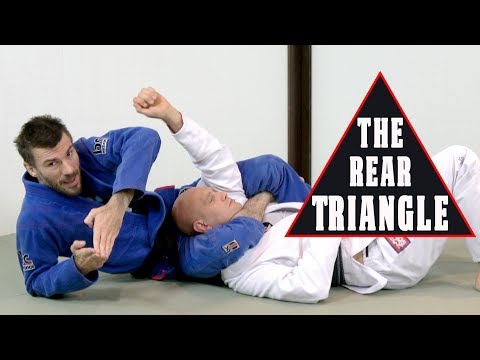
How to do the Rear Triangle Choke (or 'Ura Sankaku')
0
Rear Triangle·Stephan Kesting
Rob Biernacki breaks down the rear triangle choke (aka Ura Sankaku). This is from the back attacks module that will be …
Translation: Triangle Strangle — From Back
The rear triangle applies the triangle choke from back control by locking the legs in a figure-four around the opponent's neck and one arm from behind. [1] The attacker, established on the opponent's back, threads one leg over the opponent's shoulder and under the chin, then hooks the foot behind the opposite knee to lock the triangle configuration. [1],[2] The rear triangle combines back control dominance with the powerful leg-based strangulation mechanics of the triangle choke, creating a nearly inescapable position. [2] This variant is particularly effective as an alternative to the rear naked choke when the opponent is defending the arms but leaving the neck exposed to leg attacks. [2],[3]
The rear triangle was popularised in modern competition BJJ during the 2010s, with athletes like Ryan Hall demonstrating its effectiveness as a back attack alternative. [1] The technique represented an evolution in back attack strategy, expanding beyond arm-based chokes to include leg-based strangulation from the back. [2],[3]
The rear triangle applies the triangle choke from back control, using the legs to strangle the opponent from behind. [1]
Rear triangles were developed in modern BJJ as an alternative to the rear naked choke from back control. [1]
Rear triangles are increasingly common in modern BJJ competition, especially in no-gi formats. [1]
No images yet for this technique.
Sign in to suggest an image.
Rob Biernacki breaks down the rear triangle choke (aka Ura Sankaku). This is from the back attacks module that will be …
No instructional courses yet for this technique.
Sign in to suggest a course.
Risk of injury to the person this technique is applied to
Back triangle uses the legs from back control; combines back dominance with leg choke
Skill level needed to execute this technique reliably
Whether this technique is allowed under major competition rule sets
Kodokan Judo — Sankaku-jime
Japanese terminology sourced from Kodokan Judo — Sankaku-jime
Official Kodokan ground technique classification system
Standard Japanese martial arts terminology (kanji/hiragana)
Established Japanese martial arts naming convention — native Japanese term (和語/漢語)
Japanese terminology sourced from Kodokan Judo — Sankaku-jime
hip flexibility, long legs relative to torso
longer limbs for easier figure-four lock around head and arm
hip adductors, hamstrings, quadriceps
According to Stephan Kesting, the triangle must be positioned over the side of your opponent's neck, not over the back of their neck and shoulder. The angle is wrong if there's space between your knee and their neck—you need to scoot back far enough so your calf caps off the carotid arteries.
Stephan Kesting emphasizes closing the triangle while ensuring your Achilles tendon insertion cuts off the artery, positioning your hip to internally rotate your opponent's shoulder into their neck, and using your thigh to break their posture—all while maintaining the postural control you've established.
No—Stephan Kesting advises against unnecessary movements once you have control. Once you've established good positioning and posture break, minimize your adjustments and focus on closing and finishing the technique rather than constantly repositioning.
The rear triangle applies the triangle choke from back control by locking the legs in a figure-four around the opponent's neck and one arm from behind. The attacker, established on the opponent's back, threads one leg over the opponent's shoulder and under the chin, then hooks the foot behind the opposite knee to lock the triangle configuration.
The rear triangle was popularised in modern competition BJJ during the 2010s, with athletes like Ryan Hall demonstrating its effectiveness as a back attack alternative. The technique represented an evolution in back attack strategy, expanding beyond arm-based chokes to include leg-based strangulation from the back.
IBJJF: legal — Legal at all belt levels, gi and no-gi — chokes are the safest submission cat…; IJF: legal — Legal (shime-waza) — strangulation techniques are one of three permitted subm…; ADCC: legal — Legal; Unified MMA: legal — Legal — choke submissions are among the most common finishes in MMA; FIAS Sport Sambo: banned — All chokes prohibited in Sport Sambo; FIAS Combat Sambo: legal — Legal
Danger rating 8/10. Back triangle uses the legs from back control; combines back dominance with leg choke
The standard setup chain: Achieve Controlling Position → Isolate the Neck → Set the Grip → Apply Pressure.
Standard counters include: Tuck Chin — protect the neck by lowering the chin to prevent the choke from sinking / Two-on-One Grip Fight — use both hands to strip the choking grip before it locks / Turn Into — rotate toward the choking arm to relieve carotid pressure / Posture Up — straighten the spine and create distance to break the choking angle.
Common variants: Short choke (palm-to-palm grip) (compact grip for tight spaces when the chin is partially …); Gable grip RNC (interlocked fingers behind the head for maximum squeeze p…); Body triangle RNC (adds body triangle control for stronger hip management du…); One-arm RNC (single arm under the chin when the second arm cannot reac…).
Rear triangles are increasingly common in modern BJJ competition, especially in no-gi formats.
Top errors to watch for: Attempting without first establishing stable back control — the leg-over-shoulder transition requires positional secu… / Not including an arm in the triangle — both arms outside the legs creates a headscissors; one arm must be inside for … / Locking the triangle with the wrong leg on top — the leg crossing the neck should create the long side of the triangl… / Not adjusting if the opponent begins to escape — the rear triangle has multiple finishing angles; if the initial angl….
The Rear Triangle is also known as Sankaku-jime — From Back, Ushiro-sankaku-jime, Back Triangle, Reverse Triangle.