Russ: North/South Kimura to Head Scissors Choke
0
Headscissors From North-South·Revolution BJJ
Browse nearly 100 different video tutorials (words and video): http://hubpages.com/sports/BJJ-Tutorials Revolution Braz…
Translation: Head Scissors (katakana loanword)
The headscissors from north-south is applied when the attacker is in the north-south position and traps the opponent's head between their thighs by closing the legs around the neck from above. [1],[2] The north-south alignment places the attacker's hips directly over the opponent's face, providing optimal leverage for the thigh squeeze. [1] The attacker may turn to the side or adjust the hip angle to place the femoral area more precisely against the carotid arteries for bilateral vascular compression. [1],[2]
The north-south headscissors developed from the broader category of reverse headscissors techniques used in catch wrestling and submission grappling. [1],[2] The north-south position became a recognized control point in BJJ's positional hierarchy, and practitioners explored leg-based submissions from this pin. [1] While less common than the north-south kimura or choke, the headscissors provides an alternative attack when arm-based submissions are defended. [1],[2]
Low-percentage due to the difficulty of transitioning from north-south control to a headscissors lock; the opponent's arms are typically free to defend [1]
Found in catch wrestling curriculum; adapted to modern grappling by instructors who blend catch and BJJ methodologies [1]
Essentially unseen at major grappling competition; occasionally attempted in catch wrestling and submission-only events [1]
No images yet for this technique.
Sign in to suggest an image.
Browse nearly 100 different video tutorials (words and video): http://hubpages.com/sports/BJJ-Tutorials Revolution Braz…
Thank you my friend for watching my videos! I love sharing Jiu Jitsu all over the world! Make sure you let me know what …
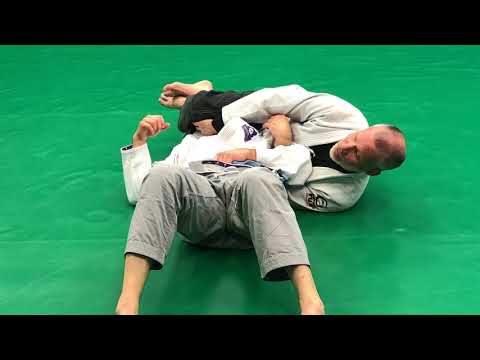
The headscissors from north-south position emerges as a leg-based choke executed from dominant top control, particularly effective when the opponent's arm is trapped or controlled. Revolution BJJ emphasizes the transition from a failed Kimura attempt, where the attacker rocks forward to establish both knees around the opponent's neck—one knee under, one over—then extends the legs straight to align with the shoulders, pinching the knees together to compress the carotid arteries or windpipe. Proper knee placement beneath the chin is critical; many practitioners mistakenly position knees on the chin or face rather than the neck, reducing choke efficacy. Carlos Machado prioritizes setup control using an X-frame with the hips rather than hand-wrist grip, reducing self-injury risk when the opponent resists rotation. Machado stresses 'hooking and fishing' the chin by using the knee to clear the opponent's defensive hand before establishing leg position, then reinforcing the choke with the second leg over the first to prevent escape. Both instructors agree that leg alignment perpendicular to the shoulders maximizes pressure; Revolution BJJ notes this prevents the common mistake of curling heels back like an armlock. Machado additionally demonstrates how rolling slightly backward after establishing the choke intensifies the frame pressure to submission-level intensity.
Synthesized from 2 instructors
No instructional courses yet for this technique.
Sign in to suggest a course.
Risk of injury to the person this technique is applied to
Headscissors use the thighs to squeeze the head laterally; risk of neck strain
Skill level needed to execute this technique reliably
Whether this technique is allowed under major competition rule sets
Japanese grappling/BJJ standard terminology; JBJJF competition usage
Official Japanese BJJ federation — competition rules and terminology
Standard katakana transliteration of Western martial arts terminology (外来語) — used in Japanese MMA, boxing, and BJJ communities
Japanese terminology sourced from Japanese grappling/BJJ standard terminology; JBJJF competition usage
shoulder and chest pressure, hip sprawl endurance
heavier upper body, broad shoulders
deltoids, pectorals, core, hip extensors
Every move, in any martial art, shares a few universal traits. Mix and match below to pinpoint the right tool — or compare equivalents across styles.
Revolution BJJ instructor Russ emphasizes that the key is getting your knees underneath the opponent's chin and around the neck—extend your legs straight so your knees pop right out underneath the chin, then pinch your knees together for the choke. A common mistake is curling your heels back like an armlock or positioning on the chin instead of under it.
Carlos Machado recommends placing one leg over the chin and locking your other leg over it, similar to triangle pressure—this makes it much harder for the opponent to push your foot away compared to having just one leg control.
Revolution BJJ's Russ advises getting your weight forward, rocking into the opponent with a pump action, then hitting your hips forward and placing one knee under the neck and one knee over it before extending your legs straight to lock in the choke.
The headscissors from north-south is applied when the attacker is in the north-south position and traps the opponent's head between their thighs by closing the legs around the neck from above. The north-south alignment places the attacker's hips directly over the opponent's face, providing optimal leverage for the thigh squeeze.
The north-south headscissors developed from the broader category of reverse headscissors techniques used in catch wrestling and submission grappling. The north-south position became a recognized control point in BJJ's positional hierarchy, and practitioners explored leg-based submissions from this pin.
IBJJF: legal — Legal at all belt levels, gi and no-gi — chokes are the safest submission cat…; IJF: legal — Legal (shime-waza) — strangulation techniques are one of three permitted subm…; ADCC: legal — Legal; Unified MMA: legal — Legal — choke submissions are among the most common finishes in MMA; FIAS Sport Sambo: banned — All chokes prohibited in Sport Sambo; FIAS Combat Sambo: legal — Legal
Danger rating 7/10. Headscissors use the thighs to squeeze the head laterally; risk of neck strain
The standard setup chain: Establish Position → Create the Threat → Secure the Hold → Finish.
Standard counters include: Early Recognition — identify the submission attempt early and begin defence immediately / Posture and Base — maintain strong posture and base to prevent submission setups / Grip Fight — deny the attacker their preferred gripping configuration.
Common variants: Standard north-south choke (shoulder drives into the neck from north-south position); Paper-cutter variation (uses the forearm blade across the throat from the north-s…); Transition finish (applied during the walk-around from side control to north…).
Essentially unseen at major grappling competition; occasionally attempted in catch wrestling and submission-only events
Top errors to watch for: Attempting without establishing north-south control first — the control position must be secure before advancing the … / Advancing the hips too quickly and losing control — slide forward incrementally; rapid hip advance can cause the oppo… / Not maintaining body weight on the opponent — the weight keeps them pinned while the legs work; lifting up to positio… / Not locking the figure-four properly — the lock is essential for structural compression; without it, the opponent pus….
The Headscissors From North-South is also known as Heddo Shizāzu, North-South Head Scissors, Top Scissors Choke.