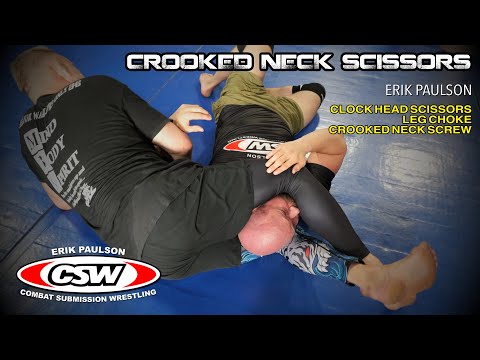
Crooked Neck Scissors - Leg Choke - Neck Crank
0
Headscissors Strangle·CSW Association
Clock Head Scissors to Leg Choke to Crooked Neck Scissors If you enjoyed this video, please click the Like Button, leav…
Translation: Head Scissors (katakana loanword)
The headscissors strangle uses both legs clamped around the opponent's head (without trapping an arm) to create bilateral compression on both sides of the neck. [1],[2] Unlike the triangle choke, which requires an arm trapped inside, the headscissors relies solely on the squeezing power of both legs against the temples and neck. Pure headscissors are less effective as blood chokes than triangles but can generate powerful compression and serve as control positions that set up transitions. [3]
The headscissors strangle mechanic relies on adductor strength and precise leg positioning around the neck — when both carotids are compressed, unconsciousness follows rapidly [1]
One of the most ancient submission mechanics in martial arts history, predating formal grappling systems. Found in virtually every culture's wrestling tradition [1]
While the technique is universally known, it has become increasingly rare at elite competition as defensive awareness and head positioning have improved [1]
No images yet for this technique.
Sign in to suggest an image.
Clock Head Scissors to Leg Choke to Crooked Neck Scissors If you enjoyed this video, please click the Like Button, leav…
No instructional courses yet for this technique.
Sign in to suggest a course.
Risk of injury to the person this technique is applied to
Headscissors use the thighs to squeeze the head laterally; risk of neck strain
Skill level needed to execute this technique reliably
Whether this technique is allowed under major competition rule sets
Japanese grappling/BJJ standard terminology; JBJJF competition usage
Official Japanese BJJ federation — competition rules and terminology
Standard katakana transliteration of Western martial arts terminology (外来語) — used in Japanese MMA, boxing, and BJJ communities
Japanese terminology sourced from Japanese grappling/BJJ standard terminology; JBJJF competition usage
hip flexibility, long legs relative to torso
longer limbs for easier figure-four lock around head and arm
hip adductors, hamstrings, quadriceps
Every move, in any martial art, shares a few universal traits. Mix and match below to pinpoint the right tool — or compare equivalents across styles.
The headscissors strangle uses both legs clamped around the opponent's head (without trapping an arm) to create bilateral compression on both sides of the neck. Unlike the triangle choke, which requires an arm trapped inside, the headscissors relies solely on the squeezing power of both legs against the temples and neck.
Headscissors techniques have ancient roots in wrestling traditions worldwide — the scissor hold appears in both Greco-Roman and catch wrestling. In modern grappling, the headscissors is more commonly used as a transitional control than a finishing submission.
IBJJF: legal — Legal at all belt levels, gi and no-gi — chokes are the safest submission cat…; IJF: legal — Legal (shime-waza) — strangulation techniques are one of three permitted subm…; ADCC: legal — Legal; Unified MMA: legal — Legal — choke submissions are among the most common finishes in MMA; FIAS Sport Sambo: banned — All chokes prohibited in Sport Sambo; FIAS Combat Sambo: legal — Legal
Danger rating 7/10. Headscissors use the thighs to squeeze the head laterally; risk of neck strain
The standard setup chain: Achieve Controlling Position → Isolate the Neck → Set the Grip → Apply Pressure.
Standard counters include: Tuck Chin — protect the neck by lowering the chin to prevent the choke from sinking / Two-on-One Grip Fight — use both hands to strip the choking grip before it locks / Turn Into — rotate toward the choking arm to relieve carotid pressure / Posture Up — straighten the spine and create distance to break the choking angle.
Common variants: Standard triangle (classic figure-four leg lock around the head and one arm …); Reverse triangle (legs locked from behind or inverted angle for different a…); Mounted triangle (applied from mount position with gravity assisting the sq…); No-arm triangle (both arms excluded, legs-only compression on the neck).
While the technique is universally known, it has become increasingly rare at elite competition as defensive awareness and head positioning have improved
Top errors to watch for: Including an arm in the headscissors — this transforms it into a triangle; the headscissors specifically excludes arms / Not understanding the distinction between headscissors and triangle — they are different submissions with different m… / Relying only on the guard headscissors — the subfamily includes entries from north-south, side control, turtle, and s… / Using only muscular squeezing — the figure-four lock and hip extension provide structural compression that supplement….
The Headscissors Strangle is also known as Heddo Shizāzu, Ashi-jime, Leg Strangle, Leg-Assisted Choke.