Smart Strategy for Older BJJ Grapplers - Brabo Choke from Closed Guard
Is the Brabo choke from closed guard the perfect submission for older BJJ players? In this video, we break down the pros…
ブラボーチョーク(Burabō Chōku)
TransliterationTranslation: Brabo Choke (katakana loanword)
The brabo choke from closed guard is applied by the bottom player who secures an overhook on the opponent's arm while feeding the lapel around the opponent's neck, creating an arm-in collar strangle from the guard position. [1],[2] The overhook traps the opponent's arm against their own neck, and the lapel feed acts as the choking surface that compresses the carotid on the opposite side. [1] The closed guard provides hip control to prevent the opponent from posturing out while the attacker works to tighten the lapel noose around the neck. [1],[2]
The brabo choke was developed by Roberto 'Gordo' Correa in Brazilian Jiu-Jitsu and shares mechanical lineage with the D'Arce choke, though it uses the gi collar as the compression surface rather than the bare forearm. [1],[2] The closed guard application represents a bottom-position adaptation of a technique more commonly associated with top control, reflecting the BJJ principle that most techniques can be applied from multiple positions within the guard system. [1] The name 'brabo' means 'angry' or 'fierce' in Portuguese. [1],[2]
A high-percentage gi submission from closed guard that exploits lapel threading to create an inescapable choking loop; requires technical lapel feeding but finishes reliably once locked [1]
Developed within the Brazilian competition BJJ scene, building on Leo Vieira's Brabo choke concept and adapted to closed guard by gi competitors in the 2000s-2010s [1]
Multiple IBJJF world championship finishes; a staple technique for gi competitors who specialize in lapel guard systems [1]
No images yet for this technique.
Sign in to suggest an image.
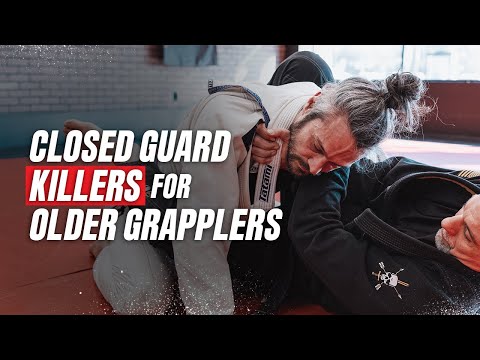
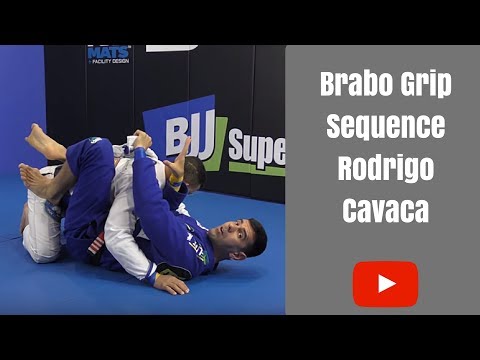
The Brabo choke from closed guard is a leverage-based submission that prioritizes grip strength and postural control over athleticism, making it particularly valuable for older grapplers or those managing injuries. Coach Chuck (Integrated Martial Athletics) emphasizes the technique's mechanical efficiency: by controlling the opponent's posture with the legs (knees pressed behind the elbows) and establishing a solid lapel grip, the top player creates a stable platform that forces the opponent to work harder. Chuck describes the initial grip transition—bringing the lapel across the body and extending it—as creating a "safety roll bar" effect that maintains control when the opponent postures up. Rodrigo Cavaca (BJJ Fanatics) provides a more detailed sequence of grip variations, demonstrating how the same lapel control can feed between hands and transition into cross-collar chokes from multiple angles. Both instructors agree on the fundamental principle: breaking posture with leg pressure, controlling the lapel, and using the cross-collar grip to finish. Cavaca additionally shows how elbow pressure from the top player's arm drives the choke and how blocking defenses (such as hand placement on the elbow) can be countered by repositioning the opponent's arm across the body. Both stress that maintaining the lapel grip and postural control prevents escape, allowing the submission to work regardless of the opponent's strength or experience level.
Synthesized from 2 instructors
No instructional courses yet for this technique.
Sign in to suggest a course.
Risk of injury to the person this technique is applied to
Lapel overhook chokes from guard use the gi collar combined with overhook control
Skill level needed to execute this technique reliably
Whether this technique is allowed under major competition rule sets
Shrapnel BJJ Academy (shrapnel-bjj.com); Let'sBJJ (letsbjj.site)
Japanese BJJ academy — technique terminology
Japanese BJJ technique resource
Standard katakana transliteration of Western martial arts terminology (外来語) — used in Japanese MMA, boxing, and BJJ communities
Japanese terminology sourced from Shrapnel BJJ Academy (shrapnel-bjj.com); Let'sBJJ (letsbjj.site)
grip or squeeze strength, positional control
strong upper body for sustained compression
forearms, biceps, pectorals, core stabilisers
Rodrigo Cavaca emphasizes that controlling posture is critical because if your opponent maintains good posture, they can escape; breaking their posture down prevents escape options and allows you to set up the choke effectively.
Coach Chuck suggests thinking of your grip placement as a 'safety roll bar,' similar to on a roller coaster, which helps you maintain structural control when your opponent tries to create distance.
Rodrigo Cavaca teaches using your foot and hips together to open space, which allows you to secure the grip and set up the choke effectively from closed guard.
The brabo choke from closed guard is applied by the bottom player who secures an overhook on the opponent's arm while feeding the lapel around the opponent's neck, creating an arm-in collar strangle from the guard position. The overhook traps the opponent's arm against their own neck, and the lapel feed acts as the choking surface that compresses the carotid on the opposite side.
The brabo choke was developed by Roberto 'Gordo' Correa in Brazilian Jiu-Jitsu and shares mechanical lineage with the D'Arce choke, though it uses the gi collar as the compression surface rather than the bare forearm. The closed guard application represents a bottom-position adaptation of a technique more commonly associated with top control, reflecting the BJJ principle that most techniques can be applied from multiple positions within the guard system.
IBJJF: legal — Legal at all belt levels, gi and no-gi — chokes are the safest submission cat…; IJF: legal — Legal (shime-waza) — strangulation techniques are one of three permitted subm…; ADCC: legal — Legal; Unified MMA: legal — Legal — choke submissions are among the most common finishes in MMA; FIAS Sport Sambo: banned — All chokes prohibited in Sport Sambo; FIAS Combat Sambo: legal — Legal
Danger rating 8/10. Lapel overhook chokes from guard use the gi collar combined with overhook control
The standard setup chain: Achieve Controlling Position → Isolate the Neck → Set the Grip → Apply Pressure.
Standard counters include: Tuck Chin — protect the neck by lowering the chin to prevent the choke from sinking / Two-on-One Grip Fight — use both hands to strip the choking grip before it locks / Turn Into — rotate toward the choking arm to relieve carotid pressure / Posture Up — straighten the spine and create distance to break the choking angle.
Common variants: Standard grip variation (primary hand configuration for maximum choking pressure); Gi variation (uses the lapel or collar as an anchor for additional fric…); No-gi variation (adapted grip and positioning for submission grappling wit…); Transition finish (applied during a positional change to catch the opponent …).
Multiple IBJJF world championship finishes; a staple technique for gi competitors who specialize in lapel guard systems
Top errors to watch for: Opening the guard before the lapel is fully fed — keep the guard closed during the entire feed; opening allows retreat / Feeding the lapel without controlling the opponent's posture — break posture first so the lapel can reach across the … / Not having a sweep backup — if the Brabo doesn't finish, transition to sweeps using the lapel grip; releasing everyth… / Attempting without understanding the arm-triangle principle — the trapped arm's shoulder is a compression surface; wi….
The Brabo Choke From Closed Guard is also known as Burabō Chōku, Guard Brabo Choke, Lapel Overhook Choke from Guard.