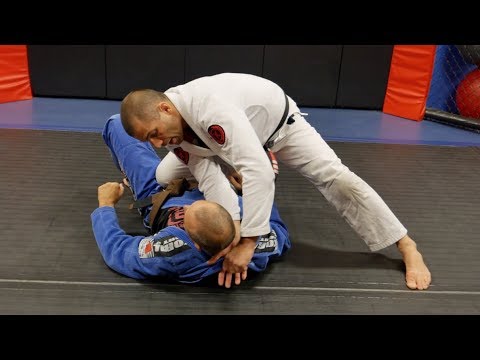
Brabo Choke From Side Control
0
Brabo Choke·MMA Leech·Added by Admin
Watch our Special FREE Tutorials at http://www.mmaleech.com/free-stuff/ Go to our Facebook page for the latest trends in…
Translation: Brabo Choke (katakana loanword)
The Brabo choke from guard uses the opponent's lapel threaded across their neck while the attacker maintains an overhook from closed or open guard to create a collar strangle. [1],[2] The attacker feeds the opponent's lapel across the neck and secures it with the overhooking arm, then uses hip movement and leg control to tighten the strangle. [1],[3] The lapel overhook configuration creates a strong mechanical advantage because the fabric is anchored on both sides of the neck through different control points. [1] The guard Brabo is distinct from the D'Arce/Brabo applied from top position. [1],[4]
The Brabo choke name originated in Brazilian Jiu-Jitsu, with 'brabo' meaning 'angry' or 'fierce' in Portuguese slang. [1],[2] The guard-based lapel overhook version developed separately from the top-position D'Arce/Brabo arm triangle, using the gi fabric for compression instead of the arm. [1],[3] Guard-based Brabo chokes became prominent as creative gi players explored lapel feeding from bottom positions. [1],[4]
One of the most effective lapel-based chokes in gi grappling — the Brabo uses the opponent's own collar or lapel to create a powerful choking mechanic that is extremely difficult to defend once secured [1]
Named after Leo 'Brabo' Vieira, pioneered in Brazilian competition jiu-jitsu in the early 2000s. The technique family has expanded significantly through innovations by the Mendes Brothers, Keenan Cornelius, and other modern gi competitors [1]
Frequently finished at IBJJF worlds, Pan, Europeans, and other major gi events. A defining technique of the modern lapel guard era [1]
No images yet for this technique.
Sign in to suggest an image.
Watch our Special FREE Tutorials at http://www.mmaleech.com/free-stuff/ Go to our Facebook page for the latest trends in…
No instructional courses yet for this technique.
Sign in to suggest a course.
Risk of injury to the person this technique is applied to
Lapel overhook chokes from guard use the gi collar combined with overhook control
Skill level needed to execute this technique reliably
Whether this technique is allowed under major competition rule sets
Shrapnel BJJ Academy (shrapnel-bjj.com); Let'sBJJ (letsbjj.site)
Japanese BJJ academy — technique terminology
Japanese BJJ technique resource
Standard katakana transliteration of Western martial arts terminology (外来語) — used in Japanese MMA, boxing, and BJJ communities
Japanese terminology sourced from Shrapnel BJJ Academy (shrapnel-bjj.com); Let'sBJJ (letsbjj.site)
long arms for threading under armpit and around neck
longer limbs, lean build
biceps, deltoids, forearm flexors, core (for sprawl pressure)
Every move, in any martial art, shares a few universal traits. Mix and match below to pinpoint the right tool — or compare equivalents across styles.
Make sure to get your hand really deep on the lapel, almost touching your shoulder against his body to create the proper angle. You want your hand behind his neck, which is very important to make the choke tight and effective.
Allow your opponent to come more onto his side so your arm is deep on his neck, then control his sleeve and guide his arm and shoulder against his neck. Pull this arm up and drive your chest on his neck for the submission.
Opening the lapel gives you great control and several attacking options, especially for chokes. Make sure to maintain nice shoulder pressure so your opponent doesn't turn into you as you open the lapel.
You can always go to the baseball bat choke, which is another great option from the Brabo position.
The Brabo choke from guard uses the opponent's lapel threaded across their neck while the attacker maintains an overhook from closed or open guard to create a collar strangle. The attacker feeds the opponent's lapel across the neck and secures it with the overhooking arm, then uses hip movement and leg control to tighten the strangle.
The Brabo choke name originated in Brazilian Jiu-Jitsu, with 'brabo' meaning 'angry' or 'fierce' in Portuguese slang. The guard-based lapel overhook version developed separately from the top-position D'Arce/Brabo arm triangle, using the gi fabric for compression instead of the arm.
IBJJF: legal — Legal at all belt levels, gi and no-gi — chokes are the safest submission cat…; IJF: legal — Legal (shime-waza) — strangulation techniques are one of three permitted subm…; ADCC: legal — Legal; Unified MMA: legal — Legal — choke submissions are among the most common finishes in MMA; FIAS Sport Sambo: banned — All chokes prohibited in Sport Sambo; FIAS Combat Sambo: legal — Legal
Danger rating 8/10. Lapel overhook chokes from guard use the gi collar combined with overhook control
The standard setup chain: Achieve Controlling Position → Isolate the Neck → Set the Grip → Apply Pressure.
Standard counters include: Tuck Chin — protect the neck by lowering the chin to prevent the choke from sinking / Two-on-One Grip Fight — use both hands to strip the choking grip before it locks / Turn Into — rotate toward the choking arm to relieve carotid pressure / Posture Up — straighten the spine and create distance to break the choking angle.
Common variants: Standard D'Arce (arm threaded under the far armpit and around the neck fro…); Marce (short choke) (tighter, shorter threading for compact body types); Standing D'Arce (applied during a scramble without going to the ground); D'Arce from turtle (threaded as the opponent attempts to re-guard from turtle…).
Frequently finished at IBJJF worlds, Pan, Europeans, and other major gi events.
Top errors to watch for: Confusing the Brabo choke with a standard cross-collar choke — the Brabo specifically traps an arm inside the lapel l… / Not feeding the lapel under the arm — the under-arm feed is the defining feature; over-the-arm or around-the-neck fee… / Using a lapel that's too short or stiff — the fabric must have enough length and flexibility to pass under the arm an… / Not understanding the arm-triangle principle — the trapped arm's shoulder provides one side of the compression; this ….
The Brabo Choke is also known as Burabō Chōku, Brabo Choke, Lapel D'Arce, Clock Choke Variant.