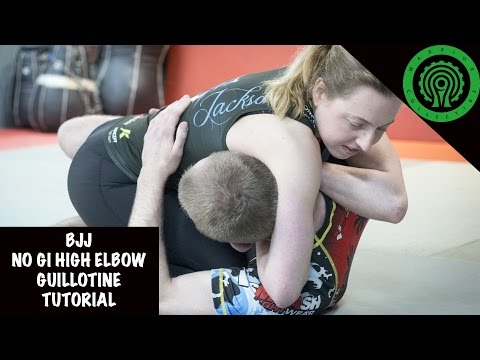
BJJ No Gi High Elbow Guillotine Tutorial
0
Reverse Guillotine From Sprawl Spin-Behind Elbow-Pin·Stuart Tomlinson
Kate Jackson, Pro MMA fighter, coach of Pure Grappling and instructor at Koncept Gym in Cornwall is here filmed by the W…
Translation: Reverse Guillotine (katakana loanword)
The reverse guillotine from sprawl spin-behind with elbow pin applies the reverse neck wrap after the attacker sprawls on a takedown and spins to a perpendicular angle behind the opponent. [1] The spin-behind creates an unusual approach angle where the attacker's arm wraps the neck from an unexpected direction, making the reverse orientation a natural consequence of the positioning. [1],[2] Once the reverse wrap is established, the attacker pins the elbow against the opponent's body or the mat and squeezes, using the elbow as a fixed fulcrum for the compression. [2] This entry sequence is fluid and fast, catching opponents who are still recovering from their failed takedown attempt. [2],[3]
Spin-behind sequences from sprawl to submission were developed in MMA and wrestling-to-grappling transition systems during the 2000s. [1] The reverse guillotine entry from this angle was a natural evolution as grapplers explored all possible choke configurations from dominant sprawl positions. [2],[3]
Effective as a scramble-based finish when the opponent shoots and the defender sprawls and spins; the momentum of the spin adds power to the choke [1]
Developed by wrestlers transitioning to no-gi grappling who combined sprawl defense with submission finishing [1]
Occasionally seen in MMA and no-gi competition when wrestlers attempt takedowns against guillotine-savvy opponents [1]
No images yet for this technique.
Sign in to suggest an image.
Kate Jackson, Pro MMA fighter, coach of Pure Grappling and instructor at Koncept Gym in Cornwall is here filmed by the W…
No instructional courses yet for this technique.
Sign in to suggest a course.
Risk of injury to the person this technique is applied to
Reverse-wrap chokes use an inverted grip pattern from front headlock for a different angle of attack
Skill level needed to execute this technique reliably
Whether this technique is allowed under major competition rule sets
Japanese BJJ community; derived from ギロチンチョーク
Japanese BJJ community; derived from ギロチンチョーク
Standard katakana transliteration of Western martial arts terminology (外来語) — used in Japanese MMA, boxing, and BJJ communities
Japanese terminology sourced from Japanese BJJ community; derived from ギロチンチョーク
forearm and grip strength, hip flexibility for guard retention
longer arms for deeper chin-strap wrap
forearm flexors, biceps, hip flexors
Stuart Tomlinson emphasizes posting on the head to clear room, then rolling the arm through and achieving a palm-to-palm grip as deep as possible, with the arm around the head positioned like a front naked choke where the opponent's chin is inside.
Pull your legs back while compressing your elbows and chest in together, and Stuart Tomlinson recommends bringing your leg up for extra drive if needed, then posting on the other leg and squeezing to finish.
Stuart Tomlinson prefers expanding the chest in and tightening rather than pulling outward, emphasizing that getting the underhook, passing the shoulder, and bringing the elbow into the body to hold it all tight is the primary control mechanism.
The reverse guillotine from sprawl spin-behind with elbow pin applies the reverse neck wrap after the attacker sprawls on a takedown and spins to a perpendicular angle behind the opponent. The spin-behind creates an unusual approach angle where the attacker's arm wraps the neck from an unexpected direction, making the reverse orientation a natural consequence of the positioning.
Spin-behind sequences from sprawl to submission were developed in MMA and wrestling-to-grappling transition systems during the 2000s. The reverse guillotine entry from this angle was a natural evolution as grapplers explored all possible choke configurations from dominant sprawl positions.
IBJJF: legal — Legal at all belt levels, gi and no-gi — chokes are the safest submission cat…; IJF: legal — Legal (shime-waza) — strangulation techniques are one of three permitted subm…; ADCC: legal — Legal; Unified MMA: legal — Legal — choke submissions are among the most common finishes in MMA; FIAS Sport Sambo: banned — All chokes prohibited in Sport Sambo; FIAS Combat Sambo: legal — Legal
Danger rating 8/10. Reverse-wrap chokes use an inverted grip pattern from front headlock for a different angle of attack
The standard setup chain: Control the Arm → Position the Hips → Pinch Knees → Extend for the Finish.
Standard counters include: Clasp Hands — grip own wrist to prevent arm extension / Stack — drive forward to compress the attacker and relieve elbow pressure / Hitchhiker Escape — rotate the thumb toward the mat and roll to extract the arm.
Common variants: Arm-in guillotine (traps the opponent's arm inside the choke for additional …); High-elbow guillotine (Marcelotine) (elevates the elbow above the head for stronger carotid co…); Standing guillotine (finished from the feet without pulling guard); Power guillotine (chin-strap grip with a rear-naked-choke-style finish for …).
Occasionally seen in MMA and no-gi competition when wrestlers attempt takedowns against guillotine-savvy opponents
Top errors to watch for: Skipping the spin and attempting the reverse wrap from in front — the reverse angle requires being behind or to the s… / Not completing the sprawl before spinning — the sprawl must drive the opponent's shot down first; premature spinning … / Spinning too far and losing the neck wrap — the spin should position you to the side or behind, not past the opponent… / Not pinning the elbow to the mat — the finish requires mat compression; keeping the elbow elevated reduces effectiveness.
The Reverse Guillotine From Sprawl Spin-Behind Elbow-Pin is also known as Ribāsu Girochin, Elbow-Pin Reverse Guillotine, Sprawl Reverse Guillotine Elbow Finish.