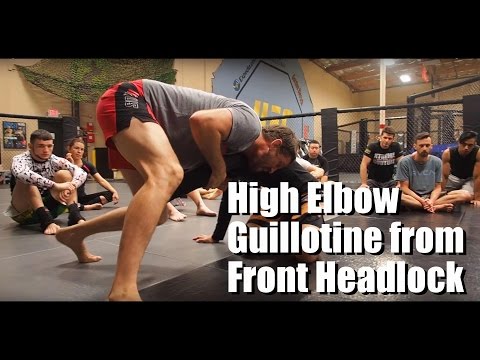
High Elbow Guillotine from the Front Headlock
0
Reverse Guillotine From Front Headlock Elbow-Pin Finish·Rich Castro
Nogi BJJ technique Xtreme Couture coach Robert Follis EM5II
Translation: Reverse Guillotine (katakana loanword)
The reverse guillotine from front headlock with elbow-pin finish uses the opposite arm orientation compared to a standard guillotine, with the finishing pressure applied by pinning the elbow against the opponent's body. [1] The attacker wraps the neck in reverse — threading from the opposite direction — then drives the elbow of the choking arm downward against the opponent's chest or shoulder, using the elbow as a fixed point against which the neck is compressed. [1],[2] The elbow pin creates a sharp fulcrum that intensifies neck pressure on a localised area. [2] This variant is effective when standard guillotine angles are unavailable due to the opponent's head position or arm placement. [2],[3]
Reverse guillotine variants developed as creative submissions in modern no-gi grappling, where practitioners explored unconventional arm-wrap directions from front headlock positions. [1] The elbow-pin finish was refined by competition grapplers seeking reliable finishing pressure from the reverse wrap. [2],[3]
Effective when the opponent defends the standard guillotine by hiding the chin — the elbow pin traps the jaw and forces the choke through the mandible [1]
A counter-to-defense variation developed in no-gi circles; refined by competitors who found standard guillotine defenses increasingly effective at high levels [1]
Occasionally seen at no-gi events when standard guillotine attempts are defended; not a primary attack but a valuable secondary finish [1]
No images yet for this technique.
Sign in to suggest an image.
Nogi BJJ technique Xtreme Couture coach Robert Follis EM5II
No instructional courses yet for this technique.
Sign in to suggest a course.
Risk of injury to the person this technique is applied to
Reverse-wrap chokes use an inverted grip pattern from front headlock for a different angle of attack
Skill level needed to execute this technique reliably
Whether this technique is allowed under major competition rule sets
Japanese BJJ community; derived from ギロチンチョーク
Japanese BJJ community; derived from ギロチンチョーク
Standard katakana transliteration of Western martial arts terminology (外来語) — used in Japanese MMA, boxing, and BJJ communities
Japanese terminology sourced from Japanese BJJ community; derived from ギロチンチョーク
forearm and grip strength, hip flexibility for guard retention
longer arms for deeper chin-strap wrap
forearm flexors, biceps, hip flexors
Rich Castro emphasizes starting with one hand on the opponent's chin and the other on the back of the armpit or elbow depending on your positioning, avoiding connecting your hands prematurely to reduce exposure.
Rich Castro stresses that your shoulder must go on the back of the neck, not the shoulder blades or too far back, because positioning it correctly on the neck prevents the opponent from driving up and escaping.
Rich Castro explains that your arm must stay parallel to the floor while you lean your head significantly over, getting your elbow positioned over the opponent's neck—this angle makes it very difficult for them to defend or escape the choke.
The reverse guillotine from front headlock with elbow-pin finish uses the opposite arm orientation compared to a standard guillotine, with the finishing pressure applied by pinning the elbow against the opponent's body. The attacker wraps the neck in reverse — threading from the opposite direction — then drives the elbow of the choking arm downward against the opponent's chest or shoulder, using the elbow as a fixed point against which the neck is compressed.
Reverse guillotine variants developed as creative submissions in modern no-gi grappling, where practitioners explored unconventional arm-wrap directions from front headlock positions. The elbow-pin finish was refined by competition grapplers seeking reliable finishing pressure from the reverse wrap.
IBJJF: legal — Legal at all belt levels, gi and no-gi — chokes are the safest submission cat…; IJF: legal — Legal (shime-waza) — strangulation techniques are one of three permitted subm…; ADCC: legal — Legal; Unified MMA: legal — Legal — choke submissions are among the most common finishes in MMA; FIAS Sport Sambo: banned — All chokes prohibited in Sport Sambo; FIAS Combat Sambo: legal — Legal
Danger rating 8/10. Reverse-wrap chokes use an inverted grip pattern from front headlock for a different angle of attack
The standard setup chain: Control the Arm → Position the Hips → Pinch Knees → Extend for the Finish.
Standard counters include: Clasp Hands — grip own wrist to prevent arm extension / Stack — drive forward to compress the attacker and relieve elbow pressure / Hitchhiker Escape — rotate the thumb toward the mat and roll to extract the arm.
Common variants: Arm-in guillotine (traps the opponent's arm inside the choke for additional …); High-elbow guillotine (Marcelotine) (elevates the elbow above the head for stronger carotid co…); Standing guillotine (finished from the feet without pulling guard); Power guillotine (chin-strap grip with a rear-naked-choke-style finish for …).
Occasionally seen at no-gi events when standard guillotine attempts are defended; not a primary attack but a valuable secondary finish
Top errors to watch for: Not driving the elbow to the mat — the finish requires mat contact; keeping the elbow elevated reduces the compression / Wrapping in the standard guillotine direction — the reverse guillotine wraps from the opposite side; standard wrappin… / Not using body weight — lean into the elbow drive; arm-only pressure is insufficient for most opponents / Attempting against an upright opponent — the elbow pin requires the opponent to be low (prone, kneeling, or turtled);….
The Reverse Guillotine From Front Headlock Elbow-Pin Finish is also known as Ribāsu Girochin, Elbow-Pin Reverse Guillotine Finish, Headlock Inverted Guillotine Elbow Lock.