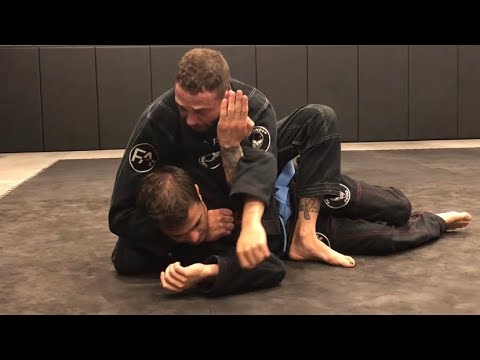
Loop choke options from mount. #brazilianjiujitsu #bjj #jiujitsu
0
Mount Loop Choke·Sickness Ferro
Loop choke attempt followed by what I like to do when defended. Thanks to my sponsors Topmount Apparel, Defense soap, G…
Translation: Loop Choke (katakana loanword)
The mount loop choke applies the loop choke collar configuration from the mounted position, where the attacker feeds one hand deep into the collar and wraps it around the back of the opponent's neck to form the signature noose. [1] From mount, gravity assists the choking pressure as the attacker's weight drives downward into the loop, compressing the collar fabric against the neck. [1],[2] The mounted position also prevents the common loop choke defence of posturing up, since the opponent is pinned supine under the attacker's weight. [2] This variant typically arises when the attacker transitions from guard to mount while maintaining the collar grip already established for the loop entry. [2],[3]
Mount applications of the loop choke emerged as competitors who favoured the guard loop choke discovered they could maintain the grip through sweeps and positional transitions. [1] The mount variant became a secondary but effective option in the loop choke practitioner's arsenal during the 2000s–2010s competition era. [2],[3]
The mount loop choke applies the loop choking mechanism from the mount for a powerful collar strangle. [1]
Mount loop chokes are a gi BJJ development for collar-based attacks from the dominant mount position. [1]
Mount loop chokes appear in gi BJJ competition. [1]
No images yet for this technique.
Sign in to suggest an image.
Loop choke attempt followed by what I like to do when defended. Thanks to my sponsors Topmount Apparel, Defense soap, G…
No instructional courses yet for this technique.
Sign in to suggest a course.
Risk of injury to the person this technique is applied to
Mount position adds top pressure to the loop choke mechanism
Skill level needed to execute this technique reliably
Whether this technique is allowed under major competition rule sets
柔術B (jiujitsu-b.com) choke technique summary
Major Japanese BJJ publication — comprehensive technique lists
Standard katakana transliteration of Western martial arts terminology (外来語) — used in Japanese MMA, boxing, and BJJ communities
Japanese terminology sourced from 柔術B (jiujitsu-b.com) choke technique summary
grip or squeeze strength, positional control
strong upper body for sustained compression
forearms, biceps, pectorals, core stabilisers
According to Sickness Ferro, the mount loop choke works best when you catch your opponent off balance early, before they're ready to defend against the attack. Establishing a solid base in mount position first is also important before committing to the technique.
The mount loop choke applies the loop choke collar configuration from the mounted position, where the attacker feeds one hand deep into the collar and wraps it around the back of the opponent's neck to form the signature noose. From mount, gravity assists the choking pressure as the attacker's weight drives downward into the loop, compressing the collar fabric against the neck.
Mount applications of the loop choke emerged as competitors who favoured the guard loop choke discovered they could maintain the grip through sweeps and positional transitions. The mount variant became a secondary but effective option in the loop choke practitioner's arsenal during the 2000s–2010s competition era.
IBJJF: legal — Legal at all belt levels, gi and no-gi — chokes are the safest submission cat…; IJF: legal — Legal (shime-waza) — strangulation techniques are one of three permitted subm…; ADCC: restricted — N/A (no-gi competition only — technique requires gi); Unified MMA: restricted — N/A (technique requires gi — not applicable in MMA); FIAS Sport Sambo: banned — All chokes prohibited in Sport Sambo; FIAS Combat Sambo: legal — Legal
Danger rating 8/10. Mount position adds top pressure to the loop choke mechanism
The standard setup chain: Achieve Controlling Position → Isolate the Neck → Set the Grip → Apply Pressure.
Standard counters include: Tuck Chin — protect the neck by lowering the chin to prevent the choke from sinking / Two-on-One Grip Fight — use both hands to strip the choking grip before it locks / Turn Into — rotate toward the choking arm to relieve carotid pressure / Posture Up — straighten the spine and create distance to break the choking angle.
Common variants: Standard grip variation (primary hand configuration for maximum choking pressure); Gi variation (uses the lapel or collar as an anchor for additional fric…); No-gi variation (adapted grip and positioning for submission grappling wit…); Transition finish (applied during a positional change to catch the opponent …).
Mount loop chokes appear in gi BJJ competition.
Top errors to watch for: Losing mount balance while establishing the loop — maintain base with the non-looping hand and hip pressure throughout / Attempting on an opponent who is flat on their back and defending their neck — the loop works best when they turn to … / Not driving the elbow to the mat — the elbow-down motion is what cinches the loop; keeping the elbow elevated reduces… / Releasing hip pressure to focus on the choke — weight must remain on the mounted opponent; lifting the hips to focus ….
The Mount Loop Choke is also known as Rūpu Chōku, Mounted Lapel Loop, Mount Position Loop Choke.