Sode Guruma Jime (Sleeve Wheel Choke)
0
Sleeve Wheel Choke·Seiryoku Zenyo·Added by Admin
Mark Gilston, 4th degree judo black belt, discusses and demonstrates applications of Sode Guruma Jime, also known as the…
Translation: Sleeve Wheel Strangle
The sleeve wheel choke (judo's sode-guruma-jime, also known as the Ezekiel choke in Brazilian Jiu-Jitsu) threads one arm behind the opponent's head, feeds the gi sleeve of that arm across the neck with the opposite hand, and rotates the arms to tighten the strangle. [1],[2] The sleeve fabric acts as a fulcrum while the forearm provides counter-pressure to compress the carotid artery on the side of the neck. [1],[3] Traditionally taught from mount and scarf hold, it can also be applied from back control by feeding the sleeve across the neck while maintaining seatbelt and hooks. [2],[4]
The sleeve wheel choke shares mechanical principles with the Ezekiel choke (sode-guruma-jime), where the sleeve serves as a compression aid. [2],[3] BJJ practitioners adapted the sleeve-threading concept for back control during the 2000s, finding it an effective alternative when the RNC and collar chokes were defended. [1] The technique is particularly associated with gi competition where sleeve manipulation is a core skill. [1],[4],[5]
The sleeve wheel choke uses a circular grip on the opponent's sleeve to create a rotational strangling action. [1]
The sleeve wheel choke is a modern BJJ competition technique developed for gi-specific attacks. [1]
Sleeve wheel chokes appear at advanced IBJJF competition. [1]
No images yet for this technique.
Sign in to suggest an image.
Mark Gilston, 4th degree judo black belt, discusses and demonstrates applications of Sode Guruma Jime, also known as the…
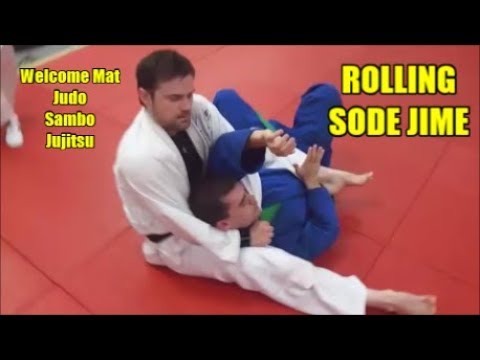
This video shows a rolling application of Sode Jime (Sleeve Choke). View hundreds of videos of judo, freestyle judo, Shi…
The sleeve wheel choke (sode guruma jime) is a precision strangling technique applicable across multiple positions and formats, both with and without gi. Seiryoku Zenyo and welcomematstevescott demonstrate complementary approaches to this fundamental jiu-jitsu submission. The core mechanics involve controlling the opponent's neck while using one's own sleeve as a choking tool—either by inserting fingers into the sleeve and applying pressure through wrist rotation and hand positioning, or by catching the sleeve with thumb and creating compression by drawing hands together. Seiryoku Zenyo emphasizes the technique's versatility from mount position (particularly low mount with squeezed knees and elevated head control), side control (scarf hold), and defensive bottom positions, detailing how breaking balance through bridging or foot hooks facilitates completion when direct pressure fails. He stresses keeping the opponent's head elevated in mount to prevent bridging escapes, and demonstrates sleeve variations when direct access is blocked. Welcomematstevescott focuses on the rolling application from bottom position, establishing a near-side hook first to prevent sit-outs and Peterson rolls, then executing the choke setup before rolling to finish mounted on the opponent's buttocks. Both instructors agree the technique requires positional control and leverage manipulation; they differ primarily in application context—Seiryoku Zenyo favors top control positions while welcomematstevescott specializes in rolling entries from bottom.
Synthesized from 2 instructors
No instructional courses yet for this technique.
Sign in to suggest a course.
Risk of injury to the person this technique is applied to
Sleeve-assisted choke uses the sleeve as a fulcrum for the forearm strangle from back control
Skill level needed to execute this technique reliably
Whether this technique is allowed under major competition rule sets
Kodokan Judo — Sode-guruma-jime
Japanese terminology sourced from Kodokan Judo — Sode-guruma-jime
Official Kodokan ground technique classification system
Standard Japanese martial arts terminology (kanji/hiragana)
Established Japanese martial arts naming convention — native Japanese term (和語/漢語)
Japanese terminology sourced from Kodokan Judo — Sode-guruma-jime
grip or squeeze strength, positional control
strong upper body for sustained compression
forearms, biceps, pectorals, core stabilisers
You must never let your opponent put his head on the mat, because if his head touches the mat, he can bridge and knock you over. Keep his head controlled and elevated throughout the technique.
No—according to Seiryoku Zenyo, either your own sleeve or your opponent's sleeve will work equally well for finishing the choke.
According to welcomematstevescott, you need to start with a near leg ride first to control the position and set up the technique; without this foundational control, your opponent can sit out or escape via a Peterson roll even if the choke is locked in.
welcomematstevescott emphasizes draping one leg over the opponent's torso and positioning the other foot to prevent him from turning away; this keeps him trapped in the choke position.
The sleeve wheel choke (judo's sode-guruma-jime, also known as the Ezekiel choke in Brazilian Jiu-Jitsu) threads one arm behind the opponent's head, feeds the gi sleeve of that arm across the neck with the opposite hand, and rotates the arms to tighten the strangle. The sleeve fabric acts as a fulcrum while the forearm provides counter-pressure to compress the carotid artery on the side of the neck.
The sleeve wheel choke shares mechanical principles with the Ezekiel choke (sode-guruma-jime), where the sleeve serves as a compression aid. BJJ practitioners adapted the sleeve-threading concept for back control during the 2000s, finding it an effective alternative when the RNC and collar chokes were defended.
IBJJF: legal — Legal at all belt levels, gi and no-gi — chokes are the safest submission cat…; IJF: legal — Legal (shime-waza) — strangulation techniques are one of three permitted subm…; ADCC: legal — Legal; Unified MMA: legal — Legal — choke submissions are among the most common finishes in MMA; FIAS Sport Sambo: banned — All chokes prohibited in Sport Sambo; FIAS Combat Sambo: legal — Legal
Danger rating 8/10. Sleeve-assisted choke uses the sleeve as a fulcrum for the forearm strangle from back control
The standard setup chain: Achieve Controlling Position → Isolate the Neck → Set the Grip → Apply Pressure.
Standard counters include: Tuck Chin — protect the neck by lowering the chin to prevent the choke from sinking / Two-on-One Grip Fight — use both hands to strip the choking grip before it locks / Turn Into — rotate toward the choking arm to relieve carotid pressure / Posture Up — straighten the spine and create distance to break the choking angle.
Common variants: Standard grip variation (primary hand configuration for maximum choking pressure); Gi variation (uses the lapel or collar as an anchor for additional fric…); No-gi variation (adapted grip and positioning for submission grappling wit…); Transition finish (applied during a positional change to catch the opponent …).
Sleeve wheel chokes appear at advanced IBJJF competition.
Top errors to watch for: Gripping too far up the sleeve — grip near the wrist for maximum sleeve length around the neck; gripping at the elbow… / Not committing to the full wheel motion — a partial rotation doesn't cinch the sleeve sufficiently; complete the arc … / Losing the sleeve grip during the rotation — maintain a firm pistol grip on the sleeve throughout the wheeling motion / Attempting without back control — the wheel choke requires a stable position behind the opponent; from guard it lacks….
The Sleeve Wheel Choke is also known as Sode-guruma-jime, Sode-guruma-jime variant, Sleeve-Assisted Rear Choke.