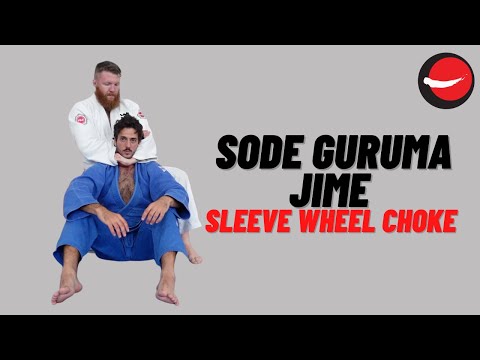
Sode Guruma Jime || Sleeve Wheel Choke
0
Sleeve Assisted Rear Strangle·The Judo Way of Life
Sode Guruma Jime || Sleeve Wheel Choke Shime Waza (Strangulation Techniques) Part of The Judo Way Of Life Education Se…
Translation: sleeve-assisted rear strangle
Sleeve-assisted rear strangles use the attacker's own gi sleeve — threaded behind the opponent's head — as a fulcrum or lever to enhance forearm compression from back control. [1],[2] The sleeve wheel choke is the signature technique: the attacker threads one arm behind the opponent's head, feeds the sleeve of that arm across the throat with the opposite hand, and squeezes to create a powerful forearm-and-fabric compression. [1],[3] The sleeve provides a grip anchor that prevents the choking arm from slipping, and the fabric distributes pressure more broadly than bare forearm contact. [1] From back control, sleeve-assisted strangles are particularly effective because the opponent cannot easily strip the sleeve grip while both arms are occupied defending. [2],[4]
Sleeve-assisted strangles from the back derive from the same mechanical principle as the Ezekiel choke (sode-guruma-jime), where the sleeve serves as a compression aid. [2],[3] While the traditional Ezekiel is applied from mount or top position, BJJ practitioners adapted the sleeve-threading concept for back control during the 2000s. [1] The sleeve wheel choke gained visibility through competition, where gi grapplers found that threading the sleeve from behind offered a strong alternative when the rear naked choke was defended. [1],[4]
The sleeve-assisted rear strangle grips the opponent's sleeve from behind to create a strangle using the gi material. [1]
Sleeve-assisted rear strangles are a gi-specific innovation in BJJ back attack systems. [1]
Sleeve-assisted rear strangles are used in gi BJJ competition from back control. [1]
No images yet for this technique.
Sign in to suggest an image.
Sode Guruma Jime || Sleeve Wheel Choke Shime Waza (Strangulation Techniques) Part of The Judo Way Of Life Education Se…
No instructional courses yet for this technique.
Sign in to suggest a course.
Risk of injury to the person this technique is applied to
Sleeve grip provides additional leverage for the forearm strangle from back mount
Skill level needed to execute this technique reliably
Whether this technique is allowed under major competition rule sets
Kodokan Judo — Official Katame-waza Classification
Judo sode (袖 = sleeve) + ushiro-jime terminology
Standard Japanese martial arts terminology (kanji/hiragana)
Established Japanese martial arts naming convention — native Japanese term (和語/漢語)
Judo sode (袖 = sleeve) + ushiro-jime terminology
grip or squeeze strength, positional control
strong upper body for sustained compression
forearms, biceps, pectorals, core stabilisers
Every move, in any martial art, shares a few universal traits. Mix and match below to pinpoint the right tool — or compare equivalents across styles.
Sleeve-assisted rear strangles use the attacker's own gi sleeve — threaded behind the opponent's head — as a fulcrum or lever to enhance forearm compression from back control. The sleeve wheel choke is the signature technique: the attacker threads one arm behind the opponent's head, feeds the sleeve of that arm across the throat with the opposite hand, and squeezes to create a powerful forearm-and-fabric compression.
Sleeve-assisted strangles from the back derive from the same mechanical principle as the Ezekiel choke (sode-guruma-jime), where the sleeve serves as a compression aid. While the traditional Ezekiel is applied from mount or top position, BJJ practitioners adapted the sleeve-threading concept for back control during the 2000s.
IBJJF: legal — Legal at all belt levels, gi and no-gi — chokes are the safest submission cat…; IJF: legal — Legal (shime-waza) — strangulation techniques are one of three permitted subm…; ADCC: legal — Legal; Unified MMA: legal — Legal — choke submissions are among the most common finishes in MMA; FIAS Sport Sambo: banned — All chokes prohibited in Sport Sambo; FIAS Combat Sambo: legal — Legal
Danger rating 8/10. Sleeve grip provides additional leverage for the forearm strangle from back mount
The standard setup chain: Achieve Controlling Position → Isolate the Neck → Set the Grip → Apply Pressure.
Standard counters include: Tuck Chin — protect the neck by lowering the chin to prevent the choke from sinking / Two-on-One Grip Fight — use both hands to strip the choking grip before it locks / Turn Into — rotate toward the choking arm to relieve carotid pressure / Posture Up — straighten the spine and create distance to break the choking angle.
Common variants: Standard grip variation (primary hand configuration for maximum choking pressure); Gi variation (uses the lapel or collar as an anchor for additional fric…); No-gi variation (adapted grip and positioning for submission grappling wit…); Transition finish (applied during a positional change to catch the opponent …).
Sleeve-assisted rear strangles are used in gi BJJ competition from back control.
Top errors to watch for: Using the sleeve grip as the primary choking force — the sleeve only assists; the choking arm must be properly positi… / Gripping a sleeve that is too loose — the fabric must be taut for the grip to transmit force effectively / Not positioning the choking arm correctly before gripping the sleeve — the arm must be across the neck with the crook… / Releasing back hooks to reach for the sleeve — maintain position first; the sleeve grip is secondary to back control.
The Sleeve Assisted Rear Strangle is also known as Sode Hojo Ushiro-jime, Rear Sleeve Choke, Sleeve-Assisted Strangle.