Strike & defenceLocksClose rangeFighting multiple people
Distance
CloseMiddleLong
Body target
Upper bodyMiddle bodyLower body
Overview
The cross collar choke from body triangle combines the powerful hip control of the body triangle with a cross-grip lapel strangle from behind. [1],[2] The body triangle locks the attacker's legs around the opponent's torso in a figure-four configuration, limiting hip escape and stabilising the position while the cross-collar grips compress both carotid arteries. [1] Lapel chokes bypass chin-tuck defences that block the standard rear naked choke, making this a useful follow-up when the chin is sealed against the arm. [2]
Also known as
Body Triangle Cross CollarBoxing[1]BT Cross ChokeBoxing[2]
The cross collar choke from the body triangle combines two techniques with distinct lineages. The cross collar grip (juji-jime) was codified by Jigoro Kano in the Kodokan shime-waza syllabus during the 1880s as a fundamental strangling technique using the gi lapels. [1] The body triangle control position emerged later within Brazilian Jiu-Jitsu, where back-control specialists developed the figure-four leg configuration to replace or supplement traditional hooks for maintaining rear mount. [2] The specific combination of body triangle with cross collar grips became prominent in sport BJJ competition during the 2000s as athletes sought submissions that could bypass chin-tuck defences against the rear naked choke. [3] Saulo Ribeiro documents the cross collar choke from the back as a high-percentage alternative when the opponent defends the neck against bare-hand strangles. [3]
Country of origin· shown in random order
🇧🇷BrazilBJJ, Submission Grappling, MMA
🇯🇵Japan十字絞(ボディトライアングルから)(Juji-jime — From Body Triangle)BJJ, Judo, Submission Grappling
🇺🇸USASubmission Grappling, MMA
🇷🇺RussiaSambo
Effectiveness
The cross collar choke from the body triangle combines the strongest back control (body triangle) with the most fundamental collar choke. [1] The body triangle immobilizes the opponent's hips while the cross collar grip attacks the neck. [1],[2]
Lineage
The cross collar choke from body triangle back control combines the strongest back control position with the classic lapel choke. [1]
Competition Record
Cross collar chokes from body triangle back control are high-percentage finishes in gi BJJ competition. [1]
Images
No images yet for this technique.
Sign in to suggest an image.
Biomechanical Mechanism
Primary Action — Bilateral compression of the carotid arteries — restricts blood flow to the brain, causing unconsciousness within seconds
Joints Involved — Cervical spine (lateral flexion), glenohumeral joint of the trapped arm (if arm-in), nuchal region
Force Vector — Lateral squeeze creates inward pressure on both sides of the neck simultaneously
Choking Mechanism — Vascular strangle — occludes carotid arteries and jugular veins, distinct from airway (tracheal) chokes
Position & Entry
From back control with seatbelt — Establish hooks or body triangle, slide choking arm under the chin, connect hands and squeeze
From turtle top (back take) — Break down the turtle, insert hooks, secure seatbelt grip, slide to back control and apply the choke
From standing back clinch — Secure rear body lock, drag opponent to the mat while inserting hooks, transition to choking position
Variants
Short choke (palm-to-palm grip) — compact grip for tight spaces when the chin is partially tucked
Gable grip RNC — interlocked fingers behind the head for maximum squeeze pressure
Body triangle RNC — adds body triangle control for stronger hip management during the choke
One-arm RNC — single arm under the chin when the second arm cannot reach behind the head
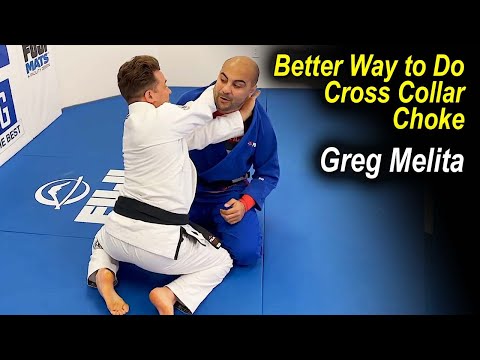
A Better Way to Do the Cross Collar Choke- Greg Melita
0
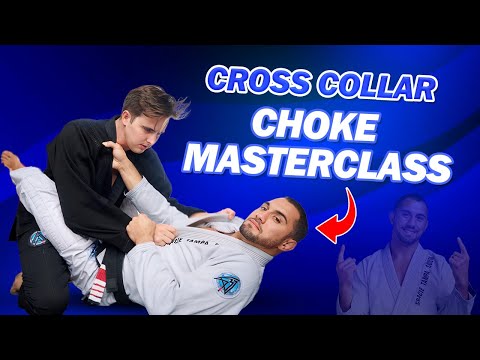
Cross Collar Choke From Body Triangle·Bernardo Faria BJJ Fanatics
Best Cross Collar Choke
-
For The Best BJJ Instructional Videos, Check Out: https://bjjfanatics.com
-
In this BJJ Traini…
2 videos
What Instructors Say
The cross collar choke from body triangle combines fundamental grip mechanics with precise positional control. Matt Arroyo Jiu Jitsu emphasizes that success depends on deep hand placement, blade orientation, and sequential finishing mechanics rather than raw strength. The first grip must penetrate deeply across the opponent's body to the opposite side, with the wrist blade positioned directly on the carotid artery; this hand is then rotated to turn the blade into the target. The second grip, inserted either palm-up (under the first arm) or palm-down (over the first arm depending on position), need not be as deep but must also have blade contact on the artery. Arroyo stresses that the gi serves only as a leverage point, while the wrist blades perform the actual choking action. The finish involves three coordinated steps: turning both blades inward, hammering the gi to increase blade pressure, and pulling the opponent's head into the attacker's chest while driving elbows down to hip level. Bernardo Faria BJJ Fanatics (via Greg Melita) contributes a conceptual refinement: managing slack creation and removal to facilitate grip entry, and critically, maintaining head position with the opponent's head positioned below the attacker's head to maximize mechanical advantage. Both instructors agree on the technique's versatility across guard, mount, and side control positions, though they emphasize different pedagogical angles—Arroyo focuses on mechanical execution while Melita prioritizes conceptual understanding of body mechanics.
Synthesized from 2 instructors
Matt Arroyo Jiu Jitsu — Everything You Need to Know About the Cross Collar Choke | Jiu Jitsu Fundamentals #bjj: Detailed four-step mechanical sequence: deep grip placement, blade rotation, imaginary nail hammering (ripping motion), and head-to-chest finish with elbow drive. Distinguishes between palm-up and palm-down second grip entries based on position (guard vs. mount). Emphasizes wrist blade contact on carotid artery as the actual choking mechanism, not gi pressure.
Bernardo Faria BJJ Fanatics — A Better Way to Do the Cross Collar Choke- Greg Melita: Introduces slack management concept: pushing the first grip to create slack for easier second grip insertion. Highlights head positioning principle—keeping opponent's head below attacker's head—as critical mechanical advantage derived from legend Fernando Margarita Pontes. Frames instruction through conceptual understanding suitable for newer practitioners.
Learn This Technique
No instructional courses yet for this technique.
Sign in to suggest a course.
Ratings
Danger Rating
Risk of injury to the person this technique is applied to
9
Extreme9/10
Body triangle amplifies choke pressure by restricting hip escape and compressing the diaphragm
Difficulty
Skill level needed to execute this technique reliably
Advanced
Competition Legality
Whether this technique is allowed under major competition rule sets
Illegal
— FIAS Sport Sambo — All chokes prohibited in Sport Sambo
✓The cross-collar choke from body triangle uses the superior control of the body triangle position to apply a cross-collar strangle from the back — the body triangle prevents hip escape while the hands attack the neck (Danaher, Back Attacks, 2019)
✓The body triangle (locking a triangle with the legs around the opponent's torso) provides unshakeable back control — freeing both hands for the choke
✓From body triangle, both hands feed into the opponent's collar: the first hand grips deep on the far side, the second hand crosses over and grips the near side
✓The body triangle creates additional pressure: the locked legs compress the ribs and restrict breathing — adding respiratory distress to the choking pressure
✓The cross-collar from body triangle is slower to set up than the RNC but harder to defend — the double collar grip is mechanically stronger than single-arm RNC grips
✓The body triangle position allows the attacker to angle the body to one side — this angle creates the space to feed the collar grips while maintaining back control
✓The gi collar provides a no-slip grip surface that makes the cross-collar choke extremely reliable from back control
Common Mistakes
!Not securing the body triangle before attacking the collar — the body triangle must be locked first; attempting the choke without secure control allows escape
!Gripping too shallow on the collar — the first hand must be deep (past the centre line) for the choke to compress both carotids
!Crossing the hands in the wrong order — the first grip goes deep on the far side; the second crosses on top
!Not using the body triangle pressure as part of the attack — the rib compression from the body triangle fatigues the opponent and forces them to address breathing, opening the neck
!Pulling the opponent sideways off the body triangle — maintain the locked position; rolling to the side can release the triangle
!Not hiding the hands — the opponent will hand-fight; feed the grips while they address the body triangle pressure
!Squeezing only with the arms — the cross-collar choke uses the pulling of both elbows toward the attacker's chest, combined with chest expansion
Standard Japanese martial arts terminology (kanji/hiragana)
4OtherJapanese Martial Arts Standard Terminology (武道用語)
Established Japanese martial arts naming convention — native Japanese term (和語/漢語)
5CitationKodokan Judo — Juji-jime
Japanese terminology sourced from Kodokan Judo — Juji-jime
Community
Athletics
Requires
hip flexibility, long legs relative to torso
Favours
longer limbs for easier figure-four lock around head and arm
Key muscles
hip adductors, hamstrings, quadriceps
Frequently Asked Questions
What's the most common mistake beginners make with the cross collar choke grip?
Matt Arroyo emphasizes that the biggest mistake is not getting a deep enough grip. The first hand must go all the way to the tag on the collar, with your thumb positioned behind the opponent's ear—not in front of it. Many beginners also mistakenly try to choke the neck with the gi itself rather than using the collar as a tool.
How should I finish the cross collar choke once I have the grips in place?
Instead of pulling your elbows upward, pull them straight down toward your hip bones while pulling the opponent's head into your chest. This generates significantly more power than the common beginner mistake of raising the elbows.
Why is it hard to get my second hand grip in when I already have the first collar grip?
Greg Melita explains that many people pull too tightly with the first hand, which makes it extremely difficult to get the second hand in. You need to manage the tension on the collar—create slack when necessary to allow the second grip to slip in properly.
What positioning principle makes the cross collar choke more effective?
Getting your head below your opponent's head creates a significant positional advantage. This concept translates across different cross collar choke variations and makes the technique much more difficult to defend.
How does the Cross Collar Choke From Body Triangle work?
The cross collar choke from body triangle combines the powerful hip control of the body triangle with a cross-grip lapel strangle from behind. The body triangle locks the attacker's legs around the opponent's torso in a figure-four configuration, limiting hip escape and stabilising the position while the cross-collar grips compress both carotid arteries.
Where does the Cross Collar Choke From Body Triangle come from?
The cross collar choke from the body triangle combines two techniques with distinct lineages. The cross collar grip (juji-jime) was codified by Jigoro Kano in the Kodokan shime-waza syllabus during the 1880s as a fundamental strangling technique using the gi lapels.
Is the Cross Collar Choke From Body Triangle legal in competition?
IBJJF: legal — Legal at all belt levels, gi and no-gi — chokes are the safest submission cat…; IJF: legal — Legal (shime-waza) — strangulation techniques are one of three permitted subm…; ADCC: restricted — N/A (no-gi competition only — technique requires gi); Unified MMA: restricted — N/A (technique requires gi — not applicable in MMA); FIAS Sport Sambo: banned — All chokes prohibited in Sport Sambo; FIAS Combat Sambo: legal — Legal
How dangerous is the Cross Collar Choke From Body Triangle?
Danger rating 9/10. Body triangle amplifies choke pressure by restricting hip escape and compressing the diaphragm
How do I set up the Cross Collar Choke From Body Triangle?
The standard setup chain: Achieve Controlling Position → Isolate the Neck → Set the Grip → Apply Pressure.
How do I defend against the Cross Collar Choke From Body Triangle?
Standard counters include: Tuck Chin — protect the neck by lowering the chin to prevent the choke from sinking / Two-on-One Grip Fight — use both hands to strip the choking grip before it locks / Turn Into — rotate toward the choking arm to relieve carotid pressure / Posture Up — straighten the spine and create distance to break the choking angle.
What are the variants of the Cross Collar Choke From Body Triangle?
Common variants: Short choke (palm-to-palm grip) (compact grip for tight spaces when the chin is partially …); Gable grip RNC (interlocked fingers behind the head for maximum squeeze p…); Body triangle RNC (adds body triangle control for stronger hip management du…); One-arm RNC (single arm under the chin when the second arm cannot reac…).
How effective is the Cross Collar Choke From Body Triangle in competition?
Cross collar chokes from body triangle back control are high-percentage finishes in gi BJJ competition.
What are common mistakes when doing the Cross Collar Choke From Body Triangle?
Top errors to watch for: Not securing the body triangle before attacking the collar — the body triangle must be locked first; attempting the c… / Gripping too shallow on the collar — the first hand must be deep (past the centre line) for the choke to compress bot… / Crossing the hands in the wrong order — the first grip goes deep on the far side; the second crosses on top / Not using the body triangle pressure as part of the attack — the rib compression from the body triangle fatigues the ….
What are other names for the Cross Collar Choke From Body Triangle?
The Cross Collar Choke From Body Triangle is also known as Juji-jime — From Body Triangle, Body Triangle Cross Collar, BT Cross Choke.