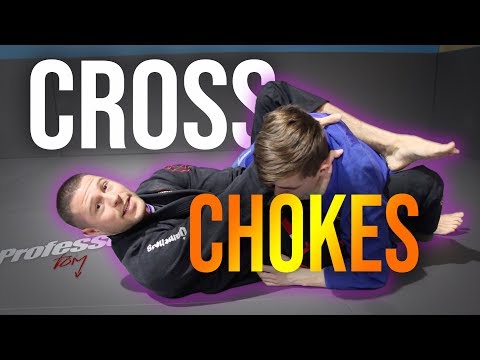
How To Make That Cross Choke Work!
0
Cross Lapel Rear Choke·The Grappling Academy
SALE SALE SALE OVER 50% OFF – BOX SET – ALL 4 COURSES 50% OFF CLICK HERE – https://bit.ly/2lAOHmp • The Blue Belt Sup…
Translation: cross lapel rear strangle
Cross lapel rear chokes are back control strangles where the attacker reaches across the opponent's neck to grip the far-side lapel, then feeds the collar across the throat to create a cross-collar compression. [1],[2] From back mount or back hooks, the attacker's forearm presses against one carotid while the crossed lapel compresses the other side. [1] The cross-collar grip from behind is one of the most fundamental gi choke configurations in judo (jūji-jime variations from ushiro) and Brazilian Jiu-Jitsu. [2],[3] The cross-grip provides a mechanical advantage because the fabric distributes pressure broadly across the neck, and the attacker can incrementally tighten by pulling elbows toward their own chest. [1],[4]
Cross lapel chokes from behind derive from the jūji-jime (十字絞め, cross strangle) family in Kodokan Judo, where crossing the hands on the collar was codified as a foundational shime-waza technique. [2],[3] In traditional judo, these were typically applied from osaekomi (pinning) positions. [2] Brazilian Jiu-Jitsu practitioners, particularly from the Gracie lineage, adapted the cross-collar grip for dedicated back control positions where hooks or body triangles maintain the attacking position. [1] The technique remains a staple at all levels of gi competition. [1],[4]
The cross lapel rear choke uses the opponent's own gi collar from behind to create a powerful strangle. [1]
Rear collar chokes come from judo's shimewaza and were refined in BJJ back-control systems. [1]
Cross lapel rear chokes are a standard finishing technique from back control in gi BJJ competition. [1]
No images yet for this technique.
Sign in to suggest an image.
SALE SALE SALE OVER 50% OFF – BOX SET – ALL 4 COURSES 50% OFF CLICK HERE – https://bit.ly/2lAOHmp • The Blue Belt Sup…
Cross lapel chokes Let's dive into some gi submission flows with different collar chokes. Most will be shown from closed…
No instructional courses yet for this technique.
Sign in to suggest a course.
Risk of injury to the person this technique is applied to
Cross-lapel grip from back creates strong bilateral compression using gi material
Skill level needed to execute this technique reliably
Whether this technique is allowed under major competition rule sets
Kodokan Judo — Official Katame-waza Classification
Judo eri-jime (collar strangle) terminology
Standard Japanese martial arts terminology (kanji/hiragana)
Established Japanese martial arts naming convention — native Japanese term (和語/漢語)
Judo eri-jime (collar strangle) terminology
grip or squeeze strength, positional control
strong upper body for sustained compression
forearms, biceps, pectorals, core stabilisers
Every move, in any martial art, shares a few universal traits. Mix and match below to pinpoint the right tool — or compare equivalents across styles.
The Grappling Academy emphasizes that the styloid head of your radius bone (the bone on the thumb side of your wrist) should be touching tight against the neck right where you'd feel a pulse—not nearly touching, but actually touching.
According to The Grappling Academy, one grip allows you to hold the opponent down if they try to get posture, but you need two grips to actually apply the choke effectively.
The Grappling Academy stresses that there's normally only one hand doing the actual choking—typically your right hand—while your left hand's job is just to staunch your elbow towards their abs and prevent the roll. Don't just try to squeeze; understand which hand is holding and which hand is choking.
The Grappling Academy advises to continue holding your cross choke when your opponent attempts a counter-choke, which creates a wonderful opportunity to maintain control rather than panic.
Cross lapel rear chokes are back control strangles where the attacker reaches across the opponent's neck to grip the far-side lapel, then feeds the collar across the throat to create a cross-collar compression. From back mount or back hooks, the attacker's forearm presses against one carotid while the crossed lapel compresses the other side.
Cross lapel chokes from behind derive from the jūji-jime (十字絞め, cross strangle) family in Kodokan Judo, where crossing the hands on the collar was codified as a foundational shime-waza technique. In traditional judo, these were typically applied from osaekomi (pinning) positions.
IBJJF: legal — Legal at all belt levels, gi and no-gi — chokes are the safest submission cat…; IJF: legal — Legal (shime-waza) — strangulation techniques are one of three permitted subm…; ADCC: restricted — N/A (no-gi competition only — technique requires gi); Unified MMA: restricted — N/A (technique requires gi — not applicable in MMA); FIAS Sport Sambo: banned — All chokes prohibited in Sport Sambo; FIAS Combat Sambo: legal — Legal
Danger rating 8/10. Cross-lapel grip from back creates strong bilateral compression using gi material
The standard setup chain: Achieve Controlling Position → Isolate the Neck → Set the Grip → Apply Pressure.
Standard counters include: Tuck Chin — protect the neck by lowering the chin to prevent the choke from sinking / Two-on-One Grip Fight — use both hands to strip the choking grip before it locks / Turn Into — rotate toward the choking arm to relieve carotid pressure / Posture Up — straighten the spine and create distance to break the choking angle.
Common variants: Standard grip variation (primary hand configuration for maximum choking pressure); Gi variation (uses the lapel or collar as an anchor for additional fric…); No-gi variation (adapted grip and positioning for submission grappling wit…); Transition finish (applied during a positional change to catch the opponent …).
Cross lapel rear chokes are a standard finishing technique from back control in gi BJJ competition.
Top errors to watch for: Not establishing back control before attacking the collar — hooks and chest-to-back contact must be secure before the… / Gripping the collar too shallow — the hand must reach deep, past the centre of the neck, for the forearm to compress … / Not hiding the grip entry — the opponent will hand-fight; use distractions (shifting hooks, threatening the RNC) to c… / Pulling the collar grips outward — like all cross chokes, the elbows must pull back toward the attacker's chest.
The Cross Lapel Rear Choke is also known as Jūji Eri Ushiro-jime, Okuri-eri-jime variant, Rear Cross Collar Choke.