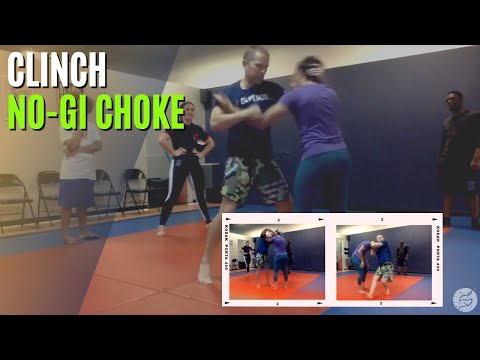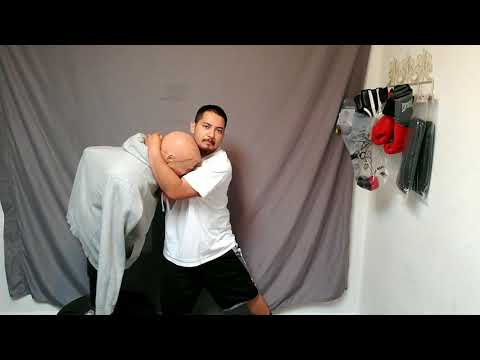
Standing Choke Baseball Choke for self defense
0
Baseball Bat From Standing Backpack·Central Coast Self Defense
How to do a standing baseball bat choke and how it can be applied in a real street self defense situation. No gi or clot…
Translation: Baseball Bat Lapel Choke Applied From a Standing Backpack Position
From a standing backpack control the attacker feeds the near lapel under the opponent's chin to the far hand, secures a cross-grip on the far lapel, drops the chest and rotates the wrists in a baseball-bat motion while driving hips forward to apply a high-leverage lapel strangle.
Evolution of gi-based backpack and baseball bat lapel concepts adapted for standing scenarios by modern BJJ competitors and instructors
Standing leverage amplifies torque on the choke, making escapes difficult and finishes rapid when the grip is properly set; the backpack position prevents the opponent from using ground-based escape mechanics. [1]
The baseball bat choke from standing backpack position was developed as a dynamic submission for situations where back control is taken from standing. [1]
Standing back control to baseball bat choke transitions appear in advanced BJJ competition. [1]
No images yet for this technique.
Sign in to suggest an image.
How to do a standing baseball bat choke and how it can be applied in a real street self defense situation. No gi or clot…
Pain is unreliable. We can't know exactly how someone will respond. The punch choke here may not lead to a tap but it c…
The baseball bat choke from standing backpack is a rear-control strangling technique applicable without specialized gi equipment, requiring only casual clothing such as a t-shirt or hoodie. Central Coast Self Defense and Fit to Fight Republic demonstrate a choke executed by establishing a backpack control position, then applying compression through a modified grip. Central Coast describes the mechanics as turning the grip as if holding a plate, sinking slightly, and bringing the elbows together to create a narrow compression point on the neck. Fit to Fight Republic emphasizes the S-grip variation, where the practitioner attempts to make the elbows touch while applying pressure, then controls the opponent by walking them backward. Both instructors agree the technique functions as both a choke and crank depending on application. Defensively, Central Coast emphasizes keeping the opponent off-balance through constant movement, contracting the ribs to absorb strikes, and burying the head against the opponent's to prevent effective punching. The technique can be maintained through takedown attempts if the practitioner prevents the opponent from achieving a mounted or guard position. Fit to Fight Republic notes the standing application is risky and less commonly seen than its ground-based variations, but can be effective when executed with surprise and proper timing. Both sources confirm the technique remains functional even if the opponent achieves top position on the ground.
Synthesized from 2 instructors
No instructional courses yet for this technique.
Sign in to suggest a course.
Risk of injury to the person this technique is applied to
Extremely high risk; standing leverage increases torque and can cause rapid loss of consciousness and severe cervical injury if fully applied
Skill level needed to execute this technique reliably
Whether this technique is allowed under major competition rule sets
Japanese BJJ community standard terminology; ベースボールチョーク (Baseball Choke) from Yahoo知恵袋 BJJ community
Japanese Q&A community — BJJ technique name verification
Mixed Japanese-Western terminology — combines traditional Japanese terms with katakana loanwords
Japanese terminology sourced from Japanese BJJ community standard terminology; ベースボールチョーク (Baseball Choke) from Yahoo知恵袋 BJJ community
grip or squeeze strength, positional control
strong upper body for sustained compression
forearms, biceps, pectorals, core stabilisers
Every move, in any martial art, shares a few universal traits. Mix and match below to pinpoint the right tool — or compare equivalents across styles.
From standing backpack control the attacker feeds the near lapel under the opponent’s chin using the inside hand, establishes a deep inside grip, then cross-grips the far lapel and rotates wrists in a baseball bat motion while applying hip pressure to finish the choke.
From standing backpack control the attacker feeds the near lapel using the outside hand to wrap over the collar, secures a cross-grip on the far lapel, establishes a strong outside bite, then rotates wrists and drives hips forward to apply a high-leverage lapel strangle while maintaining the standing anchor.
From standing backpack control the attacker secures cross-lapel grips and uses a controlled roll or spin (often dropping level and rotating around the opponent) to increase rotational torque and finish the choke while maintaining a hip/leg anchor to prevent escape.
High-skill standing variation; prioritize posture and hip anchor control before committing; spar carefully due to extremely fast finish potential.
Turn your body as if you're holding a plate, then sink slightly while establishing the grip around your opponent's neck. Central Coast Self Defense emphasizes keeping a firm grip throughout the setup.
Bring your elbows together tightly to close off a small spot where the neck sits, which cuts off blood flow and completes the choke.
Bring your foot that's closer to your opponent forward as they go down, and you can follow up with a hip toss or other takedown defense to maintain control.
Maneuver and push your opponent around to keep them off balance, making it difficult for them to throw powerful strikes since power comes from a solid base and good posture.
From a standing backpack control the attacker feeds the near lapel under the opponent's chin to the far hand, secures a cross-grip on the far lapel, drops the chest and rotates the wrists in a baseball-bat motion while driving hips forward to apply a high-leverage lapel strangle.
Evolution of gi-based backpack and baseball bat lapel concepts adapted for standing scenarios by modern BJJ competitors and instructors
10/10 — Extremely high risk; standing leverage increases torque and can cause rapid loss of consciousness and severe cervical injury if fully applied
The standard setup chain: Achieve Controlling Position → Isolate the Neck → Set the Grip → Apply Pressure.
Standard counters include: Tuck Chin — protect the neck by lowering the chin to prevent the choke from sinking / Two-on-One Grip Fight — use both hands to strip the choking grip before it locks / Turn Into — rotate toward the choking arm to relieve carotid pressure / Posture Up — straighten the spine and create distance to break the choking angle.
Common variants: Standing Backpack Baseball Bat with One Hook; Standing Backpack Baseball Bat with Body Triangle Anchor; High-Seatbelt Cross-Grip Variant.
Standing back control to baseball bat choke transitions appear in advanced BJJ competition.
Top errors to watch for: Feeding lapel too shallow; failing to lock hips and standing anchor; attempting rotation before lapel control; droppi….
The Baseball Bat From Standing Backpack is also known as Tachi Backo kara no Yakyū Batto-jime, Standing Backpack Baseball Bat Choke, Standing Rear Lapel Twist.