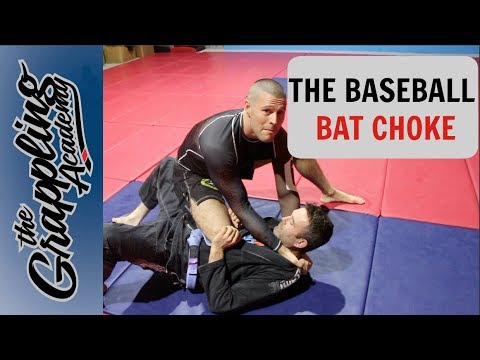
The Baseball Bat Choke
0
Baseball Bat Lapel Rear Choke·The Grappling Academy
SALE SALE SALE OVER 50% OFF – BOX SET – ALL 4 COURSES 50% OFF CLICK HERE – https://bit.ly/2lAOHmp • The Blue Belt Sup…
Translation: Baseball Bat-style Lapel Chokes Applied from Back Control
A subset of back control chokes where the attacker uses a cross-grip baseball bat configuration on the opponent’s lapel or collar while maintaining back control. [1] The arms rotate around the opponent’s neck in a bat-swinging motion, creating intense rotational and compressive force against the carotid arteries. [1],[2] This configuration is particularly effective when the opponent is turtled or seated and the attacker has established back hooks or a body triangle. [1] The cross-grip setup distinguishes this subfamily from standard rear lapel chokes — both hands grip the collar on the same side, then rotate in opposite directions to create a scissoring compression. [2],[3]
Adapted from the classical judo baseball bat choke (yakyū batto-jime), which was originally applied from front-facing positions. [2] Brazilian Jiu-Jitsu practitioners later adapted the grip configuration specifically for back control positions, where the attacker's chest-to-back contact provides superior control and a higher finish rate. [1] The rear baseball bat variation became prominent in gi grappling competitions during the 2000s as back-take strategies became central to competitive BJJ. [1],[3]
The baseball bat lapel choke uses a unique grip configuration (one hand palm-up, one palm-down on the lapel) to create a choking mechanism from multiple positions. [1]
The baseball bat choke is a popular submission in gi BJJ competition, finished from knee-on-belly, side control, and during guard passes. [1]
No images yet for this technique.
Sign in to suggest an image.
SALE SALE SALE OVER 50% OFF – BOX SET – ALL 4 COURSES 50% OFF CLICK HERE – https://bit.ly/2lAOHmp • The Blue Belt Sup…
Magid Hage is considered the one who has the best Baseball Choke in the planet. And I had the opportunity to learn it fr…
No instructional courses yet for this technique.
Sign in to suggest a course.
Risk of injury to the person this technique is applied to
Very fast loss of consciousness and potential neck damage
Skill level needed to execute this technique reliably
Whether this technique is allowed under major competition rule sets
Japanese BJJ community standard terminology; ベースボールチョーク (Baseball Choke) from Yahoo知恵袋 BJJ community
Japanese Q&A community — BJJ technique name verification
Mixed Japanese-Western terminology — combines traditional Japanese terms with katakana loanwords
Japanese terminology sourced from Japanese BJJ community standard terminology; ベースボールチョーク (Baseball Choke) from Yahoo知恵袋 BJJ community
hip flexibility, long legs relative to torso
longer limbs for easier figure-four lock around head and arm
hip adductors, hamstrings, quadriceps
Every move, in any martial art, shares a few universal traits. Mix and match below to pinpoint the right tool — or compare equivalents across styles.
Known as a “hidden blade” from the back — opponents often don’t see it coming due to familiar lapel hand fighting.
Getting comfortable with the four-finger grip is really important, as emphasized by Magid Hage in the BJJ Fanatics instruction. Grip fighting and having endurance in your grips allows you to hold on long enough for the choke to work.
If you're going to defend the choke, you have to focus solely on breaking the grip—use both hands if necessary. Many people hesitate to commit fully to grip defense because they fear losing position, but breaking the grip is the only effective defense.
The baseball bat choke can be applied from multiple positions including underneath side control and the guard, making it a versatile technique that works from everywhere.
A subset of back control chokes where the attacker uses a cross-grip baseball bat configuration on the opponent’s lapel or collar while maintaining back control. The arms rotate around the opponent’s neck in a bat-swinging motion, creating intense rotational and compressive force against the carotid arteries.
Adapted from the classical judo baseball bat choke (yakyū batto-jime), which was originally applied from front-facing positions. Brazilian Jiu-Jitsu practitioners later adapted the grip configuration specifically for back control positions, where the attacker's chest-to-back contact provides superior control and a higher finish rate.
Danger rating 10/10. Extremely high risk — very fast loss of consciousness and potential neck damage
The standard setup chain: Back mount with lapel fed under chin → cross-grip setup → rotation → turtle when lapels are exposed → failed RNC transitioning to lapel grip.
Standard counters include: Tuck Chin — protect the neck by lowering the chin to prevent the choke from sinking / Two-on-One Grip Fight — use both hands to strip the choking grip before it locks / Turn Into — rotate toward the choking arm to relieve carotid pressure / Posture Up — straighten the spine and create distance to break the choking angle.
Common variants: Standard Baseball Bat Lapel Choke from Back; Baseball Bat Collar Twist from Turtle; Inverted Baseball Bat Lapel from Backpack Position.
The baseball bat choke is a popular submission in gi BJJ competition, finished from knee-on-belly, side control, and during guard passes.
Top errors to watch for: Attempting choke without stable back hooks; Loose grips on lapels; Over-rotating and losing back control; Allowing op….
The Baseball Bat Lapel Rear Choke is also known as Yakyū Batto-jime — Haigo, Baseball Bat Choke from Back, Cross-grip Lapel Choke from Back, Rear Baseball Bat Choke.