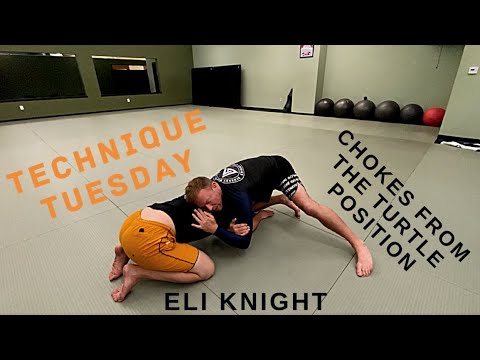
Technique Tuesday: Eli Knight - Chokes from turtle position
0
Standard Turtle Collapse Arm Triangle Choke·McDojoLife
Today my homie Eli Knight will be covering a few chokes from the turtle position. Enjoy :) If you enjoyed these techniq…
Translation: Shoulder Hold / Head-and-Arm Choke — Turtle Collapse
A kata gatame variation against turtle where the attacker collapses the defender sideways to finish the choke. After threading under the near arm and feeding it across the neck, the attacker drives shoulder and chest pressure, collapsing the turtle base to one side and finishing the choke from top side control.
Rooted in Judo newaza kata gatame, adapted in BJJ and Sambo as a high-percentage attack against turtle defenders.
Collapsing the turtle neutralises the opponent's base and creates dominant finishing angles; effective because the collapsed position naturally drives the arm across the neck. [1]
The standard turtle collapse to arm triangle uses weight and hip pressure to flatten the turtled opponent before securing the choke. [1]
Turtle collapse arm triangles are used in BJJ competition as a way to finish against turtled opponents. [1]
No images yet for this technique.
Sign in to suggest an image.
Today my homie Eli Knight will be covering a few chokes from the turtle position. Enjoy :) If you enjoyed these techniq…
No instructional courses yet for this technique.
Sign in to suggest a course.
Risk of injury to the person this technique is applied to
Collapsing the turtle removes base and quickly exposes the choke.
Skill level needed to execute this technique reliably
Whether this technique is allowed under major competition rule sets
Kodokan Judo — Official Katame-waza Classification (肩固め Kata-gatame)
Japanese terminology sourced from Kodokan Judo — Official Katame-waza Classification (肩固め Kata-gatame)
Official Kodokan ground technique classification system
Established Japanese martial arts naming convention — native Japanese term (和語/漢語)
Japanese terminology sourced from Kodokan Judo — Official Katame-waza Classification (肩固め Kata-gatame)
hip flexibility, long legs relative to torso
longer limbs for easier figure-four lock around head and arm
hip adductors, hamstrings, quadriceps
One of the most reliable methods to attack turtle, as it combines positional breakdown with a direct submission threat.
According to Eli Knight, position your chest toward the base of your opponent's shoulder so their head goes into your diaphragm, then cup your second hand and drive forward while cutting back in with your arms to create pressure, similar to a ten-finger guillotine.
Eli Knight recommends cupping to the back of their bicep, pulling back to drag and open the space, then shooting your arm through under their armpit with the back of your hand against their lat and shoulder to transition into the arm triangle or anaconda choke.
Eli Knight emphasizes shooting your arm in nice and deep by the neck, then driving your elbow down to the floor, placing your hand in the bend of your elbow, and squeezing while driving your hips forward to finish the choke.
Eli Knight suggests going palm to palm instead, keeping your forearm against the opponent's tricep and wedging their arm and neck together tightly as an alternative finish.
A kata gatame variation against turtle where the attacker collapses the defender sideways to finish the choke. After threading under the near arm and feeding it across the neck, the attacker drives shoulder and chest pressure, collapsing the turtle base to one side and finishing the choke from top side control.
Rooted in Judo newaza kata gatame, adapted in BJJ and Sambo as a high-percentage attack against turtle defenders.
Danger: 9/10 | Collapsing the turtle removes base and quickly exposes the choke.
The standard setup chain: Achieve Controlling Position → Isolate the Neck → Set the Grip → Apply Pressure.
Standard counters include: Tuck Chin — protect the neck by lowering the chin to prevent the choke from sinking / Two-on-One Grip Fight — use both hands to strip the choking grip before it locks / Turn Into — rotate toward the choking arm to relieve carotid pressure / Posture Up — straighten the spine and create distance to break the choking angle.
Common variants: Collapse directly into side control; Collapse into mount finish; Collapse into north-south choke.
Turtle collapse arm triangles are used in BJJ competition as a way to finish against turtled opponents.
Top errors to watch for: Collapsing before securing head-and-arm lock / Not blocking hip, allowing spin escape / Squeezing too early without angle.
The Standard Turtle Collapse Arm Triangle Choke is also known as Kata Gatame — Standard Turtle Collapse, Standard Turtle Arm Triangle, Kata Gatame Turtle Collapse, Turtle Breakdown Arm Triangle.