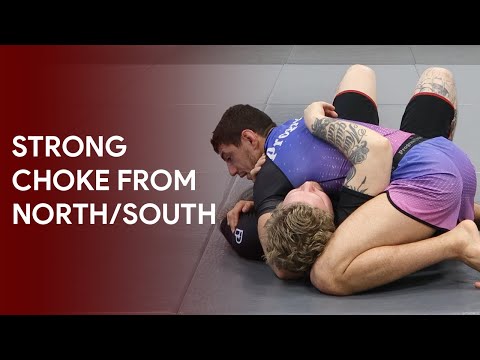
Arm Triangle from North South
0
Arm Triangle Choke — From Open Guard – No-Gi·Tarik BJJ
Hey there, fellow BJJ enthusiasts! Join me as we dive into the intricacies of the Arm Triangle from North South position…
Translation: Shoulder Hold / Arm-and-Head Lock — From Open Guard – No-Gi
A no-gi variation of the arm triangle choke applied from the open guard. Without the aid of collar grips, the attacker uses arm threading, shoulder pressure, and hip angling to isolate the opponent’s head and arm. Unlike closed guard, control must be maintained with hooks, hip movement, or grips on the opponent’s arms to keep them trapped while finishing the choke.
Adapted from closed guard and half guard arm triangle concepts. Became popular in no-gi grappling as open guard variations developed in submission grappling and MMA.
Effective in no-gi when strong hip angling and leg control are maintained; requires precise distance management from open guard to trap the arm before the opponent can disengage. [1]
The arm triangle from open guard in no-gi was developed for modern submission grappling competition. [1]
Open guard arm triangles appear in no-gi competition, particularly at ADCC events. [1]
No images yet for this technique.
Sign in to suggest an image.
Hey there, fellow BJJ enthusiasts! Join me as we dive into the intricacies of the Arm Triangle from North South position…
No instructional courses yet for this technique.
Sign in to suggest a course.
Risk of injury to the person this technique is applied to
Can render opponent unconscious quickly if held properly
Skill level needed to execute this technique reliably
Whether this technique is allowed under major competition rule sets
Kodokan Judo — Official Katame-waza Classification (肩固め Kata-gatame)
Japanese terminology sourced from Kodokan Judo — Official Katame-waza Classification (肩固め Kata-gatame)
Official Kodokan ground technique classification system
Established Japanese martial arts naming convention — native Japanese term (和語/漢語)
Japanese terminology sourced from Kodokan Judo — Official Katame-waza Classification (肩固め Kata-gatame)
hip flexibility, long legs relative to torso
longer limbs for easier figure-four lock around head and arm
hip adductors, hamstrings, quadriceps
Can follow failed guillotine, failed triangle, or failed arm drag attempts from open guard. Useful when opponent drives forward into open guard.
Place your opponent's bicep on the far side and walk your hips towards their legs—this hip movement creates the necessary angle for the choke to work effectively.
Do the work on controlling the arm even if you need to feint an attack on the forearm; when your opponent defends that fake attack, you can switch to the actual choke.
A no-gi variation of the arm triangle choke applied from the open guard. Without the aid of collar grips, the attacker uses arm threading, shoulder pressure, and hip angling to isolate the opponent’s head and arm.
Adapted from closed guard and half guard arm triangle concepts. Became popular in no-gi grappling as open guard variations developed in submission grappling and MMA.
Danger: 9/10 | Can render opponent unconscious quickly if held properly
The standard setup chain: open guard → Thread arm under opponent’s head, trap far arm, adjust hips and hooks to control posture, angle off to the side, apply choke with shoulder drive. → Achieve Controlling Position → Isolate the Neck → Set the Grip.
Standard counters include: Tuck Chin — protect the neck by lowering the chin to prevent the choke from sinking / Two-on-One Grip Fight — use both hands to strip the choking grip before it locks / Turn Into — rotate toward the choking arm to relieve carotid pressure / Posture Up — straighten the spine and create distance to break the choking angle.
Common variants: Can use butterfly hooks, lasso-style leg placement, or shin-to-bicep control to stabilize the opponent’s posture before finishing the choke..
Open guard arm triangles appear in no-gi competition, particularly at ADCC events.
Top errors to watch for: Losing control of opponent’s posture / Weak hooks or hip control / Shallow arm threading / Relying solely on arm squeeze.
The Arm Triangle Choke — From Open Guard – No-Gi is also known as Kata Gatame — From Open Guard – No-Gi, Arm Triangle from Open Guard, Open Guard No-Gi Kata Gatame, No-Gi Head-and-Arm Choke from Open Guard.