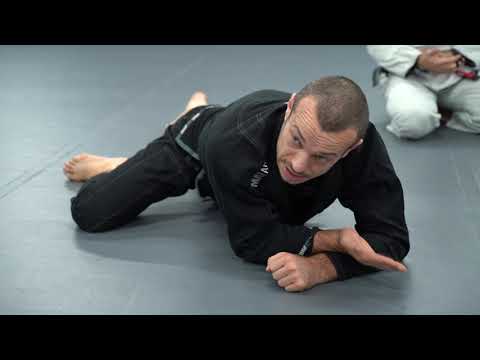
Head and arm choke from mount (arm triangle) - Lachlan Giles
0
S-Mount Arm Triangle Transition·Absolute MMA St Kilda - Melbourne
Check out http://lachlangiles.net for more instructionals
Translation: Shoulder Hold / Head-and-Arm Choke — S-Mount
An arm triangle variation applied from S-Mount. The attacker raises one knee high beside the opponent’s head and swings the other knee across their chest, creating the “S” shape. This tightens control over the head-and-arm while giving greater downward pressure. The attacker may finish directly from S-Mount or transition to side control while maintaining the choke for increased tightness.
Adapted from classical Kata Gatame; refined in Brazilian Jiu-Jitsu as an advanced mount submission. The S-Mount adjustment was popularized for creating maximum chest pressure while limiting opponent’s defensive options.
The S-mount provides extreme positional control that isolates the arm and restricts defensive movement, creating a high-percentage entry to the arm triangle with minimal escape opportunities. [1]
The S-mount to arm triangle transition was developed in BJJ as an advanced mount attack, using the S-mount to isolate the arm before transitioning. [1]
S-mount arm triangle transitions appear at high-level BJJ competition. [1]
No images yet for this technique.
Sign in to suggest an image.
Check out http://lachlangiles.net for more instructionals
No instructional courses yet for this technique.
Sign in to suggest a course.
Risk of injury to the person this technique is applied to
Direct vascular choke with strong positional control; difficult for defender to bridge or escape due to high mount.
Skill level needed to execute this technique reliably
Whether this technique is allowed under major competition rule sets
Kodokan Judo — Official Katame-waza Classification (肩固め Kata-gatame)
Japanese terminology sourced from Kodokan Judo — Official Katame-waza Classification (肩固め Kata-gatame)
Official Kodokan ground technique classification system
Established Japanese martial arts naming convention — native Japanese term (和語/漢語)
Japanese terminology sourced from Kodokan Judo — Official Katame-waza Classification (肩固め Kata-gatame)
hip flexibility, long legs relative to torso
longer limbs for easier figure-four lock around head and arm
hip adductors, hamstrings, quadriceps
Often used when the opponent defends standard mount arm triangle by framing or bridging—S-Mount changes the angle, making defense harder.
Place your bicep across the opponent's chest with your hand positioned low, then apply pressure by driving your weight from bottom to top rather than pushing down from the face. This upward pressure allows you to slip past a tucked chin and land on the neck more effectively.
You want your body weight sprawling with your elbow kept low to be the main mechanism of the choke, not arm squeezing. If your elbow lifts or your hips come too high, you'll lose pressure on the neck.
Put your hands together underneath the opponent's shoulder blade to keep them from rolling flat and facing away, which would make the choke impossible. You can also maintain control by staying low with your shoulder and head positioned as a tripod against their body.
Keep your elbow jammed into the opponent's neck and make sure your hand and shoulder are both lower than the line of their head so your bicep lands across the neck when you sprawl down.
An arm triangle variation applied from S-Mount. The attacker raises one knee high beside the opponent’s head and swings the other knee across their chest, creating the “S” shape.
Adapted from classical Kata Gatame; refined in Brazilian Jiu-Jitsu as an advanced mount submission. The S-Mount adjustment was popularized for creating maximum chest pressure while limiting opponent’s defensive options.
Danger rating 9/10. Direct vascular choke with strong positional control; difficult for defender to bridge or escape due to high mount.
The standard setup chain: Achieve Controlling Position → Isolate the Neck → Set the Grip → Apply Pressure.
Standard counters include: Tuck Chin — protect the neck by lowering the chin to prevent the choke from sinking / Two-on-One Grip Fight — use both hands to strip the choking grip before it locks / Turn Into — rotate toward the choking arm to relieve carotid pressure / Posture Up — straighten the spine and create distance to break the choking angle.
Common variants: Direct S-Mount finish; S-Mount to Side Arm Triangle; S-Mount to Back Take if opponent rolls.
S-mount arm triangle transitions appear at high-level BJJ competition.
Top errors to watch for: Not securing high knee position before setting the choke / Letting the opponent’s elbow escape from across the neck / Overcommitting chest forward and getting swept / Attempting to squeeze with arms only.
The S-Mount Arm Triangle Transition is also known as Kata Gatame — S-Mount, S-Mount Kata Gatame, S-Mount Arm Triangle, High-Mount Head-and-Arm Choke.