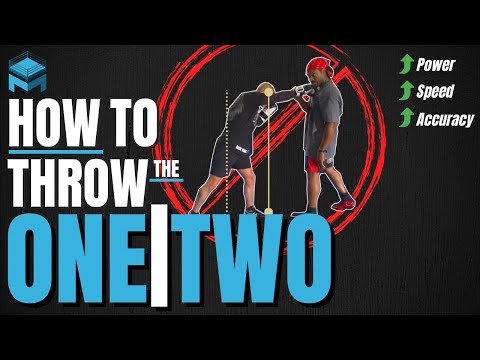
How To Throw The One-Two (Jab-Cross) | Alternate Way To Throw The Right Hand
0
Standard One-Two·Marvin Cook·Added by Admin
Remember to LIKE | COMMENT | SUBSCRIBE | NOTIFICATIONS Review the TRUE BOXERS STANCE videos to help understand t…
Translation: standard one-two
The standard one-two is the basic execution of the jab-cross combination, where the jab is thrown first at full extension, immediately followed by the rear cross as the lead hand returns to guard. [1] Dempsey described this as the 'bread and butter' combination of boxing, effective at all levels from amateur to professional. [1] Haislet documented the standard one-two as the first combination taught to amateur boxers, emphasising that the jab must be committed (not a half-jab) to properly set up the cross. [2] The standard one-two remains the most frequently used combination in both boxing and MMA. [3]
The one-two (jab-cross) is the most fundamental and commonly used combination in boxing, valued because the jab creates the opening that the cross exploits. [1] Dempsey described the jab-cross as the 'bread and butter' combination, emphasising that the jab occupies the opponent's vision and guard while the rear cross follows the same line with full power. [1]
The one-two combination is as old as modern boxing itself, having been a fundamental pairing since the adoption of the Queensberry Rules and the standardisation of the orthodox stance. [1]
No images yet for this technique.
Sign in to suggest an image.
Remember to LIKE | COMMENT | SUBSCRIBE | NOTIFICATIONS Review the TRUE BOXERS STANCE videos to help understand t…
No instructional courses yet for this technique.
Sign in to suggest a course.
Risk of injury to the person this technique is applied to
Jab/cross; fundamental striking tool, cumulative brain trauma risk
Skill level needed to execute this technique reliably
Whether this technique is allowed under major competition rule sets
Karate-Do Kyohan: The Master Text (Gichin Funakoshi, 1935)
Alias sources — [1] Championship Fighting (Dempsey, 1950) [2] Boxing (Fleischer, 1958) [3] Boxing Mastery (Hatmaker, 2004)
Effectiveness sources — [1] Championship Fighting (Dempsey, 1950)
Standard katakana transliteration of Western martial arts terminology (外来語) — used in Japanese MMA, boxing, and BJJ communities
Alias sources — [1] Championship Fighting (Dempsey, 1950) [2] Boxing (Fleischer, 1958) [3] Boxing Mastery (Hatmaker, 2004)
Effectiveness sources — [1] Championship Fighting (Dempsey, 1950)
hand speed, shoulder endurance, quick retraction
longer reach for keeping opponents at distance
anterior deltoid, triceps, serratus anterior, core
No. Marvin Cook emphasizes you should not throw from the hip, as it makes it much harder to exit the punch and return to your proper boxer stance once you fall into that right hand.
According to Marvin Cook, initiate the movement from your rear foot and push forward, sliding laterally while maintaining your stance. You want to move your rear hand laterally and keep it straight rather than looping it.
Marvin Cook stresses that after every punch you must reestablish your stance in relation to your opponent's position, maintaining control in your body so that if your jab is slipped in any direction, you're already lined up for the next punch.
The classic jab-cross sequence thrown in rapid succession, using the jab to gauge distance and clear the line for the power cross.
The standard one-two is the basic execution of the jab-cross combination, where the jab is thrown first at full extension, immediately followed by the rear cross as the lead hand returns to guard. Dempsey described this as the 'bread and butter' combination of boxing, effective at all levels from amateur to professional.
Unified MMA: legal — Legal striking technique; WBC/Boxing: legal — Legal — punches are the core technique of boxing; WKF: legal — Legal, jodan/chudan punch scores 1 point (yuko) — controlled contact required; Kyokushin: restricted — Body punches legal at full power, head punches banned; WT: restricted — Punches to trunk only (1 point), punches to head banned; ITF: legal — Legal — hand techniques to head and body both permitted; WAKO: legal — Legal in Full Contact and Low Kick formats; K: legal — 1/GLORY — Legal — full power punches to head and body; IFMA: legal — Legal
Danger rating 5/10. High — jab/cross; fundamental striking tool, cumulative brain trauma risk
The standard setup chain: Assume Fighting Stance → Generate Power → Execute Strike → Recover to Guard.
Standard counters include: Block — absorb the strike with a protective guard position / Evasion — move the target out of the strike's path / Counter-Attack — time an offensive response during the recovery phase of the strike.
Common variants: Standard jab (quick, straight lead-hand punch from orthodox stance); Power jab (stepping into the jab with more body weight for increased…); Double jab (two rapid jabs to set up a follow-up power shot); Body jab (targeting the midsection instead of the head).
The one-two is the most commonly thrown punch combination in professional boxing and MMA competition. CompuBox data consistently shows the jab-cross sequence as the highest-volume combination across all weight classes.
Top errors to watch for: Throwing both punches at the same time rather than sequentially — the jab must precede the cross / Reaching with the jab instead of stepping, which puts you too far from the cross landing zone / Not sitting down on the cross — the power punch must have full hip rotation and weight transfer / Dropping the lead hand after the jab instead of pulling it back to guard the chin.
The Standard One-Two is also known as Sutandādo Wan Tsū, Standard Jab-Cross, Standard One-Two Punch, Basic Combination.