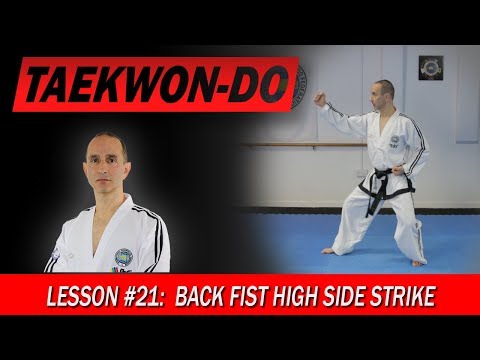
Back Fist High Side Strike - Taekwon-Do Lesson #21
0
Standard Standing Backfist·Donato Nardizzi·Added by Admin
This video shows you how to perform a Back Fist High Side Strike. Recommended for 8th kup grade students and above, the …
Translation: standard standing backfist
The standard standing backfist is the basic execution of the stationary backfist, delivered with a quick arm extension and wrist snap from a fighting stance. [1] Nakayama described the proper execution as requiring the elbow to lead the motion, with the fist whipping outward at the end of the arm's arc to strike with the first two knuckles' dorsal surface. [2] This technique appears in multiple Shotokan kata, including Heian Nidan and Tekki Shodan, where it is used as a close-range counter-attack. [2]
Standard standing backfist. [1]
From karate. [1]
Used in competition. [1]
No images yet for this technique.
Sign in to suggest an image.
This video shows you how to perform a Back Fist High Side Strike. Recommended for 8th kup grade students and above, the …
To watch a better quality of this video you can click HD Bruce Lee's JKD - "Jeet Kune Do" or "The Way of the Intercepti…
The standard standing backfist is a versatile striking technique executed by making contact with the back two knuckles of a tightly squeezed fist. Donato Nardizzi emphasizes that the technique employs an outward swinging motion from the shoulder, with the forearm twisting minimally at the end—distinct from a full inner forearm block. The striking arm begins underneath with palm facing down, then swings across the body as the opposite fist retracts to the hip, creating crossing arm mechanics. Nardizzi details precise body alignment: the backfist should finish lined up with the shoulder center at eye level for high strikes, typically targeting the temple, with the body positioned half-facing the target. He stresses footwork mechanics, particularly pivoting the rear foot outward to generate power through abdominal jerking rather than relying solely on arm motion. Close Combat Martial Arts Training's Kim demonstrates the backfist within a JKD framework, emphasizing forward stepping to generate power and striking force, though offering less detail on stance mechanics and finishing position. Both instructors agree on the technique's fundamental mechanics—an outward swinging motion from the shoulder with contact via the back knuckles—but Nardizzi provides substantially more technical depth regarding stance variations, body rotation, footwork principles, and anatomical alignment.
Synthesized from 2 instructors
No instructional courses yet for this technique.
Sign in to suggest a course.
Risk of injury to the person this technique is applied to
Spinning/standing backfist; metacarpal fracture risk to striker
Skill level needed to execute this technique reliably
Whether this technique is allowed under major competition rule sets
Muay Thai: The Art of Fighting (Yod Ruerngsa, Khun Kao Charuad & James Cartmell, 2002)
Alias sources — [1] Karate-Do Kyohan (Funakoshi, 1935) [2] Dynamic Karate (Nakayama, 1966) [3] Kukkiwon Taekwondo Textbook (Kukkiwon, 2006)
History sources — [1] Karate-Do Kyohan (Funakoshi, 1935) [2] Best Karate Vol. 3 (Nakayama, 1978)
Official karate technique names (和語/漢語)
Established Japanese martial arts naming convention — native Japanese term (和語/漢語)
Alias sources — [1] Karate-Do Kyohan (Funakoshi, 1935) [2] Dynamic Karate (Nakayama, 1966) [3] Kukkiwon Taekwondo Textbook (Kukkiwon, 2006)
History sources — [1] Karate-Do Kyohan (Funakoshi, 1935) [2] Best Karate Vol. 3 (Nakayama, 1978)
hand speed, hip rotation, wrist alignment on impact
proportional reach, strong wrists, fast-twitch shoulder muscles
deltoids, pectorals, triceps, core rotators, forearms
Pull the opposite arm back while executing the technique, breathe out, and fix your gaze all at the same time to add power to the strike.
You can perform the backfist from walking stance to walking stance using the same fundamental principles as the stationary version.
A non-spinning backfist thrown by snapping the arm outward from a bent-elbow position, using the wrist as a pivot point to whip the back of the fist toward the target.
The standard standing backfist is the basic execution of the stationary backfist, delivered with a quick arm extension and wrist snap from a fighting stance. Nakayama described the proper execution as requiring the elbow to lead the motion, with the fist whipping outward at the end of the arm's arc to strike with the first two knuckles' dorsal surface.
Unified MMA: legal — Legal striking technique; WBC/Boxing: legal — Legal — punches are the core technique of boxing; WKF: legal — Legal, jodan/chudan punch scores 1 point (yuko) — controlled contact required; Kyokushin: restricted — Body punches legal at full power, head punches banned; WT: restricted — Punches to trunk only (1 point), punches to head banned; ITF: legal — Legal — hand techniques to head and body both permitted; WAKO: legal — Legal in Full Contact and Low Kick formats; K: legal — 1/GLORY — Legal — full power punches to head and body; IFMA: legal — Legal
Danger rating 5/10. High — spinning/standing backfist; metacarpal fracture risk to striker
The standard setup chain: Assume Fighting Stance → Generate Power → Execute Strike → Recover to Guard.
Standard counters include: Block — absorb the strike with a protective guard position / Evasion — move the target out of the strike's path / Counter-Attack — time an offensive response during the recovery phase of the strike.
Common variants: Horizontal elbow (swinging the elbow horizontally at head level); Uppercut elbow (rising elbow from below targeting the chin); Downward elbow (chopping the elbow straight down (Muay Thai sok tat)); Spinning elbow (full rotation before driving the elbow into the target).
Used in competition.
Top errors to watch for: Extending the entire arm and turning it into a long, slow swing — the elbow must stay as the fixed pivot / Not snapping the wrist at impact, reducing the whip-like force / Aiming at the forehead or top of the head where the bone is thickest — target the temple or jaw / Dropping the elbow during the snap so the backfist travels downward instead of horizontally.
The Standard Standing Backfist is also known as Tachi Uraken (Kihon-gata), Standard Uraken, Standard Standing Back Fist, Deungjumeok Ap Chigi.