Introduction to the Back Fist
The back fist is a versatile striking tool in Taekwon-Do capable of attacking in multiple directions: forwards, backwards, sideways, downwards, and across. The technique is executed by forming a tight fist with the striking surface being the first two knuckles of the back of the hand. Today's focus is the back fist high side strike, commonly performed in walking stance as seen in the third of Taekwon-Do's 24 patterns, Dul Santo.
Mechanics and Initial Movement
The back fist high side strike is an outward swinging technique executed from the shoulder, beginning with the palm facing downward and concluding with a slight forearm twist. This motion is similar to an inner forearm side block but with less rotational force to ensure proper back-fist contact. The striking arm should flick from the elbow to generate acceleration, while simultaneously pulling the opposite fist back to the hip in a crossing motion.
Stance and Footwork Mechanics
Practitioners should enter a walking stance while allowing the feet to pivot by raising and dropping the heels. This pivoting action frees abdominal movement, enabling more powerful jerking motions without placing excessive stress on the knees. Proper footwork transfers power from the lower body to the striking technique.
Target Alignment and Finishing Position
Upon completion of the back fist high side strike, the striking arm should align with the center of the shoulder at eye level. The practitioner's body assumes a half-facing position, with the fist angled slightly to ensure the first two knuckles make contact with the target, typically the opponent's temple.
Execution from Parallel to Walking Stance
From a parallel stance, the practitioner shifts weight onto the balancing foot and pivots it outward while maintaining a neutral body position. As the arms cross in the wind-up phase, the body rises, then drops into a walking stance with the rear foot pivoting outward at approximately 25 degrees. This pivot maximizes abdominal jerking power while the technique, opposite-arm pull, and breathing are executed simultaneously with focused gaze.
Walking Stance to Walking Stance Progression
When performing back fist high side strike from walking stance to walking stance, the practitioner steps forward onto the balancing leg, turns the foot outward into a half-facing position, and executes the technique using identical principles as the parallel-to-walking transition. This continuous stepping variation develops fluidity and power generation in sequential techniques.
L-Stance Variation
The back fist high side strike can also be effectively performed in L-stance, where the rear foot remains pointing outward without rotating back to a forward position. In L-stance, body weight drops vertically rather than shifting forward, distributing 70 percent of weight onto the rear leg while maintaining the same striking mechanics as the walking stance version.
Practice Progression
Instructors should guide students through progressive practice stages: initial arm movements with proper rotation and opposite-arm pulls, footwork and stance transitions separately, and finally combined execution at full speed. Practicing the technique from both parallel-to-walking and walking-to-walking transitions, as well as in L-stance, ensures comprehensive technique mastery across multiple applications.
Back Fist High Side Strike - Taekwon-Do Lesson #21
Key Takeaways
- •Introduction to the Back Fist
- •Mechanics and Initial Movement
- •Stance and Footwork Mechanics
- •Target Alignment and Finishing Position
This video shows you how to perform a Back Fist High Side Strike. Recommended for 8th kup grade students and above, the video explains, in detail, how to practice every aspect of the block including positioning the arms before the block, positioning the arms at the end of the block, sine wave motion and how to develop more power. Intro by Miren Patel http://mirenpatel.com Want to see more videos on Taekwon-Do? Subscribe to my channel: http://www.youtube.com/channel/UCMc95Uvuz52fG1hx4hAQ__g?sub_confirmation=1 Website: http://donatonardizzi.com _________________________________________________________________ Disclaimer : I recognise Grand Master General Choi Hong Hi as the true authority on Taekwon-Do. The information in my tutorial is based on my interpretation of Taekwon-Do as taught to me by the Founder General Choi Hong Hi and as referred to in his book ‘TAEKWON-DO’ (5th Edition 1999) Published by ITF and printed in Canada. Other Taekwon-Do Masters and Grand Masters may have a different interpretation of Taekwon-Do theory and practice, so if you are a Taekwon-Do student, it is important to check with your instructor if you are not sure about which interpretation you should be following.
Frequently Asked Questions
What does this video teach about standard standing backfist?
This video covers introduction to the back fist, mechanics and initial movement, stance and footwork mechanics. It provides detailed instruction from Donato Nardizzi.
How long does it take to learn standard standing backfist?
The basic mechanics can be understood in a single session, but developing reliable execution requires consistent drilling over weeks of practice. This 8-part breakdown helps structure your training by isolating each phase of the technique.
What are the key details for finishing standard standing backfist?
The back fist high side strike can also be effectively performed in L-stance, where the rear foot remains pointing outward without rotating back to a forward position. In L-stance, body weight drops vertically rather than shifting forward, distributing 70 percent of weight onto the rear leg while maintaining the same striking mechanics as the walking stance version.
Related videos

How To Do Basic JKD Techniques
Close Combat Martial Arts Training

Backfist Secrets
Chip Quimby & Authentic Karate Training Center

How to Do a Spinning Backfist Tutorial - Get That Flash KO!
First Strike Athletics
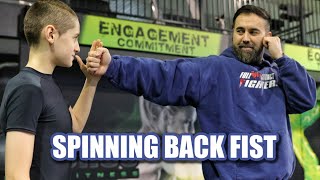
How To Do The Spinning Backfist | MMA
Danny Fung

Beginner's MMA Crash Course: Lesson 1 Basics
fightTIPS