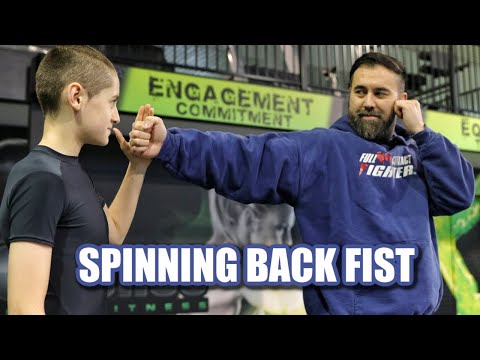
How to Do a Spinning Backfist Tutorial - Get That Flash KO!
0
Spinning Backfist·First Strike Athletics
Thank you for checking out this How to Do a Spinning Backfist Tutorial video. This is an advanced MMA technique with a l…
Translation: spinning backfist
The spinning backfist combines a full-body rotation with a backfist strike, generating centrifugal force through the spin. [1] While the basic backfist has ancient origins in karate, the spinning variant gained prominence in American sport karate competition in the 1970s and 1980s, where fighters like Joe Lewis and Chuck Norris demonstrated its effectiveness in point fighting. [1] In kickboxing, the spinning backfist was adopted as a power technique, and it later became a notable weapon in MMA, where fighters such as Shonie Carter (who knocked out Matt Serra at UFC 31 in 2001) demonstrated its fight-ending potential. [2]
The spinning backfist uses full body rotation to deliver a powerful backfist strike. [1]
From karate and kung fu; adopted into MMA and kickboxing. [1]
Has produced notable knockouts in MMA and kickboxing. [1]
No images yet for this technique.
Sign in to suggest an image.
Thank you for checking out this How to Do a Spinning Backfist Tutorial video. This is an advanced MMA technique with a l…
The Spinning Backfist can be used as an excellent offensive attack if used intelligently. In this video, I describe how …
No instructional courses yet for this technique.
Sign in to suggest a course.
Risk of injury to the person this technique is applied to
Spinning/standing backfist; metacarpal fracture risk to striker
Skill level needed to execute this technique reliably
Whether this technique is allowed under major competition rule sets
Karate-Do Kyohan: The Master Text (Gichin Funakoshi, 1935)
Alias sources — [1] Karate-Do Kyohan (Funakoshi, 1935) [2] Championship Fighting (Dempsey, 1950) [3] Kukkiwon Taekwondo Textbook (Kukkiwon, 2006)
History sources — [1] The Art of Striking (Blauer, 2004) [2] Ultimate MMA Conditioning (Jamieson, 2009)
Official karate technique names (和語/漢語)
Established Japanese martial arts naming convention — native Japanese term (和語/漢語)
Alias sources — [1] Karate-Do Kyohan (Funakoshi, 1935) [2] Championship Fighting (Dempsey, 1950) [3] Kukkiwon Taekwondo Textbook (Kukkiwon, 2006)
History sources — [1] The Art of Striking (Blauer, 2004) [2] Ultimate MMA Conditioning (Jamieson, 2009)
hand speed, hip rotation, wrist alignment on impact
proportional reach, strong wrists, fast-twitch shoulder muscles
deltoids, pectorals, triceps, core rotators, forearms
Every move, in any martial art, shares a few universal traits. Mix and match below to pinpoint the right tool — or compare equivalents across styles.
First Strike Athletics emphasizes that your heel placement is crucial—aim your heel at your target because that's where your power comes from. Step across with your lead foot, and keep your eyes on your opponent throughout the spin so you can see the target before you throw and adjust if they move or block.
Both approaches work, but First Strike Athletics explains the trade-off: following through gives you better angles and protection against counter-punches, while pulling back (by stepping your rear foot to create distance and framing) keeps you on an angle away from your opponent if the strike is blocked.
First Strike Athletics recommends throwing a rotational or angular attack from your lead side first—for example, a one-two combination—which loads up your rear hand and sets up the spinning backfist. Danny Fung also suggests feinting a body kick to hide your step and disguise the spinning backfist.
First Strike Athletics warns that if your arm is fully extended and gets blocked, your elbow can strike your partner's forearm, so keep your elbow protected. Always practice cleanly and not too hard, as the technique can do significant damage.
A backfist delivered after a full 360-degree spin of the body, using the rotational momentum to generate significant power through the back of the hand.
The spinning backfist combines a full-body rotation with a backfist strike, generating centrifugal force through the spin. While the basic backfist has ancient origins in karate, the spinning variant gained prominence in American sport karate competition in the 1970s and 1980s, where fighters like Joe Lewis and Chuck Norris demonstrated its effectiveness in point fighting.
Unified MMA: legal — Legal striking technique; WBC/Boxing: legal — Legal — punches are the core technique of boxing; WKF: legal — Legal, jodan/chudan punch scores 1 point (yuko) — controlled contact required; Kyokushin: restricted — Body punches legal at full power, head punches banned; WT: restricted — Punches to trunk only (1 point), punches to head banned; ITF: legal — Legal — hand techniques to head and body both permitted; WAKO: legal — Legal in Full Contact and Low Kick formats; K: legal — 1/GLORY — Legal — full power punches to head and body; IFMA: legal — Legal
Danger rating 5/10. High — spinning/standing backfist; metacarpal fracture risk to striker
The standard setup chain: Assume Fighting Stance → Generate Power → Execute Strike → Recover to Guard.
Standard counters include: Block — absorb the strike with a protective guard position / Evasion — move the target out of the strike's path / Counter-Attack — time an offensive response during the recovery phase of the strike.
Common variants: Standing backfist (snapping the back of the fist outward from a lead position); Spinning backfist (full rotation before striking with the back of the fist); Jumping spinning backfist (adding an airborne component for extra speed and power).
Has produced notable knockouts in MMA and kickboxing.
Top errors to watch for: Spinning without looking for the target — you become blind during the rotation and may miss entirely or get countered / Spinning too slowly, giving the opponent time to duck under or step back out of range / Throwing the spinning backfist from too far away so only the forearm or wrist connects, with no force / Not committing to the full rotation and stopping halfway, which leaves your back exposed.
The Spinning Backfist is also known as Kaiten Uraken, Uraken Uchi, Spinning Back Fist, Dwi Jireugi.