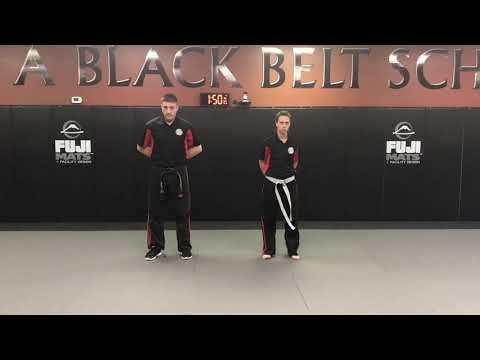
Krav Maga Strike Set # 1
0
Krav Maga Strike·Hendersonville Martial Arts
This is one of the Krav Maga rotations we cover in our Basic Training program at HMA. This video includes the Muay Thai…
Translation: Krav Maga strike
The Krav Maga Strike family covers striking techniques from the Israeli self-defence system designed specifically for real-world combat situations — emphasising maximum damage through gross motor movements that work under extreme stress with zero sporting restrictions. [1] Krav Maga strikes prioritise palm-heel strikes, hammer fists, eye gouges, throat strikes, groin kicks, and other techniques that target the body's most vulnerable areas — techniques that are illegal in every combat sport but essential for self-defence. [1],[2] The system was developed by Imi Lichtenfeld for the Israeli Defence Forces (IDF) and is designed to work for soldiers and civilians without extensive martial arts training, using natural body movements that function under the adrenaline dump and fine-motor-skill degradation of a real attack. [2],[3] Krav Maga striking philosophy is fundamentally different from sport striking: the goal is to neutralise the threat as quickly as possible through aggressive, pre-emptive attacks to vulnerable targets. [3]
Krav Maga was developed by Imi Lichtenfeld (1910–1998), a champion boxer, wrestler, and gymnast who developed street-fighting skills defending the Jewish community in Bratislava, Slovakia in the 1930s. [1] After emigrating to Israel (then Palestine) in 1942, Lichtenfeld was recruited to train the Haganah (Jewish paramilitary) and later the IDF in hand-to-hand combat, formalising his system into what became Krav Maga ('contact combat' in Hebrew). [1],[2] The system was adopted as the official combat system of the IDF and later adapted for civilian self-defence by Lichtenfeld and his students, spreading worldwide from the 1980s onward. [2],[3]
Krav Maga's effectiveness lies in its simplicity and its targeting of the body's most vulnerable areas — techniques that require minimal training to execute effectively in a self-defence scenario. [1] The system's effectiveness has been validated through decades of use by the IDF and Israeli security services in real combat situations. [2] However, Krav Maga techniques have not been tested under controlled sport competition conditions because they target illegal areas — their effectiveness against trained fighters in a sporting context is unproven and debated. [3]
No images yet for this technique.
Sign in to suggest an image.
This is one of the Krav Maga rotations we cover in our Basic Training program at HMA. This video includes the Muay Thai…
No instructional courses yet for this technique.
Sign in to suggest a course.
Risk of injury to the person this technique is applied to
Very high for the receiver — Krav Maga strikes target the body's most vulnerable areas (eyes, throat, groin, base of skull); many techniques can cause permanent injury or death; this is by design, as the system is intended for life-threatening situations, not sport
Skill level needed to execute this technique reliably
Whether this technique is allowed under major competition rule sets
Krav Maga: How to Defend Yourself Against Armed Assault (Imi Lichtenfeld & Eyal Yanilov, 2001)
Description sources — [1] Krav Maga: How to Defend Yourself (Lichtenfeld & Yanilov, 2001) [2] Complete Krav Maga (Levine & Whitman, 2007) [3] Krav Maga philosophy and training methodology
History sources — [1] Imi Lichtenfeld biography [2] IDF combat training history [3] Global spread of Krav Maga from 1980s
Description sources — [1] Krav Maga: How to Defend Yourself (Lichtenfeld & Yanilov, 2001) [2] Complete Krav Maga (Levine & Whitman, 2007) [3] Krav Maga philosophy and training methodology
History sources — [1] Imi Lichtenfeld biography [2] IDF combat training history [3] Global spread of Krav Maga from 1980s
aggression and willingness to commit to the counter-attack, basic coordination, mental toughness under stress
physically fit individuals (helps with burst attacks and escape), but the system is explicitly designed to work for people of all sizes and fitness levels
legs (kicking and bursting forward), core (power transfer), forearms (palm strikes and hammer fists), hip flexors (knee strikes)
Every move, in any martial art, shares a few universal traits. Mix and match below to pinpoint the right tool — or compare equivalents across styles.
The Krav Maga Eye Gouge is a close-range attack using the fingers or thumb to strike the eyes, used in life-threatening situations as a primary or secondary attack. [1]
The Krav Maga Groin Kick is a direct front kick to the groin delivered with maximum speed and minimal telegraphing, designed as a primary self-defence opening technique. [1]
The Krav Maga Hammer Fist delivers the bottom of the fist in a hammering motion, effective against various targets from multiple angles with minimal injury risk to the striker. [1]
The Krav Maga Palm Strike uses the heel of the palm to deliver a powerful strike to the face, chin, or nose, reducing the risk of hand injury compared to a closed fist. [1]
The Krav Maga Throat Strike targets the throat using the web of the hand between thumb and forefinger, potentially disabling the attacker's breathing. [1]
After striking, follow up with counter strikes, elbows, and clinches to neutralize the threat, then escape the situation. The goal is not just to strike, but to create an opening to get away safely.
Krav Maga strikes and counter strikes are used to clear chokes from multiple angles (front, behind, with push or pull variations), allowing you to neutralize the attacker and create space to escape.
The Krav Maga Strike family covers striking techniques from the Israeli self-defence system designed specifically for real-world combat situations — emphasising maximum damage through gross motor movements that work under extreme stress with zero sporting restrictions. Krav Maga strikes prioritise palm-heel strikes, hammer fists, eye gouges, throat strikes, groin kicks, and other techniques that target the body's most vulnerable areas — techniques that are illegal in every combat sport but essential for self-defence.
Krav Maga was developed by Imi Lichtenfeld (1910–1998), a champion boxer, wrestler, and gymnast who developed street-fighting skills defending the Jewish community in Bratislava, Slovakia in the 1930s. After emigrating to Israel (then Palestine) in 1942, Lichtenfeld was recruited to train the Haganah (Jewish paramilitary) and later the IDF in hand-to-hand combat, formalising his system into what became Krav Maga ('contact combat' in Hebrew).
Unified MMA: legal — Legal (palm strikes, slaps permitted); WBC/Boxing: banned — Only closed-fist punches permitted; WKF: restricted — Varies by technique — some open-hand strikes legal in kata, generally restric…; Kyokushin: banned — Only closed-fist strikes to body permitted; WT: banned — Prohibited; ITF: restricted — Some knife hand techniques legal; WAKO: banned — Closed fist only; K: banned — 1/GLORY — Closed fist only; IFMA: legal — Legal — palm strikes permitted in Muay Thai
Danger rating 8/10. Very high for the receiver — Krav Maga strikes target the body's most vulnerable areas (eyes, throat, groin, base of skull); many techniques can cause permanent injury or death; this is by design, as the system is intended for life-threatening situations, not sport
The standard setup chain: Recognise Threat → Burst Forward → Strike Primary Target → Continue (Retzev) → Scan → Escape.
Standard counters include: Krav Maga strikes are designed for self-defence against untrained attackers — against trained fighters, standard mart… / Distance — maintaining range prevents close-range Krav Maga strikes / Training — a trained fighter's superior timing and technique generally overcomes Krav Maga's gross motor approach / Wrestling/Grappling — taking the fight to the ground neutralises Krav Maga's standing strike emphasis.
Common variants: Palm-heel strike (the primary Krav Maga striking technique; driving the pal…); Hammer fist (downward strikes to the back of the neck, temple, or coll…); Eye strike (thumb gouge or finger strike to the eyes; a primary self-…); Throat strike (palm or web-of-hand strike to the trachea); Groin kick (straight kick or knee to the groin; the most commonly tau…); Headbutt (driving the forehead into the attacker's nose from close …); Knee to groin from clinch (a knee strike to the groin when grabbed or bear-hugged); Biting (considered a legitimate self-defence tool in Krav Maga fo…).
Krav Maga has no official competition record because it is a self-defence system, not a sport. Its techniques are illegal in all regulated combat sports.
Top errors to watch for: Using sport-fighting range and timing — Krav Maga is not boxing; the techniques are designed for sudden close-range a… / Holding back on training intensity — Krav Maga training must be realistic; half-speed practice doesn't prepare for re… / Neglecting the 'scan and assess' after counter-attacking — Krav Maga teaches checking for additional threats after th… / Attempting Krav Maga techniques in sport competition — these techniques are illegal in every sport and will result in….
The Krav Maga Strike is also known as Kuravu Maga Sutoraiku, Krav Maga Striking Technique, KM Strike, Israeli Combat Strike.