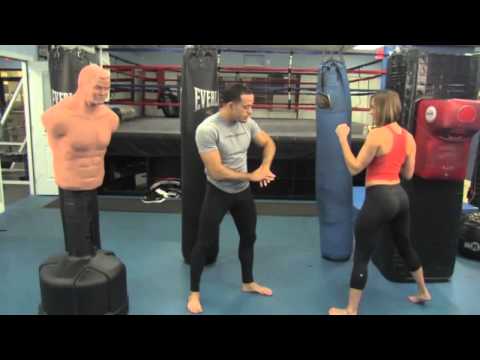
Knee Strike Techniques: Simple MMA Workout at Home
0
Standard Ground Knee Strike·weight loss motivation tips·Added by Admin
Check out http://www.FatLossUncut.com. Learn the proper knee strike techniques for your MMA workout at home. Do you kno…
Translation: standard ground knee strike
The standard ground knee strike is the basic execution of a knee delivered from a top position to a downed opponent's body or head (where legal). [1] This technique gained particular prominence in PRIDE Fighting Championships, where fighters like Mauricio 'Shogun' Rua used ground knees from side control and half-guard to devastating effect in bouts against Quinton Jackson (PRIDE Total Elimination 2005) and others. [2] The technique's inclusion or exclusion from rulesets has been one of the most debated topics in MMA regulation since the unified rules were first adopted in 2001. [1]
A standard ground knee technique. [1]
From MMA. [1]
Used in MMA. [1]
No images yet for this technique.
Sign in to suggest an image.
Check out http://www.FatLossUncut.com. Learn the proper knee strike techniques for your MMA workout at home. Do you kno…
No instructional courses yet for this technique.
Sign in to suggest a course.
Risk of injury to the person this technique is applied to
Knees from ground positions; legal in MMA ground-and-pound
Skill level needed to execute this technique reliably
Whether this technique is allowed under major competition rule sets
Muay Thai: The Art of Fighting (Yod Ruerngsa, Khun Kao Charuad & James Cartmell, 2002)
Alias sources — [1] Unified Rules of MMA (ABC, 2001) [2] MMA Instruction Manual (Shamrock, 2003) [3] Muay Thai Unleashed (Delp, 2006)
History sources — [1] Ultimate MMA Conditioning (Jamieson, 2009) [2] PRIDE Fighting Championships Official Rules (Dream Stage Entertainment, 2000)
Standard katakana transliteration of Western martial arts terminology (外来語) — used in Japanese MMA, boxing, and BJJ communities
Alias sources — [1] Unified Rules of MMA (ABC, 2001) [2] MMA Instruction Manual (Shamrock, 2003) [3] Muay Thai Unleashed (Delp, 2006)
History sources — [1] Ultimate MMA Conditioning (Jamieson, 2009) [2] PRIDE Fighting Championships Official Rules (Dream Stage Entertainment, 2000)
hip flexion power, clinch control ability, close-range comfort
long thigh for greater leverage, strong hip flexors
hip flexors, quadriceps, core, grip (for clinch)
You want to hit with the spear—the tip of the knee, the bony part. This ensures maximum effectiveness of the strike.
Step to open up your hips with your lead leg on the ball of your foot, turn out slightly to open the hips, and stay on the ball of your foot throughout. When you land, keep your heel off the ground so you can immediately follow up with another strike.
You want to fire the knee at a 45-degree angle, not straight ahead. Fire through with your hips rather than throwing upward.
Knees work synergistically with everything—you can use them off strikes like jabs and crosses, when defending against takedowns after a sprawl, or by pulling an opponent's head into the knee. They should be mixed into combinations of 2-4 strikes, alternating between left and right sides.
The fundamental ground knee strike delivered from side control or mount, driving the knee into the opponent's midsection or thigh using hip pressure and body weight.
The standard ground knee strike is the basic execution of a knee delivered from a top position to a downed opponent's body or head (where legal). This technique gained particular prominence in PRIDE Fighting Championships, where fighters like Mauricio 'Shogun' Rua used ground knees from side control and half-guard to devastating effect in bouts against Quinton Jackson (PRIDE Total Elimination 2005) and others.
Unified MMA: restricted — Knees to standing opponent legal, knees to head of grounded opponent banned; WBC/Boxing: banned — All knee strikes prohibited; WKF: banned — Prohibited in sport karate; Kyokushin: legal — Legal to body; WT: banned — Prohibited; ITF: banned — Prohibited; WAKO: banned — Prohibited in most formats; K: restricted — 1/GLORY — One clinch knee allowed before referee break; IFMA: legal — Legal — knees are a core Muay Thai weapon, clinch knees highly scored
Danger rating 6/10. High — knees from ground positions; legal in MMA ground-and-pound
The standard setup chain: Clinch or Frame → Pull Opponent In → Drive the Knee.
Standard counters include: Hip Check — push the opponent's hips away to create distance and kill the knee angle / Clinch Control — control the opponent's head and posture to prevent knee generation / Step Back — create distance to escape the knee's effective range.
Common variants: Straight knee (driving the knee straight upward into the body or head); Curved knee (round knee) (swinging the knee from the side in a circular path); Flying knee (leaping forward and driving the knee at the apex of the jump); Clinch knee (pulling the opponent into the knee from Muay Thai plum po…).
Used in MMA.
Top errors to watch for: Over-committing to the knee and rolling off the opponent or losing mount / Not stabilising with the hands before driving the knee — you need a base to deliver force downward / Kneeing too softly, which does not create any reaction and gives the opponent time to escape / Targeting protected areas like the opponent's curled arms or elbows.
The Standard Ground Knee Strike is also known as Guraundo Nī Sutoraiku (Kihon-gata), Standard Grounded Knee, Standard Ground Knee Strike, Kneeling Knee Strike.