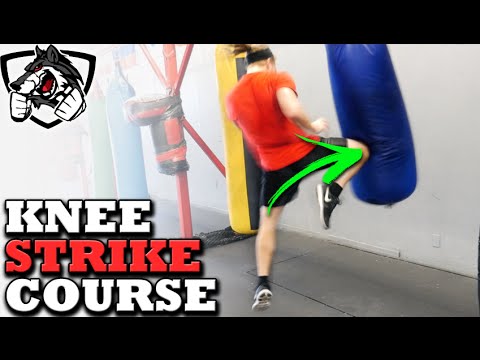
Comprehensive Guide to Throwing Knee Strikes in Muay Thai
0
Standard Ground Knee·fightTIPS
Get the full video►http://bit.ly/1FIOiju Comprehensive Elbow Guide►https://youtu.be/kjfC4Pr5trw After many requests, the…
Translation: standard ground knee
The standard ground knee subfamily represents the most common form of knee strike delivered to a grounded opponent, typically from a top position such as side control or mount. [1] Ground knee strikes have been a contested element of combat sports rulemaking since the early UFC era (1993 onward), with organisations adopting varying rules about their legality. [1] In the Japanese PRIDE Fighting Championships (1997-2007), ground knees to the head were legal and became a signature tactic of fighters such as Wanderlei Silva and Mauricio Rua. [2]
Standard ground knee strike. [1]
From MMA. [1]
Used in MMA. [1]
No images yet for this technique.
Sign in to suggest an image.
Get the full video►http://bit.ly/1FIOiju Comprehensive Elbow Guide►https://youtu.be/kjfC4Pr5trw After many requests, the…
No instructional courses yet for this technique.
Sign in to suggest a course.
Risk of injury to the person this technique is applied to
Knees from ground positions; legal in MMA ground-and-pound
Skill level needed to execute this technique reliably
Whether this technique is allowed under major competition rule sets
Muay Thai: The Art of Fighting (Yod Ruerngsa, Khun Kao Charuad & James Cartmell, 2002)
Alias sources — [1] Unified Rules of MMA (ABC, 2001) [2] MMA Instruction Manual (Shamrock, 2003) [3] Muay Thai Unleashed (Delp, 2006)
History sources — [1] Ultimate MMA Conditioning (Jamieson, 2009) [2] PRIDE Fighting Championships Official Rules (Dream Stage Entertainment, 2000)
Standard katakana transliteration of Western martial arts terminology (外来語) — used in Japanese MMA, boxing, and BJJ communities
Alias sources — [1] Unified Rules of MMA (ABC, 2001) [2] MMA Instruction Manual (Shamrock, 2003) [3] Muay Thai Unleashed (Delp, 2006)
History sources — [1] Ultimate MMA Conditioning (Jamieson, 2009) [2] PRIDE Fighting Championships Official Rules (Dream Stage Entertainment, 2000)
hip flexion power, clinch control ability, close-range comfort
long thigh for greater leverage, strong hip flexors
hip flexors, quadriceps, core, grip (for clinch)
Every move, in any martial art, shares a few universal traits. Mix and match below to pinpoint the right tool — or compare equivalents across styles.
You should strike with the kneecap, the top of the tibia, or the bottom of the femur. According to fightTIPS, bringing your heel all the way up to your butt ensures proper contact with these striking surfaces.
FightTIPS recommends leaning your upper body back while driving your hips forward and turning the knee over, which gives you extra pop in your hips and extra distance.
Yes—fightTIPS highlights that short knee strikes can be devastating if they target vital areas like the liver, as demonstrated by Giorgio Petrojan dropping Andy Sauer with a simple, very short left knee.
A knee strike delivered from a dominant top position on the ground, using body weight and hip drive to strike a downed opponent's body or head.
The standard ground knee subfamily represents the most common form of knee strike delivered to a grounded opponent, typically from a top position such as side control or mount. Ground knee strikes have been a contested element of combat sports rulemaking since the early UFC era (1993 onward), with organisations adopting varying rules about their legality.
Unified MMA: restricted — Knees to standing opponent legal, knees to head of grounded opponent banned; WBC/Boxing: banned — All knee strikes prohibited; WKF: banned — Prohibited in sport karate; Kyokushin: legal — Legal to body; WT: banned — Prohibited; ITF: banned — Prohibited; WAKO: banned — Prohibited in most formats; K: restricted — 1/GLORY — One clinch knee allowed before referee break; IFMA: legal — Legal — knees are a core Muay Thai weapon, clinch knees highly scored
Danger rating 6/10. High — knees from ground positions; legal in MMA ground-and-pound
The standard setup chain: Clinch or Frame → Pull Opponent In → Drive the Knee.
Standard counters include: Hip Check — push the opponent's hips away to create distance and kill the knee angle / Clinch Control — control the opponent's head and posture to prevent knee generation / Step Back — create distance to escape the knee's effective range.
Common variants: Straight knee (driving the knee straight upward into the body or head); Curved knee (round knee) (swinging the knee from the side in a circular path); Flying knee (leaping forward and driving the knee at the apex of the jump); Clinch knee (pulling the opponent into the knee from Muay Thai plum po…).
Used in MMA.
Top errors to watch for: Sacrificing positional control to throw knees — position is more valuable than a single ground strike / Rising up too much and creating space for the opponent to escape or reguard / Kneeing the hip bone or elbow, which hurts the kicker / Not controlling the opponent's movement — they shrimp away during the knee.
The Standard Ground Knee is also known as Sutandādo Guraundo Nī, Ground-and-Pound Knee, Grounded Knee Strike, Kneeling Knee.