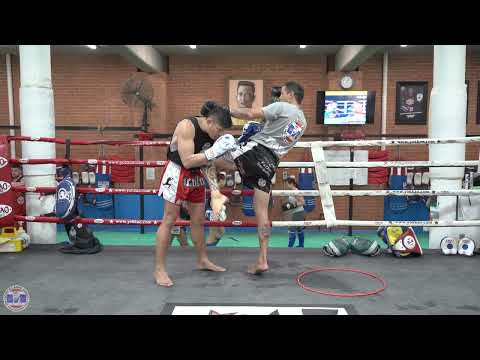
KHAO CHIANG - 45 ANGLE KNEE
0
Standard Khao Loi·Thai Boxing Online·Added by Admin
Knee strikes are one of the most lethal and important weapons of Muay Thai. A well-placed knee strike to the right area …
Translation: standard flying knee
The standard Khao Loi represents the classical Muay Thai execution of the flying knee, where the fighter steps or hops forward and launches off one or both feet to drive the lead knee upward into the opponent. [1] Kraitus and Rennehan describe this as the orthodox form taught in Thai training camps, where the technique is drilled on heavy bags and with pad holders from an early age. [1] The standard version prioritises height and forward momentum, aiming to connect the kneecap with the opponent's chin, sternum, or solar plexus at the peak of the jump. [2] This execution was famously demonstrated in Thai stadium bouts throughout the 20th century. [1]
The flying knee is a traditional Muay Thai technique that has been part of the art's competitive arsenal for generations, frequently featured in wai kru (pre-fight ritual) demonstrations. [1]
The flying knee is one of the most dramatic knockout techniques in both Muay Thai and MMA. [1] Jorge Masvidal's five-second flying knee knockout of Ben Askren at UFC 239 (2019) set the record for the fastest knockout in UFC history. [2] In ONE Championship, Stamp Fairtex has used flying knees effectively in her Muay Thai bouts. [1]
No images yet for this technique.
Sign in to suggest an image.
Knee strikes are one of the most lethal and important weapons of Muay Thai. A well-placed knee strike to the right area …
No instructional courses yet for this technique.
Sign in to suggest a course.
Risk of injury to the person this technique is applied to
Airborne knee strike; devastating KO potential (numerous UFC finishes)
Skill level needed to execute this technique reliably
Whether this technique is allowed under major competition rule sets
Muay Thai: The Art of Fighting (Yod Ruerngsa, Khun Kao Charuad & James Cartmell, 2002)
Alias sources — [1] Muay Thai Unleashed (Delp, 2006) [2] Muay Thai: The Art of Fighting (Kraitus & Kraitus, 1988) [3] Dynamic Karate (Nakayama, 1966)
Effectiveness sources — [1] Muay Thai: The Art of Fighting (Kraitus & Kraitus, 1988)
Standard katakana transliteration of Western martial arts terminology (外来語) — used in Japanese MMA, boxing, and BJJ communities
Alias sources — [1] Muay Thai Unleashed (Delp, 2006) [2] Muay Thai: The Art of Fighting (Kraitus & Kraitus, 1988) [3] Dynamic Karate (Nakayama, 1966)
Effectiveness sources — [1] Muay Thai: The Art of Fighting (Kraitus & Kraitus, 1988)
hip flexion power, clinch control ability, close-range comfort
long thigh for greater leverage, strong hip flexors
hip flexors, quadriceps, core, grip (for clinch)
The angle knee is struck at a 45-degree angle rather than straight up, with your heel out and your weight on your toe. Thai Boxing Online emphasizes that this angled position is crucial—you don't want the knee to be straight up like a regular knee strike.
You need to bend your leg as much as you can during the strike rather than extending it fully straight, which gives your opponent an opportunity to catch and hold your leg. Thai Boxing Online stresses keeping a slight bend so your opponent can't secure a grip.
Step forward with the opposite leg from the knee you're throwing—for example, step with your left leg forward when throwing a right knee. Thai Boxing Online teaches alternating sides: step and deliver with one side, then switch and repeat with the other leg.
Your hand can swing down naturally during the strike, and keeping your shoulder high is important for proper form. Thai Boxing Online shows that while your hands can be involved, the focus should remain on the angled leg position and range.
The fundamental flying knee executed by explosively pushing off the ground, driving one knee upward while pulling the opponent's head down with the hands to maximize impact.
The standard Khao Loi represents the classical Muay Thai execution of the flying knee, where the fighter steps or hops forward and launches off one or both feet to drive the lead knee upward into the opponent. Kraitus and Rennehan describe this as the orthodox form taught in Thai training camps, where the technique is drilled on heavy bags and with pad holders from an early age.
Unified MMA: restricted — Knees to standing opponent legal, knees to head of grounded opponent banned; WBC/Boxing: banned — All knee strikes prohibited; WKF: banned — Prohibited in sport karate; Kyokushin: legal — Legal to body; WT: banned — Prohibited; ITF: banned — Prohibited; WAKO: banned — Prohibited in most formats; K: restricted — 1/GLORY — One clinch knee allowed before referee break; IFMA: legal — Legal — knees are a core Muay Thai weapon, clinch knees highly scored
Danger rating 8/10. Very High — airborne knee strike; devastating KO potential (numerous UFC finishes)
The standard setup chain: Assume Fighting Stance → Generate Power → Execute Strike → Recover to Guard.
Standard counters include: Block — absorb the strike with a protective guard position / Evasion — move the target out of the strike's path / Counter-Attack — time an offensive response during the recovery phase of the strike.
Common variants: Straight knee (driving the knee straight upward into the body or head); Curved knee (round knee) (swinging the knee from the side in a circular path); Flying knee (leaping forward and driving the knee at the apex of the jump); Clinch knee (pulling the opponent into the knee from Muay Thai plum po…).
The flying knee is one of the most dramatic knockout techniques in both Muay Thai and MMA. Jorge Masvidal's five-second flying knee knockout of Ben Askren at UFC 239 (2019) set the record for the fastest knockout in UFC history.
Top errors to watch for: Leaping without the push-back setup — the opponent must be moving backward for the flying knee to track them / Not driving the hip through the knee at the peak of the jump — the knee must thrust forward, not just rise / Releasing the head grip too early and not pulling the opponent into the impact / Landing on both feet simultaneously, which is unstable and prevents follow-up.
The Standard Khao Loi is also known as Sutandādo Kao Roi, Standard Flying Knee, Standard Jumping Knee, Tobi Hiza Geri.