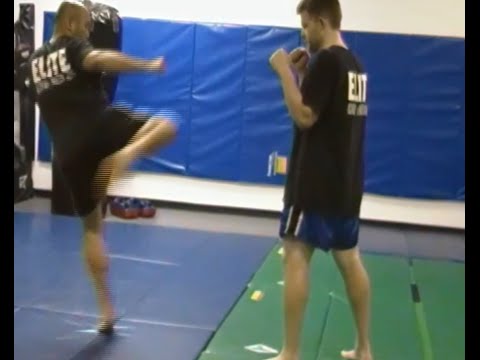
Muay Thai - Diagonal Knee Setup
0
Diagonal Knee·Elite Academy of Martial Arts, GA
I show how to setup the diagonal knee in Muay Thai. Website: http://eliteacademyofmartialarts.com/ Facebook: https://ww…
Translation: diagonal knee
The diagonal knee subfamily represents a category of angled knee strikes delivered on a 45-degree trajectory, a hallmark of Thai clinch fighting. [1] Delp documents the diagonal knee as a staple of Muay Thai clinch work, noting that the angled trajectory makes it effective at striking the ribcage even when an opponent is squared up in the clinch. [2] The technique has been a standard component of Muay Thai training since the formalisation of stadium rules at Rajadamnern (est. 1945) and Lumpinee (est. 1956). [1]
The diagonal knee strikes at an upward angle to the body or head. [1]
From Muay Thai's khao chiang. [1]
Used in Muay Thai and MMA. [1]
No images yet for this technique.
Sign in to suggest an image.
I show how to setup the diagonal knee in Muay Thai. Website: http://eliteacademyofmartialarts.com/ Facebook: https://ww…
No instructional courses yet for this technique.
Sign in to suggest a course.
Risk of injury to the person this technique is applied to
Muay Thai khao khong; diagonal knee to ribs/thigh
Skill level needed to execute this technique reliably
Whether this technique is allowed under major competition rule sets
Muay Thai: The Art of Fighting (Yod Ruerngsa, Khun Kao Charuad & James Cartmell, 2002)
Alias sources — [1] Muay Thai: The Art of Fighting (Kraitus & Kraitus, 1988) [2] Muay Thai Unleashed (Delp, 2006) [3] WBC Muay Thai Rules (2014)
History sources — [1] Muay Thai: The Art of Fighting (Kraitus & Rennehan, 2002) [2] Muay Thai Unleashed (Delp, 2006)
Official karate technique names (和語/漢語)
Established Japanese martial arts naming convention — native Japanese term (和語/漢語)
Alias sources — [1] Muay Thai: The Art of Fighting (Kraitus & Kraitus, 1988) [2] Muay Thai Unleashed (Delp, 2006) [3] WBC Muay Thai Rules (2014)
History sources — [1] Muay Thai: The Art of Fighting (Kraitus & Rennehan, 2002) [2] Muay Thai Unleashed (Delp, 2006)
hip flexion power, clinch control ability, close-range comfort
long thigh for greater leverage, strong hip flexors
hip flexors, quadriceps, core, grip (for clinch)
Every move, in any martial art, shares a few universal traits. Mix and match below to pinpoint the right tool — or compare equivalents across styles.
Keep the knee clean by not extending the leg—instead, focus on the lift and pivot motion before firing the diagonal knee. Elite Academy of Martial Arts emphasizes this economy of movement to maintain control and power.
Use strikes like jabs, hooks, kicks, or inside kicks to provoke a reaction from your opponent, then grab them to set up the clinch for the diagonal knee. Elite Academy of Martial Arts teaches that you need to initiate engagement if your opponent is staying back defensively.
Grab the opponent's hand and pull that side down while climbing in, making sure to control the other hand so you don't get hit. Elite Academy of Martial Arts stresses controlling both hands while already closing distance as your opponent punches.
A knee strike driven upward at a diagonal angle, targeting the ribs, floating ribs, or side of the body from within the clinch or at close range.
The diagonal knee subfamily represents a category of angled knee strikes delivered on a 45-degree trajectory, a hallmark of Thai clinch fighting. Delp documents the diagonal knee as a staple of Muay Thai clinch work, noting that the angled trajectory makes it effective at striking the ribcage even when an opponent is squared up in the clinch.
Unified MMA: restricted — Knees to standing opponent legal, knees to head of grounded opponent banned; WBC/Boxing: banned — All knee strikes prohibited; WKF: banned — Prohibited in sport karate; Kyokushin: legal — Legal to body; WT: banned — Prohibited; ITF: banned — Prohibited; WAKO: banned — Prohibited in most formats; K: restricted — 1/GLORY — One clinch knee allowed before referee break; IFMA: legal — Legal — knees are a core Muay Thai weapon, clinch knees highly scored
Danger rating 7/10. Very High — Muay Thai khao khong; diagonal knee to ribs/thigh
The standard setup chain: Clinch or Frame → Pull Opponent In → Drive the Knee.
Standard counters include: Hip Check — push the opponent's hips away to create distance and kill the knee angle / Clinch Control — control the opponent's head and posture to prevent knee generation / Step Back — create distance to escape the knee's effective range.
Common variants: Straight knee (driving the knee straight upward into the body or head); Curved knee (round knee) (swinging the knee from the side in a circular path); Flying knee (leaping forward and driving the knee at the apex of the jump); Clinch knee (pulling the opponent into the knee from Muay Thai plum po…).
Used in Muay Thai and MMA.
Top errors to watch for: Throwing the knee straight up and calling it diagonal — the hip must actually rotate to create the angle / Not driving through the target — the diagonal knee must penetrate, not just touch / Hitting the opponent's elbow with the kneecap — painful and potentially injurious to the kicker / Losing clinch control while adjusting the angle.
The Diagonal Knee is also known as Naname Hiza-geri, Khao Chiang, Oblique Knee, Angled Knee Strike.