Setup and Entry
The instructor demonstrates a three-punch combination (jab, cross, hook) followed by a tight elbow cover on the third count. Upon the third punch, the attacker steps in to catch and parry, executing a tight elbow cover before immediately securing a clinch by grabbing with one arm at a time.
Diagonal Knee Mechanics
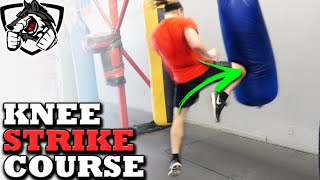
Upon establishing the clinch, the opponent typically expects a straight knee and tightens their defense accordingly. The diagonal knee exploits this expectation by striking at an angled trajectory toward the opponent's side. The technique is executed by lifting and pivoting the hips similarly to a diagonal kick, but keeping the toes back to strike with the knee rather than extending the leg.
Straight vs. Diagonal Strategy
The attacker may throw a straight knee first to determine the opponent's blocking position, then immediately follow with a diagonal knee that arrives at an unexpected angle. The diagonal knee proves effective because it bypasses the opponent's centered defense, similar to how a hook punch travels around straight punch defenses.
Diagonal vs. Curve Knee Comparison
The diagonal knee differs from a curve knee in both strength and range. While the curve knee is executed in close quarters and provides less power, the diagonal knee requires space and generates greater force while still arriving at an angled approach. The diagonal technique is superior when distance allows for a proper pivot.
Hip Mechanics and Pivoting
The key to executing the diagonal knee is maintaining proper hip lift and pivot, identical to the mechanics of a roundhouse kick. The striker lifts the knee while pivoting the base leg, keeping the striking leg clean and compact rather than extending it, allowing the knee to travel at the diagonal angle.
Stair Climber Entry Sequence
When an opponent avoids engagement, the attacker uses a four-step entry called the 'stair climber': (1) initiating with a kick or strike to provoke reaction, (2) hand-checking the opponent's front arm, (3) controlling the near-side arm by pulling downward, and (4) climbing the second arm to the head while securing the clinch position.
Arm Control and Pulling Mechanics
When the attacker pulls the opponent's front arm downward, the opponent's natural instinct to flex and resist creates inward momentum, drawing them closer. Simultaneously, the attacker controls the opposite arm to prevent counterattacks, establishing a secure clinch position. This mechanical advantage uses the opponent's own defensive response as a setup for entry.
Target Areas and Follow-Through
Once the clinch is secured, the attacker fires the diagonal knee toward the opponent's chest or sternum area between the arms, rather than targeting a centerline the opponent is actively defending. If the opponent successfully blocks a straight knee, the attacker immediately pivots to deliver the diagonal strike. The technique concludes with an elbow strike or pushing the opponent away to reset.
Muay Thai - Diagonal Knee Setup
Key Takeaways
- •Setup and Entry
- •Diagonal Knee Mechanics
- •Straight vs. Diagonal Strategy
- •Diagonal vs. Curve Knee Comparison
I show how to setup the diagonal knee in Muay Thai. Website: http://eliteacademyofmartialarts.com/ Facebook: https://www.facebook.com/EliteAcademyOfMartialArts?ref=hl
Related Techniques
Frequently Asked Questions
What does this video teach about diagonal knee?
This video covers setup and entry, diagonal knee mechanics, straight vs. diagonal strategy. It provides detailed instruction from Elite Academy of Martial Arts, GA.
How long does it take to learn diagonal knee?
The basic mechanics can be understood in a single session, but developing reliable execution requires consistent drilling over weeks of practice. This 8-part breakdown helps structure your training by isolating each phase of the technique.
What are the key details for finishing diagonal knee?
When the attacker pulls the opponent's front arm downward, the opponent's natural instinct to flex and resist creates inward momentum, drawing them closer. Simultaneously, the attacker controls the opposite arm to prevent counterattacks, establishing a secure clinch position. This mechanical advantage uses the opponent's own defensive response as a setup for entry.