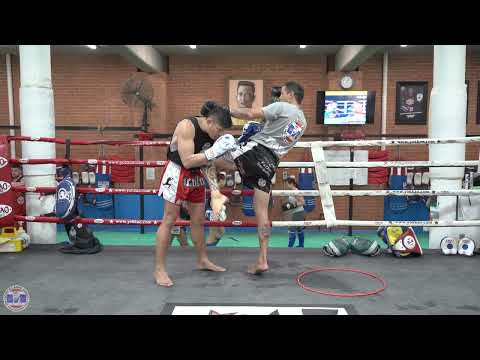
KHAO CHIANG - 45 ANGLE KNEE
0
Khao Chiang·Thai Boxing Online
Knee strikes are one of the most lethal and important weapons of Muay Thai. A well-placed knee strike to the right area …
Translation: diagonal knee
Khao Chiang (เข่าเฉียง), the diagonal knee, is a traditional Muay Thai technique whose Thai name translates literally to 'slanting knee.' [1] Kraitus and Rennehan describe it as one of the fundamental khao (knee) weapons in the Muay Thai arsenal, used primarily from the clinch to attack the opponent's floating ribs at a diagonal angle. [1] Delp documents Khao Chiang as a technique developed through generations of Thai stadium fighters who refined the precise 45-degree angle to maximise impact on the ribcage while maintaining clinch control. [2] The technique gained international prominence as Muay Thai spread globally in the 1970s-1990s. [2]
Khao chiang (diagonal knee) strikes upward at an angle. [1]
A traditional Muay Thai knee. [1]
Used in Muay Thai. [1]
No images yet for this technique.
Sign in to suggest an image.
Knee strikes are one of the most lethal and important weapons of Muay Thai. A well-placed knee strike to the right area …
No instructional courses yet for this technique.
Sign in to suggest a course.
Risk of injury to the person this technique is applied to
Muay Thai khao khong; diagonal knee to ribs/thigh
Skill level needed to execute this technique reliably
Whether this technique is allowed under major competition rule sets
Muay Thai: The Art of Fighting (Yod Ruerngsa, Khun Kao Charuad & James Cartmell, 2002)
Alias sources — [1] Muay Thai Unleashed (Delp, 2006) [2] Muay Thai: The Art of Fighting (Kraitus & Kraitus, 1988) [3] Muay Thai: A Living Legacy (Vail, 2014)
History sources — [1] Muay Thai: The Art of Fighting (Kraitus & Rennehan, 2002) [2] Muay Thai Unleashed (Delp, 2006)
Standard katakana transliteration of Western martial arts terminology (外来語) — used in Japanese MMA, boxing, and BJJ communities
Alias sources — [1] Muay Thai Unleashed (Delp, 2006) [2] Muay Thai: The Art of Fighting (Kraitus & Kraitus, 1988) [3] Muay Thai: A Living Legacy (Vail, 2014)
History sources — [1] Muay Thai: The Art of Fighting (Kraitus & Rennehan, 2002) [2] Muay Thai Unleashed (Delp, 2006)
hip flexion power, clinch control ability, close-range comfort
long thigh for greater leverage, strong hip flexors
hip flexors, quadriceps, core, grip (for clinch)
No, the khao chiang is a long-range knee strike that doesn't require grabbing. Thai Boxing Online emphasizes that you simply step forward and deliver the angled knee while maintaining your stance.
You should bend your leg as much as possible to prevent your opponent from catching and holding your leg. Thai Boxing Online stresses this bending is critical for keeping your leg safe from being controlled.
Step forward with the opposite leg of the knee you're striking with—if throwing a right knee, step with your left leg forward, then bring the knee back to your stance. Practice both sides alternating to develop balance.
A Muay Thai diagonal knee strike driven upward and inward at a 45-degree angle, targeting the opponent's ribcage from the side while controlling the clinch.
Khao Chiang (เข่าเฉียง), the diagonal knee, is a traditional Muay Thai technique whose Thai name translates literally to 'slanting knee. ' Kraitus and Rennehan describe it as one of the fundamental khao (knee) weapons in the Muay Thai arsenal, used primarily from the clinch to attack the opponent's floating ribs at a diagonal angle.
Unified MMA: restricted — Knees to standing opponent legal, knees to head of grounded opponent banned; WBC/Boxing: banned — All knee strikes prohibited; WKF: banned — Prohibited in sport karate; Kyokushin: legal — Legal to body; WT: banned — Prohibited; ITF: banned — Prohibited; WAKO: banned — Prohibited in most formats; K: restricted — 1/GLORY — One clinch knee allowed before referee break; IFMA: legal — Legal — knees are a core Muay Thai weapon, clinch knees highly scored
Danger rating 7/10. Very High — Muay Thai khao khong; diagonal knee to ribs/thigh
The standard setup chain: Assume Fighting Stance → Generate Power → Execute Strike → Recover to Guard.
Standard counters include: Block — absorb the strike with a protective guard position / Evasion — move the target out of the strike's path / Counter-Attack — time an offensive response during the recovery phase of the strike.
Common variants: Straight knee (driving the knee straight upward into the body or head); Curved knee (round knee) (swinging the knee from the side in a circular path); Flying knee (leaping forward and driving the knee at the apex of the jump); Clinch knee (pulling the opponent into the knee from Muay Thai plum po…).
Used in Muay Thai.
Top errors to watch for: Not rotating the hip to create the diagonal angle — it becomes a standard straight knee / Hitting the elbow or forearm because the angle was not sharp enough to go around the guard / Not pulling the opponent's head to the opposite side — the head pull opens the target area / Losing clinch control during the rotational setup.
The Khao Chiang is also known as Kao Chian, Diagonal Knee, Slanting Knee, Oblique Knee Strike.