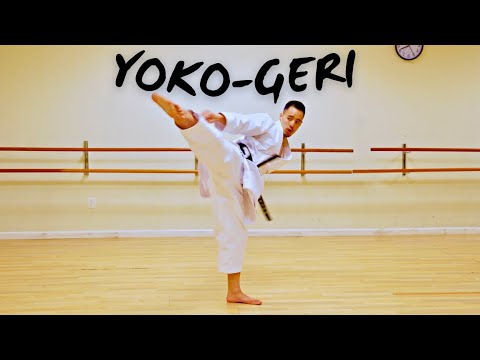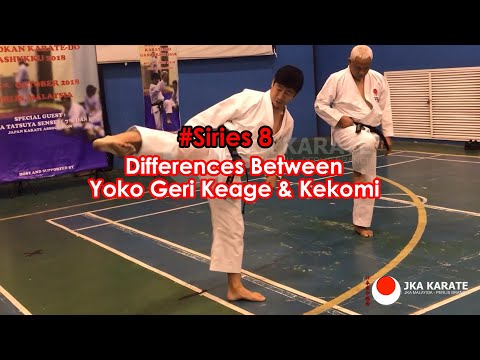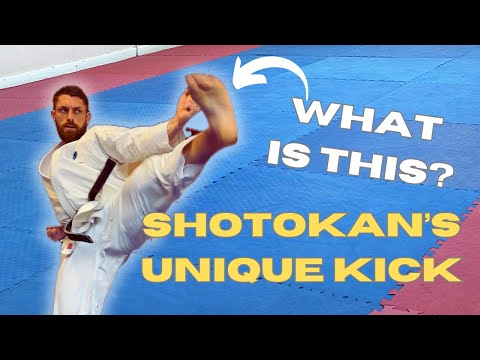
How to Use this Unique Shotokan Karate Kick - “Yoko Geri Keage”
0
Yoko Keage·John Gardiner
#karate #martialarts #shotokan #tips #kicks #coaching #training 🔥Art Martial Clothing - use code “CLUB20” for a 20% d…
Translation: side snap kick (rising)
Yoko Keage is the rising/snapping side kick in karate — the leg swings upward laterally in a snapping arc, striking with the edge of the foot (sokuto) and retracting quickly. [1] Unlike the thrusting side kick (yoko kekomi) which drives through the target horizontally, keage rises upward into the target from below. [1] It is one of the two fundamental side kick forms in traditional karate (keage/snap and kekomi/thrust). [1]
Documented in traditional karate manuals. [1]
Primarily a training, demonstration, and point-fighting technique. Rarely seen in full-contact MMA or kickboxing due to acrobatic risk and telegraphing. Appears occasionally in TKD and point-fighting karate tournaments. [1]
No images yet for this technique.
Sign in to suggest an image.
#karate #martialarts #shotokan #tips #kicks #coaching #training 🔥Art Martial Clothing - use code “CLUB20” for a 20% d…
Yoko Geri Keage & Yoko Geri Kekomi (Karate Tutorial) | by Jason Leung, 4th Dan Shotokan Today we are learning how to do …
Hi Subscriber This coming video, to describe the different of yoko geri keage and kekomi. and its also how to improve …
Yoko Keage (side snap kick) is a distinctive rising kick taught predominantly in Shotokan karate, executed from a chambered position with the knee raised to the side and the foot drawn in with the sole facing laterally. According to Ultimate Karate, the technique follows a four-phase sequence: chamber (up), extension (out), retraction (back), and repositioning (down), using glute activation to drive the strike with the blade of the foot in a straight vertical line rather than a swinging arc characteristic of mawashi geri. John Gardiner emphasizes that Yoko Keage differs from side thrust kick (Keikomi) in both biomechanics and application: the former angles the body and knee at approximately 45 degrees to the frontal plane, targeting low areas such as the groin and inner thigh as a setup technique to generate opponent reaction for follow-up elbow strikes, rather than as a power-generation kick. Gardiner notes the contact point is the outside edge and top of the foot, with minimal hip penetration compared to thrust variations. JKA Karate Club Perlis Malaysia contributes emphasis on proper body mechanics, particularly the importance of touching the body during chambering to engage full bodyweight rather than relying solely on arm weight, and stresses the distinction between weak and strong execution. All three instructors agree the technique requires significant practice and precision, with Ultimate Karate cautioning against viewing it as natural movement and recommending visualization of solid targets during practice to develop proper impact mechanics.
Synthesized from 3 instructors
No instructional courses yet for this technique.
Sign in to suggest a course.
Risk of injury to the person this technique is applied to
Rising snap has less power than thrust but targets vulnerable areas.
Skill level needed to execute this technique reliably
Whether this technique is allowed under major competition rule sets
Oyama, M. This Is Karate / Essentials of Karate.
[1] Oyama / Funakoshi, Karate technique manuals
Official karate technique names (和語/漢語)
Established Japanese martial arts naming convention — native Japanese term (和語/漢語)
[1] Oyama / Funakoshi, Karate technique manuals
hip flexibility for high lateral chamber, balance on supporting leg
long legs, flexible hip adductors
hip abductors (lift), quadriceps (snap extension), core stabilizers (balance), gluteus medius (hip control)
Yoko keage (side snap kick) is the snapping variant of the side kick — the foot travels vertically upward to snap into the armpit, chin, or floating ribs. Combined with yoko kekomi (thrust), it forms the complete karate side kick system. (Nakayama, Dynamic Karate; De Bremaeker & Faige, Essential Book of Martial Arts Kicks)
Chamber by raising your knee out to the side with the flat of your foot pointed to the side—you don't need to go directly perpendicular, just raise the knee with the intention of going sideways. Your foot should be drawn in with the sole facing outward, according to Ultimate Karate.
Your leg should come up in a straight line and go down in a straight line, not swing around the way a roundhouse kick does. Ultimate Karate emphasizes visualizing a wall or door in front of you—if the kick becomes circular like a roundhouse, you won't penetrate through the target.
According to John Gardiner, yoko keage is traditionally aimed at low targets including the groin, inside of the thigh, and hip joint, as classical karate doesn't rely on high kicks. The same hip-pop action can be adapted to head height for close-range fighting by angling the knee toward the target.
John Gardiner recommends starting from a natural stance and turning your feet about 45 degrees—this small angle is key to the technique, as the full side-kick foot position is not ideal for yoko keage. You can also start with one leg back to generate torque from your hip flexors, according to Ultimate Karate.
When people try to make yoko keage extremely high in competition, the kick mechanics break down and it becomes more like a mawashi geri (roundhouse kick) because the setup isn't designed for that height, according to John Gardiner. This undermines the technique's original purpose.
Yoko Keage is the rising/snapping side kick in karate — the leg swings upward laterally in a snapping arc, striking with the edge of the foot (sokuto) and retracting quickly. Unlike the thrusting side kick (yoko kekomi) which drives through the target horizontally, keage rises upward into the target from below.
Documented in traditional karate manuals.
WKF Karate: Legal: legal — controlled contact; Unified MMA: Legal {src:Unified Rules of MMA, August 2025|/sources/Unified: legal — MMA-Rules-August-2025.pdf}; WAKO Kickboxing: Legal {src:WAKO Full Contact Rules|/sources/WAKO: legal — Full-Contact-Rules.pdf}
Danger rating 5/10. Moderate — rising snap has less power than thrust but targets vulnerable areas.
The standard setup chain: Kizami-zuki (jab) → draw opponent's guard up → yoko keage to exposed armpit → Step into opponent's range → front leg yoko keage snap to chin → Block mawashi geri → immediate yoko keage to opponent's ribs while their leg returns.
Standard counters include: Catch the leg — grab the snapping kick before it retracts / Step back — the snapping motion has limited range / Low kick counter — attack the standing leg as the kicking leg lifts.
Common variants: Jodan yoko keage (rising to the head/face); Chudan yoko keage (rising to the ribs/armpit); Gedan yoko keage (rising to the inner thigh).
Primarily a training, demonstration, and point-fighting technique. Rarely seen in full-contact MMA or kickboxing due to acrobatic risk and telegraphing.
Top errors to watch for: Kicking with the flat of the foot instead of the edge — loses cutting effect / Not retracting — leaves the leg exposed / Pushing instead of snapping — that's kekomi, not keage / Not turning the foot properly — incorrect striking surface.
The Yoko Keage is also known as Yoko Keage, Yoko-Keage, Side Snap Rising Kick, Rising Side Kick, Side Keage.