How To JKD Side Kick | Core JKD Sidekick Training
0
Oblique Back Side Kick·corejkd
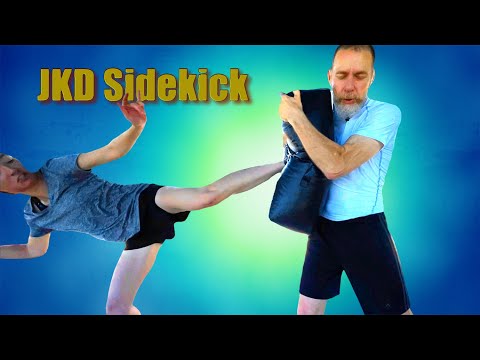
Ming delivers the details on a successful, powerful JKD sidekick - and the Core JKD short range side kick. Highlighting …
Translation: Oblique back side kick
The Oblique Back Side Kick is delivered diagonally backward at approximately 45 degrees, combining the mechanics of a back kick with the thrusting trajectory of a side kick. [1] This angle is optimal for reaching opponents who have moved to the practitioner's rear quarter, a position too far back for a standard side kick but not directly behind for a back kick. [1] The oblique angle provides both reach and power while maintaining reasonable balance. [1]
The Oblique Back Side Kick offers tactical advantages in specific situations where a standard side kick would be less effective. [1]
Cross-style martial arts kicking tradition. [1]
Primarily a training, demonstration, and point-fighting technique. Rarely seen in full-contact MMA or kickboxing due to acrobatic risk and telegraphing. Appears occasionally in TKD and point-fighting karate tournaments. [1]
No images yet for this technique.
Sign in to suggest an image.
Ming delivers the details on a successful, powerful JKD sidekick - and the Core JKD short range side kick. Highlighting …
If you want to learn to do something right, it is best to learn from the best in the business. When it comes to kicking,…
The oblique back side kick combines linear pathway efficiency with deceptive setup mechanics. Core JKD emphasizes maintaining a straight line to target by crossing the centerline and stepping behind with the rear foot, then chambering the kick from a high position rather than dragging it from the ground—this minimizes interception opportunity and reduces gravitational resistance. The instructor stresses penetration through the target, not merely striking it, with body angle critical: leaning back slightly maintains balance while allowing rebound without over-tilting, whereas excessive forward lean or upright posture reduces power transfer. Budo Brothers' Chip Townsend frames the back kick as a deceptive striking tool disguised within neutral stance geometry; the "pivot, look, kick" progression obscures intent by avoiding postural telegraphs like hip extension or squared shoulders that announce spin direction. Townsend notes the kick's functional lethality for joint targeting (knees, ribs, arms) when properly set up, and advocates a linear rather than wide swing trajectory for speed and readability reduction. Both instructors agree on the importance of linear efficiency and training against proper shield work (Core JKD specifies firm, body-integrated pad contact; Budo Brothers emphasizes reading mechanics without telegraphing). Core JKD addresses range variation (long vs. short range applications), while Budo Brothers prioritizes disguise within fighting stance as the primary strategic advantage.
Synthesized from 2 instructors
No instructional courses yet for this technique.
Sign in to suggest a course.
Risk of injury to the person this technique is applied to
Side kick variants deliver significant lateral force to the target
Skill level needed to execute this technique reliably
Whether this technique is allowed under major competition rule sets
Essential Book of Martial Arts Kicks (De Bremaeker & Faige, 2010)
[1] De Bremaeker & Faige, Essential Book of Martial Arts Kicks (2010)
Requires good lateral hip flexibility
Strong core for balance
gluteus medius, hip abductors, quadriceps
Documented in De Bremaeker & Faige, Section 2.8. A backward side kick at a diagonal angle — between a straight back side kick and a spinning back kick. (De Bremaeker & Faige, Essential Book of Martial Arts Kicks, 2010)
Core JKD emphasizes that targeting the high line will cause your opponent to stumble more and lose their base, forcing them to move significantly to recapture balance. This gives you better control over how they travel and respond to the strike.
Core JKD recommends maintaining a medium body position—get rebound from the kick but avoid tilting too far in either direction, as this will throw off your balance. You want gravity to do the work rather than muscling the foot down with excessive tension.
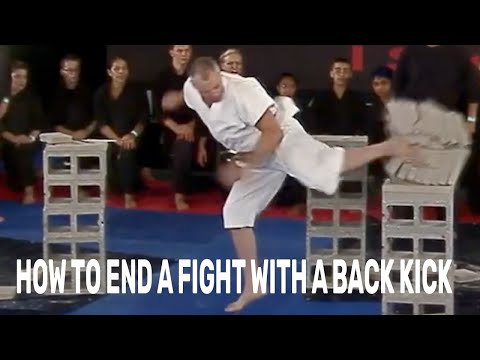
According to Chip Townsend, the back kick requires a pivot, look, and kick as one fluid motion without spinning excessively. A true reverse side kick is different—the back kick is about forward momentum and positioning rather than a full spin.
Core JKD warns against backing up too far and then running at your opponent with the kick, as this significantly reduces its effectiveness. The technique works best from a good fighting distance where you can generate momentum naturally.
The Oblique Back Side Kick is delivered diagonally backward at approximately 45 degrees, combining the mechanics of a back kick with the thrusting trajectory of a side kick. This angle is optimal for reaching opponents who have moved to the practitioner's rear quarter, a position too far back for a standard side kick but not directly behind for a back kick.
The Oblique Back Side Kick is a specialised variant of the side kick documented in cross-style kicking methodology. Side kick variations have been developed across karate, taekwondo, and kung fu traditions.
Unified MMA: legal — Legal striking technique; WBC/Boxing: banned — All kicks prohibited in boxing; WKF: legal — Legal, chudan (body) kick scores 2 points, jodan (head) kick scores 3 points; Kyokushin: legal — Legal at full power to body and head; WT: legal — Legal, body kick 2 points, head kick 3 points, spinning body 4 points, spinni…; WAKO: legal — Legal in Full Contact and Low Kick formats; K: legal — 1/GLORY — Legal; IFMA: legal — Legal — kicks are a core Muay Thai technique
Danger rating 6/10. Side kick variants deliver significant lateral force to the target
The standard setup chain: Feint or jab → Chamber → Oblique Back Side Kick to target → Follow-up technique.
Standard counters include: Step inside the kick range / Catch and sweep / Counter with low roundhouse.
Common variants: High oblique back side kick (targeting head level); Mid oblique back side kick (targeting body); Low oblique back side kick (targeting legs).
Primarily a training, demonstration, and point-fighting technique. Rarely seen in full-contact MMA or kickboxing due to acrobatic risk and telegraphing.
Top errors to watch for: Attempting the oblique back side kick without sufficient side kick foundation / Poor balance during execution / Insufficient hip rotation.
The Oblique Back Side Kick is also known as Oburīku Bakku Saido Kikku, Angled Back Side Kick.