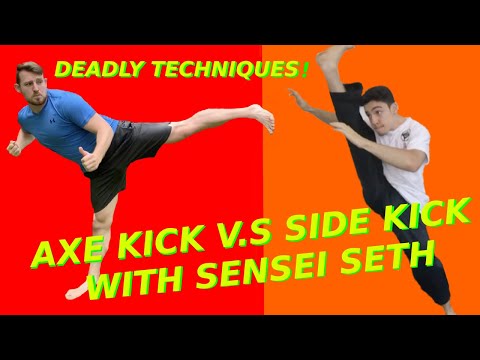
Axe Kick V.S Side Kick With Sensei Seth
0
Bent-Body Side Kick·RG MARTIAL ARTS
I am very excited to share this collab between @SenseiSeth and @RGMARTIALARTS. In this video you will learn more about …
Translation: Bent-body side kick — a side kick with exaggerated lateral body lean away from the target, trading balance for significantly extended reach
The Bent-Body Side Kick uses an exaggerated lateral body lean away from the target, bending at the waist toward the ground on the non-kicking side, to extend the effective reach of the side kick by approximately 12-18 inches beyond the standard version. [1] In a standard side kick (yoko geri kekomi), the torso remains relatively upright, and the kicking range is determined by the length of the leg plus the hip's lateral displacement. [1] The Bent-Body variant dramatically increases this range by tilting the entire torso away from the kick — as the body leans toward the floor on the non-kicking side, the kicking hip rises correspondingly, allowing the foot to travel further toward the target. [1] The trade-off is explicit: the extreme lean sacrifices balance (the centre of gravity shifts far from the base of support) in exchange for reach that can surprise opponents who believe they are standing safely beyond kicking distance. [1] De Bremaeker and Faige document the Bent-Body Side Kick as particularly useful against taller opponents or when the opponent is retreating and has created more distance than a standard side kick can cover. [1] The technique appears in competition karate, taekwondo, and kickboxing, where fighters use the extended reach to score points or deliver damage from ranges that the opponent considers safe. [1] Bill 'Superfoot' Wallace, the undefeated middleweight kickboxing champion famous for his side kick, frequently used the bent-body lean to extend his already formidable side kick range — opponents who thought they were out of range were caught by the extra 12-18 inches the lean provided. [2] The critical skill is knowing when the extra reach is worth the balance sacrifice: the Bent-Body Side Kick should be used as a single explosive action, not as a sustained position, because the extreme lean leaves the kicker unable to follow up, block, or evade until they recover their upright posture. [1]
The Bent-Body Side Kick developed organically in competitive karate and kickboxing as fighters sought to extend their kicking range beyond the standard side kick's reach. [1] Bill 'Superfoot' Wallace (1945-present), the undefeated Professional Karate Association (PKA) middleweight champion who defended his title an unprecedented 23 times, was the most famous practitioner of the extended-range side kick. [2] Wallace, who fought exclusively from a left (southpaw) stance due to a right knee injury, relied primarily on three kicks from his left leg: the side kick, hook kick, and roundhouse kick — all delivered with the extended-lean technique that maximised range from his single-leg attacking platform. [2] His ability to reach opponents from distances they considered safe earned him the 'Superfoot' nickname and made the Bent-Body Side Kick famous worldwide. [2] De Bremaeker and Faige included the technique in their 2010 cross-style compilation, noting its appearance across karate, taekwondo, and kickboxing competition. [1]
The Bent-Body Side Kick's effectiveness is situational: it excels against retreating opponents and at maximum range, where the standard side kick falls short. [1] Bill Wallace's undefeated career (23 title defences) using the extended-range side kick as a primary weapon demonstrates the technique's viability at the highest levels of competition. [2] The extra 12-18 inches of range transforms the side kick from a close-to-mid-range weapon into a genuine long-range threat, fundamentally changing the distance at which the opponent must begin defending. [1] The balance sacrifice is a calculated risk: when used as a single decisive technique against a retreating or stationary opponent, the risk is acceptable; when used recklessly against an advancing opponent, the balance sacrifice is exploitable. [1]
Bill 'Superfoot' Wallace: PKA middleweight champion, 23 consecutive title defences (undefeated), primarily using the extended-range side kick. The Bent-Body Side Kick is commonly used in WKF karate and WT taekwondo competition for long-range scoring. The technique's ability to score from beyond the opponent's expected kicking range produces a disproportionate number of scoring techniques in point competition.
No images yet for this technique.
Sign in to suggest an image.
I am very excited to share this collab between @SenseiSeth and @RGMARTIALARTS. In this video you will learn more about …
The wing chun training series is a follow up from the wing chun basic lessons level 1 or stage 1. These lessons concentr…
The bent-body side kick is a powerful striking technique that leverages the body's kinetic chain to deliver force at distance. RG Martial Arts emphasizes the mechanics of chamber and extension: the practitioner points the foot away from the target, aligns the knee toward the opposite shoulder, and drives through the heel or blade of the foot to create a straight line from eyes through shoulder, hip, knee, and foot. The instructor stresses avoiding impact with the balls of the feet or toes, which dissipate force, instead recommending either the heel (analogous to a palm strike) or the bladed edge (analogous to a knife-hand chop) for proper force penetration. RG Martial Arts advocates a setup using an overhand hand movement to elevate the opponent's guards before stepping and driving the kick. Master Wong's Wing Chun approach contextualizes side-kick defense within partner drill work, focusing on blocking the incoming kick's shin and calf with the back of the hand to control distance and develop reactive timing. While RG Martial Arts addresses offensive execution and setup tactics, Master Wong emphasizes defensive application and footwork coordination within a combative exchange, demonstrating complementary aspects of side-kick utility in fighting scenarios.
Synthesized from 2 instructors
No instructional courses yet for this technique.
Sign in to suggest a course.
Risk of injury to the person this technique is applied to
The side kick is one of the most powerful kicks in martial arts (it drives the entire body weight through the heel in a linear thrust), and the Bent-Body variant does not sacrifice power — only balance. A Bent-Body Side Kick to the solar plexus, ribs, or hip joint delivers full side-kick force at an unexpected range, making it a genuine fight-ending weapon. Bill 'Superfoot' Wallace produced numerous knockouts and stoppages using the extended-range side kick. [1,2]
Skill level needed to execute this technique reliably
Whether this technique is allowed under major competition rule sets
Essential Book of Martial Arts Kicks (De Bremaeker & Faige, 2010)
description: [1] De Bremaeker 2010 pp.71-72, [2] Wallace 1982
Standard katakana transliteration of Western martial arts terminology (外来語) — used in Japanese MMA, boxing, and BJJ communities
description: [1] De Bremaeker 2010 pp.71-72, [2] Wallace 1982
Requires strong oblique muscles (lateral trunk flexors) for controlled lean and recovery
Good balance on the standing leg during the lean
Standard side kick flexibility (hip abduction, hamstring flexibility)
Core strength for maintaining the kick's linear thrust during the lean
Tall practitioners with long legs gain the most absolute range extension, but the proportional benefit is the same for all body types
You should use your heel to strike, not the balls of your feet or toes. According to Sensei Seth (RG MARTIAL ARTS), hitting with your toes or ball of the foot creates give in the impact, whereas the heel digs in solidly for maximum effect.
Most of your power should come on the way down, not during the raise. Sensei Seth emphasizes that a common mistake is raising the kick with full power and then letting gravity bring it down slowly; instead, you should raise it and actively drive it down with force to maximize impact.
You should maintain a straight line from your eyes through your shoulder, hip, knee, and foot while looking at your target. According to Sensei Seth, this alignment is achieved whether you land with a bladed foot or other foot position.
Sensei Seth recommends throwing a few push kicks first to make your opponent believe more push kicks are coming, then switching to the bent-body side kick when they're focused on defending against that pattern.
The Bent-Body Side Kick uses an exaggerated lateral body lean away from the target, bending at the waist toward the ground on the non-kicking side, to extend the effective reach of the side kick by approximately 12-18 inches beyond the standard version. In a standard side kick (yoko geri kekomi), the torso remains relatively upright, and the kicking range is determined by the length of the leg plus the hip's lateral displacement.
The Bent-Body Side Kick developed organically in competitive karate and kickboxing as fighters sought to extend their kicking range beyond the standard side kick's reach. Bill 'Superfoot' Wallace (1945-present), the undefeated Professional Karate Association (PKA) middleweight champion who defended his title an unprecedented 23 times, was the most famous practitioner of the extended-range side kick.
Unified MMA: legal — Legal striking technique; WBC/Boxing: banned — All kicks prohibited in boxing; WKF: legal — Legal, chudan (body) kick scores 2 points, jodan (head) kick scores 3 points; Kyokushin: legal — Legal at full power to body and head; WT: legal — Legal, body kick 2 points, head kick 3 points, spinning body 4 points, spinni…; WAKO: legal — Legal in Full Contact and Low Kick formats; K: legal — 1/GLORY — Legal; IFMA: legal — Legal — kicks are a core Muay Thai technique
Danger rating 7/10. The side kick is one of the most powerful kicks in martial arts (it drives the entire body weight through the heel in a linear thrust), and the Bent-Body variant does not sacrifice power — only balance. A Bent-Body Side Kick to the solar plexus, ribs, or hip joint delivers full side-kick force at an unexpected range, making it a genuine fight-ending weapon. Bill 'Superfoot' Wallace produced numerous knockouts and stoppages using the extended-range side kick.
The standard setup chain: Establish standard side kicks at normal range (conditioning the opponent to their expected range) → Opponent begins retreating to their perceived 'safe' distance beyond your normal kick range → They feel safe at this distance and lower their defensive urgency → Fire the Bent-Body Side Kick with the lean adding 12-18 inches of range → The kick reaches the opponent at a distance they considered safe → Heel impacts the solar plexus, ribs, or hip → Immediately recover upright posture → Follow up with advancing techniques or reset to fighting distance.
Standard counters include: Advance into the kick — closing distance jams the side kick before the lean can develop its range / Catch the foot — the Bent-Body kick is slower to retract than a standard side kick because the body must recover from… / Low sweep — the standing leg during the deep lean is bearing the full body weight at an unstable angle; a sweep to th… / Angle off to the outside — stepping past the kick on the outside takes the target out of range while positioning for ….
Common variants: Slight lean (15-20°) (moderate range extension with good balance retention); Deep lean (30-45°) (maximum range extension with significant balance sacrifice); Hand-on-floor Bent-Body (touching the non-kicking hand to the floor for momentary …); Bent-Body to head (using the lean to elevate the kicking leg high enough to …); Bent-Body to body (the standard version targeting the midsection (solar plex…); Bent-Body low line (targeting the knee or thigh with the extended range).
Bill 'Superfoot' Wallace: PKA middleweight champion, 23 consecutive title defences (undefeated), primarily using the extended-range side kick. The Bent-Body Side Kick is commonly used in WKF karate and WT taekwondo competition for long-range scoring.
Top errors to watch for: Leaning before kicking — the lean must happen during the kick's extension, not before. Pre-leaning telegraphs the ext… / Leaning too deeply — excessive lean (beyond 45°) creates a nearly horizontal body position from which recovery is ext… / Losing the side kick's linear thrust — the lean can cause the kick to arc rather than thrust if the hip alignment is … / Not recovering immediately — staying in the leaned position after the kick leaves the kicker vulnerable to counters, ….
The Bent-Body Side Kick is also known as Bento Bodi Saido Kikku, Leaning Side Kick, Extended Reach Side Kick, Counter-Balance Side Kick, Long Range Side Kick.