Elbows & Hands. What’s a Crescent Kick for? Re-chamber your front kicks.
0
Standard Outside Crescent·Ramsey Dewey
Q&A with the coach Let’s talk technique
Translation: standard outside crescent
The Standard Outside Crescent Kick is executed by swinging the kicking leg upward and outward in a wide arc from the centreline to the outside, striking the target with the outer blade of the foot or the heel. [1] The technique requires hip flexibility and strong abductor muscles to generate speed and power through the arc, and the standing leg must be well grounded to maintain balance during the sweeping motion. [1],[2] It is frequently used in taekwondo competition and traditional karate kata. [2],[3]
Standard outside crescent kick. [1]
From TKD/karate. [1]
Used in competition. [1]
No images yet for this technique.
Sign in to suggest an image.
Q&A with the coach Let’s talk technique
The techniques after the yin yang position with out the ring would be 1. Grab and pull 2. Upward elbow block 3.inside lo…
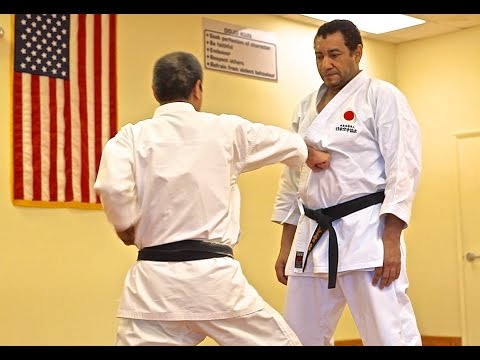
Master Osaka 8th Dan JKA explains Oi Zuki. Sensei Nagatomo 7th Dan JKA translates filmed at JKA HQ in Florida.
The standard outside crescent kick is a close-range head strike executed from within grappling distance or clinch range, according to Ramsey Dewey's analysis. Dewey emphasizes that the outside crescent kick travels from the outside inward, whipping toward the side of the head using the lateral surface of the leg or foot. He clarifies that while the technique may feel weak to beginners due to insufficient practice, it becomes powerful when properly trained. The outside crescent kick functions effectively as both a direct striking technique and as a feint or setup tool in combinations—for example, throwing a high outside crescent to draw the opponent's guard upward, then immediately following with a low-line round kick to the liver. Dewey stresses that proficiency requires substantial repetition and comfort fighting in close quarters, skills often underdeveloped in early martial artists who prefer fighting at distance. He notes that the outside crescent kick is completely ineffective at range and serves no application in knife defense scenarios. The technique is particularly valued in styles emphasizing infighting, such as Wing Chun, where the necessary distance and positioning align with the style's core principles. Practitioners must develop confidence in close-range work before the outside crescent kick becomes a viable tactical option.
Synthesized from 3 instructors
No instructional courses yet for this technique.
Sign in to suggest a course.
Risk of injury to the person this technique is applied to
Arcing kick; primarily used for guard manipulation
Skill level needed to execute this technique reliably
Whether this technique is allowed under major competition rule sets
Karate-Do Kyohan: The Master Text (Gichin Funakoshi, 1935)
Alias sources — [1] Kukkiwon Taekwondo Textbook (Kukkiwon, 2006) [2] Karate-Do Kyohan (Funakoshi, 1935) [3] Dynamic Karate (Nakayama, 1966)
Effectiveness sources — [1] Comprehensive Asian Fighting Arts (Draeger & Smith, 1969)
Official karate technique names (和語/漢語)
Established Japanese martial arts naming convention — native Japanese term (和語/漢語)
Alias sources — [1] Kukkiwon Taekwondo Textbook (Kukkiwon, 2006) [2] Karate-Do Kyohan (Funakoshi, 1935) [3] Dynamic Karate (Nakayama, 1966)
Effectiveness sources — [1] Comprehensive Asian Fighting Arts (Draeger & Smith, 1969)
speed, power generation through kinetic chain, striking surface conditioning
athletic build with fast-twitch muscle fibres
varies by strike — hip rotators, shoulders, core
According to Ramsey Dewey, a crescent kick is most effective when you've closed the distance to close range with your opponent. At fighting distance where you can safely engage, a crescent kick is relatively useless—you want to establish proximity first, often by using a front kick to bridge the gap.
Ramsey Dewey recommends re-chambering your leg after a front kick rather than letting it drop, because if you don't re-chamber, front kicks become easy for your opponent to catch.
The Standard Outside Crescent Kick is executed by swinging the kicking leg upward and outward in a wide arc from the centreline to the outside, striking the target with the outer blade of the foot or the heel. The technique requires hip flexibility and strong abductor muscles to generate speed and power through the arc, and the standing leg must be well grounded to maintain balance during the sweeping motion.
The standard outside crescent kick has been a staple of taekwondo and karate technique since the formalisation of these arts in the mid-20th century. The technique is included in numerous traditional forms and is regularly practised in both Eastern and Western martial arts schools.
Unified MMA: legal — Legal striking technique; WBC/Boxing: banned — All kicks prohibited in boxing; WKF: legal — Legal, chudan (body) kick scores 2 points, jodan (head) kick scores 3 points; Kyokushin: legal — Legal at full power to body and head; WT: legal — Legal, body kick 2 points, head kick 3 points, spinning body 4 points, spinni…; WAKO: legal — Legal in Full Contact and Low Kick formats; K: legal — 1/GLORY — Legal; IFMA: legal — Legal — kicks are a core Muay Thai technique
Danger rating 5/10. High — arcing kick; primarily used for guard manipulation
The standard setup chain: Assume Fighting Stance → Generate Power → Execute Strike → Recover to Guard.
Standard counters include: Check (Shin Block) — raise the shin to intercept the kick before it lands / Catch and Sweep — catch the kicking leg and sweep the standing leg / Step Inside — close distance inside the kick's effective range to smother it.
Common variants: Standard variation (primary execution of the strike from the most common stance); Power variation (modified mechanics for maximum force generation); Speed variation (minimised telegraph for a faster, harder-to-read attack); Counter variation (timed to exploit the opponent's offensive commitment).
Used in competition.
Top errors to watch for: Starting the swing already going outward without first crossing inward — the inside-to-outside trajectory is what def… / Not reaching sufficient height at the striking point — the arc must be at head level / Losing balance because the outward momentum pulls the body off the standing foot / Using the kick as a power strike instead of a sweeping, clearing motion — the force is moderate, not devastating.
The Standard Outside Crescent is also known as Soto Mikazuki-geri (Kihon-gata), Bakkat Bandal Chagi, Mikazuki Geri Soto, Standard Outward Arc Kick.