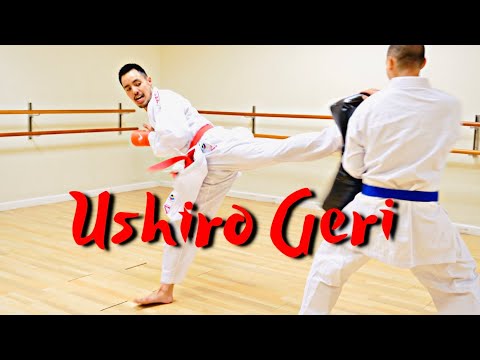
USHIRO GERI TUTORIAL (Spinning Back Kick)
0
Standard Spinning Back Kick·ULTIMATE KARATE
Welcome to Ultimate Karate, in today's Karate Lesson we are learning Ushiro Geri AKA "Spinning Back Kick" Jason Leung is…
Translation: standard spinning back kick
The Standard Spinning Back Kick is executed by pivoting on the lead foot, rotating the body 180 degrees to face away from the opponent, looking over the shoulder to acquire the target, and thrusting the rear heel straight back with full leg extension. [1] The rotational momentum of the spin adds force to the linear thrust, and the heel impacts the opponent's solar plexus, liver, or abdomen with tremendous penetrating power. [1],[2] This technique requires precise distance and timing, as the rotation momentarily obscures the kicker's vision and creates vulnerability if the kick misses. [2],[3]
The standard spinning back kick is a staple of taekwondo (dwi chagi), where it is one of the most powerful and commonly used spinning techniques in competition. [1] The technique has been adopted across kickboxing and MMA, with memorable performances by fighters such as Bas Rutten, Cung Le, and Yoel Romero demonstrating its effectiveness. [2],[3]
The spinning back kick delivers enormous force by combining rotational momentum with a linear heel thrust, producing one of the highest impact forces of any kick. [1] Biomechanical studies have measured spinning back kicks generating forces exceeding 1,500 pounds, making them among the most powerful techniques in striking martial arts. [1]
The back kick is a signature technique shared across taekwondo (dwi chagi) and karate (ushiro geri), with both traditions claiming it as a fundamental kick in their curricula. [1]
No images yet for this technique.
Sign in to suggest an image.
Welcome to Ultimate Karate, in today's Karate Lesson we are learning Ushiro Geri AKA "Spinning Back Kick" Jason Leung is…
In this video We demonstrate basic to advanced drills to help you practice and master your spinning back kick. To learn…
The spinning back kick is a powerful strike... if you throw it correctly! But many people make one big mistake. Try this…
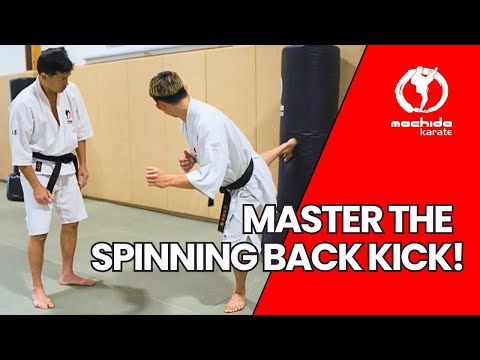
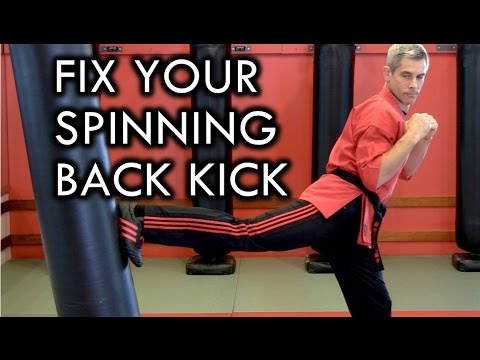
The standard spinning back kick, known as Ushiro Geri in Japanese, is widely regarded as one of the most powerful strikes in martial arts. All three instructors emphasize that proper execution requires careful control of rotation and positioning. SenseiAndo stresses the critical distinction between a true back kick and a turning side kick: a back kick occurs when the striker's back faces the opponent with toes pointing 180 degrees away, striking with the heel. He identifies a common error where excessive head turning causes the entire spine and hips to rotate beyond 180 degrees, unintentionally converting the technique into a side kick. His solution is to spot the target with only the corner of one eye, initiating the kick as soon as the target becomes visible. Machida Karate and Ultimate Karate (Jason Leung) both emphasize the importance of minimal hip rotation to maintain proper alignment. Machida recommends thinking of the technique as a turning motion rather than spinning, moving forward while turning rather than purely rotating. Both Machida and Leung stress keeping toes pointed downward and striking with the heel to maximize power transfer. Leung additionally highlights the importance of following through with hip extension and the supporting leg to drive through the target, contrasting traditional forward-landing approaches with tactical modern combat positioning. All three instructors agree that maintaining awareness of the target and avoiding over-rotation are essential to executing a true back kick rather than accidentally reverting to a side kick.
Synthesized from 3 instructors
No instructional courses yet for this technique.
Sign in to suggest a course.
Risk of injury to the person this technique is applied to
Spinning back kick generates extreme force; liver/solar plexus KO risk
Skill level needed to execute this technique reliably
Whether this technique is allowed under major competition rule sets
Karate-Do Kyohan: The Master Text (Gichin Funakoshi, 1935)
Alias sources — [1] Kukkiwon Taekwondo Textbook (Kukkiwon, 2006) [2] Best Karate Vol. 5 (Nakayama, 1979) [3] Taekwondo: The State of the Art (Park, 1989)
Effectiveness sources — [1] Biomechanics of Striking Arts, in Martial Arts Medicine (Kordi et al., 2009)
Official karate technique names (和語/漢語)
Established Japanese martial arts naming convention — native Japanese term (和語/漢語)
Alias sources — [1] Kukkiwon Taekwondo Textbook (Kukkiwon, 2006) [2] Best Karate Vol. 5 (Nakayama, 1979) [3] Taekwondo: The State of the Art (Park, 1989)
Effectiveness sources — [1] Biomechanics of Striking Arts, in Martial Arts Medicine (Kordi et al., 2009)
rotational awareness, hip extension power, target spotting ability
strong posterior chain for powerful backward thrust
glutes, hamstrings, erector spinae, core rotators
According to Ando Mierzwa, this happens when you try to look at your target with both eyes while spinning—your head rotation causes your feet to turn further than intended. Spot your target with only one eye to keep your shoulders squared and throw a true back kick instead of accidentally converting to a side kick.
Ando Mierzwa recommends thinking of it as a 'turnaround technique' rather than a spinning technique. You only need to turn enough so your shoulders are squared toward the target—full circular spinning will throw off your aim and balance.
Ultimate Karate notes that the traditional approach is better for demonstrating fundamentals and Kihon, while the modern approach is more practical for real combat and application, emphasizing driving through the target with locked eyes, toes down, and squared hips rather than landing forward.
Machida Karate emphasizes that you should turn and go forward—not just spin in place. Turn, move forward, and then kick; this ensures proper momentum and prevents the common mistake of spinning without forward progression.
The Standard Spinning Back Kick is executed by pivoting on the lead foot, rotating the body 180 degrees to face away from the opponent, looking over the shoulder to acquire the target, and thrusting the rear heel straight back with full leg extension. The rotational momentum of the spin adds force to the linear thrust, and the heel impacts the opponent's solar plexus, liver, or abdomen with tremendous penetrating power.
The standard spinning back kick is a staple of taekwondo (dwi chagi), where it is one of the most powerful and commonly used spinning techniques in competition. The technique has been adopted across kickboxing and MMA, with memorable performances by fighters such as Bas Rutten, Cung Le, and Yoel Romero demonstrating its effectiveness.
Unified MMA: legal — Legal striking technique; WBC/Boxing: banned — All kicks prohibited in boxing; WKF: legal — Legal, chudan (body) kick scores 2 points, jodan (head) kick scores 3 points; Kyokushin: legal — Legal at full power to body and head; WT: legal — Legal, body kick 2 points, head kick 3 points, spinning body 4 points, spinni…; WAKO: legal — Legal in Full Contact and Low Kick formats; K: legal — 1/GLORY — Legal; IFMA: legal — Legal — kicks are a core Muay Thai technique
Danger rating 7/10. Very High — spinning back kick generates extreme force; liver/solar plexus KO risk
The standard setup chain: Stance and Range → Chamber the Leg → Execute the Kick → Recover.
Standard counters include: Check (Shin Block) — raise the shin to intercept the kick before it lands / Catch and Sweep — catch the kicking leg and sweep the standing leg / Step Inside — close distance inside the kick's effective range to smother it.
Common variants: Standard back kick (spinning and thrusting the heel backward into the target); Spinning back kick (full 360° rotation for maximum power); Mule kick (short backward thrust without a full spin).
Conor McGregor knocked out Marcus Brimage with a spinning back kick to the body at UFC on Fuel TV 9 (2013) in his promotional debut. Cung Le used the spinning back kick as a primary weapon in his Strikeforce career.
Top errors to watch for: Separating the spin and the kick into two distinct actions instead of one fluid motion / Looking at the ground during the spin instead of at the target — keep the eyes up and searching / Spinning off the centre of balance and wobbling through the kick / Not extending the hip fully at the moment of impact — the heel must drive through the target.
The Standard Spinning Back Kick is also known as Ushiro Mawashi-geri (Kihon-gata), Dwi Dollyo Chagi, Ushiro Mawashi Geri, Turning Back Kick.