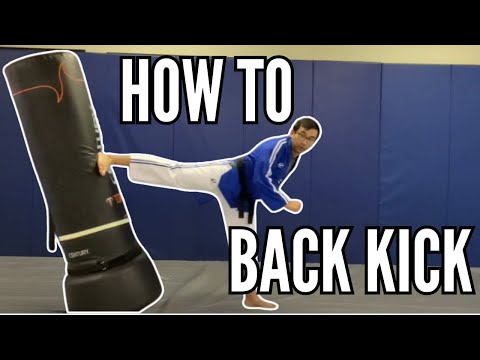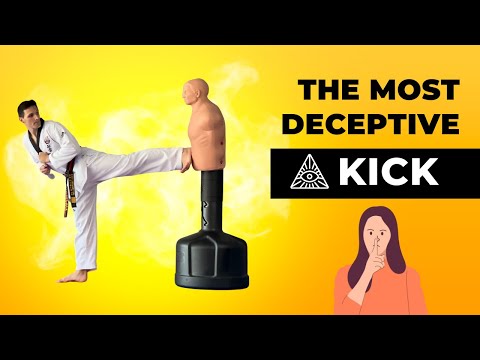
How to Do a Taekwondo Back Kick
0
Standard Back Kick·Taekwondo Guide
Paul Van Schoyck of Taekwondo Guide demonstrates how to do a back kick (the most deceptive kick in Taekwondo) along with…
Translation: standard back kick
The Standard Back Kick subfamily covers the fundamental back kick execution, where the fighter looks over the shoulder, pivots on the lead foot, and drives the heel of the rear foot straight back into the opponent's midsection or solar plexus. [1] The kicking leg extends fully in a linear thrust, and the power is generated by driving the hip backward while maintaining a rigid leg structure at the moment of impact. [1],[2] The standard back kick is one of the most powerful linear kicks, and its trajectory makes it difficult to catch or sweep compared to circular kicks. [2],[3]
The standard back kick has been a core technique in taekwondo since the art's formalisation in the 1950s, and it appears as ushiro geri in Shotokan karate's standard curriculum. [1] The technique is universally taught across kicking arts and has proven effective in both point-based and full-contact competition. [2],[3]
Standard back kick. [1]
From TKD and karate. [1]
Used in competition. [1]
No images yet for this technique.
Sign in to suggest an image.
Paul Van Schoyck of Taekwondo Guide demonstrates how to do a back kick (the most deceptive kick in Taekwondo) along with…
🏠 Dojo Go Online Academy 2.0 is Live! https://www.skool.com/grand-prairie-muay-thai-3175/about 20+ weeks of structured,…
No instructional courses yet for this technique.
Sign in to suggest a course.
Risk of injury to the person this technique is applied to
Spinning back kick generates extreme force; liver/solar plexus KO risk
Skill level needed to execute this technique reliably
Whether this technique is allowed under major competition rule sets
Karate-Do Kyohan: The Master Text (Gichin Funakoshi, 1935)
Alias sources — [1] Kukkiwon Taekwondo Textbook (Kukkiwon, 2006) [2] Karate-Do Kyohan (Funakoshi, 1935) [3] Dynamic Karate (Nakayama, 1966)
Effectiveness sources — [1] Comprehensive Asian Fighting Arts (Draeger & Smith, 1969)
Mixed Japanese-Western terminology — combines traditional Japanese terms with katakana loanwords
Alias sources — [1] Kukkiwon Taekwondo Textbook (Kukkiwon, 2006) [2] Karate-Do Kyohan (Funakoshi, 1935) [3] Dynamic Karate (Nakayama, 1966)
Effectiveness sources — [1] Comprehensive Asian Fighting Arts (Draeger & Smith, 1969)
rotational awareness, hip extension power, target spotting ability
strong posterior chain for powerful backward thrust
glutes, hamstrings, erector spinae, core rotators
Every move, in any martial art, shares a few universal traits. Mix and match below to pinpoint the right tool — or compare equivalents across styles.
The most common mistake is trying to kick too early in the turn before you've fully rotated and looked over your shoulder. You need to complete your turn and visual check before lifting your kicking foot.
Lean your upper body forward and show your back to the target while keeping your kick traveling in a straight line. This forward lean combined with proper body alignment ensures your heel strikes directly at the opponent rather than on an angled path.
Aim with your heel. Step with your heel first, look over your shoulder, pick up your leg, bend your knee, and thrust out as if throwing a side kick.
The Standard Back Kick subfamily covers the fundamental back kick execution, where the fighter looks over the shoulder, pivots on the lead foot, and drives the heel of the rear foot straight back into the opponent's midsection or solar plexus. The kicking leg extends fully in a linear thrust, and the power is generated by driving the hip backward while maintaining a rigid leg structure at the moment of impact.
The standard back kick has been a core technique in taekwondo since the art's formalisation in the 1950s, and it appears as ushiro geri in Shotokan karate's standard curriculum. The technique is universally taught across kicking arts and has proven effective in both point-based and full-contact competition.
Unified MMA: legal — Legal striking technique; WBC/Boxing: banned — All kicks prohibited in boxing; WKF: legal — Legal, chudan (body) kick scores 2 points, jodan (head) kick scores 3 points; Kyokushin: legal — Legal at full power to body and head; WT: legal — Legal, body kick 2 points, head kick 3 points, spinning body 4 points, spinni…; WAKO: legal — Legal in Full Contact and Low Kick formats; K: legal — 1/GLORY — Legal; IFMA: legal — Legal — kicks are a core Muay Thai technique
Danger rating 7/10. Very High — spinning back kick generates extreme force; liver/solar plexus KO risk
The standard setup chain: Stance and Range → Chamber the Leg → Execute the Kick → Recover.
Standard counters include: Check (Shin Block) — raise the shin to intercept the kick before it lands / Catch and Sweep — catch the kicking leg and sweep the standing leg / Step Inside — close distance inside the kick's effective range to smother it.
Common variants: Standard back kick (spinning and thrusting the heel backward into the target); Spinning back kick (full 360° rotation for maximum power); Mule kick (short backward thrust without a full spin).
Used in competition.
Top errors to watch for: Spinning without spotting the target over the shoulder — the most common and most dangerous mistake / Swinging the leg in an arc instead of thrusting straight back — keep the trajectory linear / Kicking with the sole of the foot flat instead of driving with the heel point / Leaning forward during the kick and exposing the back of the head.
The Standard Back Kick is also known as Sutandādo Ushiro-geri, Dwi Chagi, Ushiro Geri, Back Thrust Kick.