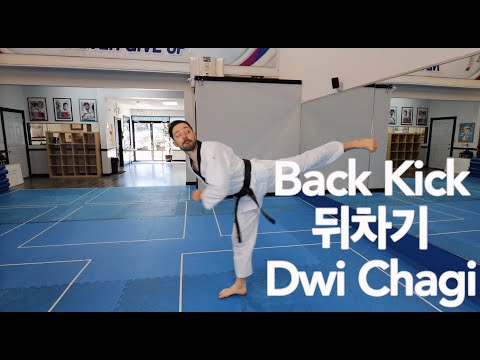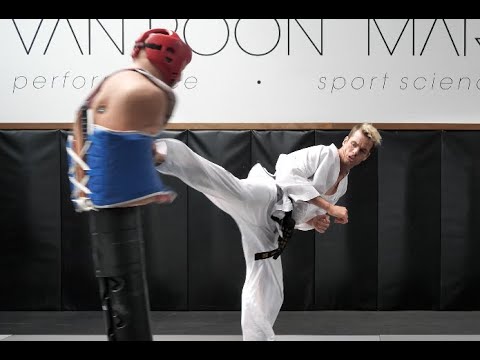
Tutorial: Back Kick AKA Back Piercing Kick (뒷차지르기. 後ろ蹴り)
0
Drop Back Kick·Van Roon Martial Arts
Tutorial: Back Kick AKA Back Piercing Kick (뒷차지르기. 後ろ蹴り) In this video Carl van Roon looks at key considerations for th…
Translation: Drop back kick
The Drop Back Kick is a back kick delivered while intentionally dropping the body forward to the ground. [1] The forward drop creates momentum that adds power to the backward kick, while the unexpected level change makes the kick difficult to defend. [1] This sacrifice technique requires practiced falling skills for safe execution. [1]
Offers specific tactical advantages over the standard back kick in appropriate situations. [1]
Cross-style martial arts kicking tradition; documented in kick compendiums. [1]
An acrobatic kick variation primarily seen in demonstrations and point-fighting tournaments. Not practical in full-contact competition due to the ground recovery time required. [1]
No images yet for this technique.
Sign in to suggest an image.
Tutorial: Back Kick AKA Back Piercing Kick (뒷차지르기. 後ろ蹴り) In this video Carl van Roon looks at key considerations for th…
Back Kick 뒤차기 Dwi Chagi is arguably one of the strongest kicks! Training a good Back Kick will benefit your 'power' dem…
The back kick, known as dwee chuggy in Korean or ushirogeri in Japanese, is considered one of the strongest kicks in martial arts due to its ability to harness the body's largest muscle groups, particularly the glutes, combined with hip extension and rotational force. Both TaekwondoShawn and Van Roon Martial Arts emphasize that proper execution requires leaning the chest forward in the opposite direction of the kick while chambering the knee high and extending straight back with the heel or foot blade (bao kal in Korean, yosokuto in Japanese). TaekwondoShawn stresses maintaining close knee alignment to avoid converting the technique into a side kick, keeping toes pulled in line with the body, and executing the kick as one continuous motion rather than two separate parts to maximize power generation. Van Roon adds that the true back kick maintains a direct center-line approach, distinguishing it from the more powerful but less efficient spinning or turning side kick variation. Both instructors agree on the importance of the recoil and recommend preparatory conditioning through exercises like burpees, split squats, and forward-backward leg swings to develop the necessary strength and flexibility. TaekwondoShawn highlights the technique's versatility in competitive sparring (earning more points than front turning kicks), power breaking demonstrations, and self-defense applications including shin rakes and groin strikes. Van Roon contextualizes the back kick's range advantages over spinning variations, noting it can be executed from closer distance while maintaining directness and efficiency.
Synthesized from 2 instructors
No instructional courses yet for this technique.
Sign in to suggest a course.
Risk of injury to the person this technique is applied to
Back Kick variant with standard striking power
Skill level needed to execute this technique reliably
Whether this technique is allowed under major competition rule sets
Essential Book of Martial Arts Kicks (De Bremaeker & Faige, 2010)
[1] De Bremaeker & Faige, Essential Book of Martial Arts Kicks (2010)
Requires solid back kick foundation
Good balance and coordination
Documented in De Bremaeker & Faige, Section 4.5. A drop kick variant where the attacker drops to the ground while delivering a back kick — sacrifices position for unexpected angle. (De Bremaeker & Faige, Essential Book of Martial Arts Kicks, 2010)
According to TaekwondoShawn, a big bad habit is opening up into a side kick instead of keeping the kick straight back. You want to close the same shoulder as the kicking leg to keep your body straight and engage your glutes properly at impact.
TaekwondoShawn emphasizes pulling your toes in line with the rest of your body to expose the foot blade (the striking surface), while squeezing your glutes tight throughout the extension and recoil.
TaekwondoShawn recommends forward-backward leg swings through full range of motion and squat jacks to prepare your body, followed by split squats to engage the glutes—the biggest muscle involved in the back kick.
TaekwondoShawn stresses that the back kick should look like one motion after practice, advising not to break it up too much or practice it as two separate motions. The power comes from combining the extending motion with the spinning momentum without stopping.
The Drop Back Kick is a back kick delivered while intentionally dropping the body forward to the ground. The forward drop creates momentum that adds power to the backward kick, while the unexpected level change makes the kick difficult to defend.
The Drop Back Kick is a specialised variant documented in cross-style kicking methodology. It represents an advanced development of the standard back kick.
Unified MMA: legal — Legal striking technique; WBC/Boxing: banned — All kicks prohibited in boxing; WKF: legal — Legal, chudan (body) kick scores 2 points, jodan (head) kick scores 3 points; Kyokushin: legal — Legal at full power to body and head; WT: legal — Legal, body kick 2 points, head kick 3 points, spinning body 4 points, spinni…; WAKO: legal — Legal in Full Contact and Low Kick formats; K: legal — 1/GLORY — Legal; IFMA: legal — Legal — kicks are a core Muay Thai technique
Danger rating 6/10. Back Kick variant with standard striking power
The standard setup chain: Feint → Drop Back Kick → Follow-up combination.
Standard counters include: Step inside range / Block and counter / Low kick to support leg.
Common variants: High variant; Mid variant; Low variant.
An acrobatic kick variation primarily seen in demonstrations and point-fighting tournaments. Not practical in full-contact competition due to the ground recovery time required.
Top errors to watch for: Attempting without solid back kick foundation / Poor balance / Insufficient power generation.
The Drop Back Kick is also known as Doroppu Bakku Kikku, Dropping Back Kick, Sacrifice Back Kick.