Strike & defenceLocksClose rangeFighting multiple people
Distance
CloseMiddleLong
Limb angle
Zero180–135°135–90°90–45°45–0°
Body target
Upper bodyMiddle bodyLower body
Overview
The Standard Outside Axe Kick is executed by swinging the kicking leg in a wide lateral arc up and over the opponent's guard from the outside, then driving the heel downward in a chopping motion onto the collarbone, shoulder, or head. [1] The kick uses hip abductor and flexor muscles to lift the leg in the sweeping arc, followed by hip adduction and extension to accelerate the downward strike. [1],[2] This technique is commonly seen in taekwondo and full-contact karate competition as an offensive or counter-attacking weapon. [2],[3]
The standard outside axe kick became a mainstream competition technique through taekwondo and was further popularised by Andy Hug in K-1 kickboxing, where his axe kick knockouts became some of the most replayed moments in combat sports history. [1] The technique continues to be a regular feature of taekwondo Olympic competition. [2],[3]
The outside axe kick drops the heel vertically onto the opponent's collarbone, shoulder, or crown of the head, using gravity and hip flexor power to drive the heel downward. [1] A clean axe kick to the head can produce a knockout, while strikes to the collarbone can cause fractures. [1]
Lineage
The axe kick (naeryeo chagi) is a signature technique of taekwondo and has been part of the art's competition repertoire since its early formalisation. [1] It is also found in karate as kakato otoshi geri. [1]
Competition Record
Andy Hug was famous for his axe kick in K-1 kickboxing competition, using it to win the 1996 K-1 World Grand Prix. [1] The axe kick remains a high-scoring technique in Olympic taekwondo competition. [2]
Images
No images yet for this technique.
Sign in to suggest an image.
Biomechanical Mechanism
Primary Action — Ballistic leg extension or rotation — the shin or foot impacts the target at high velocity
Joints Involved — Hip (flexion/rotation), knee (extension for front kicks, flexion-extension for roundhouse), ankle (stabilised)
Force Vector — Linear (front kick/teep — hip flexion and knee extension) or rotational (roundhouse — hip rotation with shin contact)
Kinetic Chain — Pivot foot rotation → hip turn → femur whip → shin contact — the leg acts as a heavy bat with the hip as the pivot
Position & Entry
From fighting stance — Raise the leg high (straight or crescent), drive the heel down onto the target (collarbone, shoulder, or head)
From close range — Short-arc axe kick brought down quickly when the opponent's hands are low
As counter (after opponent's kick) — Raise the leg as the opponent recovers from their kick, bring the heel down
Variants
Outside axe kick — raising the leg outside and bringing the heel straight down
Inside axe kick — raising the leg inside in a crescent arc before chopping down
Spinning axe kick — adding a spin before the downward chop
1Stance and Range — verify correct distance for the kick to land at full extension
2Chamber the Leg — lift the knee to prepare the kicking trajectory
3Execute the Kick — extend the leg through the target with the appropriate striking surface
4Recover — retract the leg and return to fighting stance
Sources & References
Primary Source
Karate-Do Kyohan: The Master Text (Gichin Funakoshi, 1935)
1BookMuay Thai: The Art of Fighting (Kraitus, 2002)
Alias sources — [1] Kukkiwon Taekwondo Textbook (Kukkiwon, 2006) [2] Taekwondo: The State of the Art (Park, 1989) [3] Karate-Do Kyohan (Funakoshi, 1935)
2BookKarate-Do Kyohan (Funakoshi, 1935)
Effectiveness sources — [1] Taekwondo: The State of the Art (Jun, 1989)
4OtherJapanese Martial Arts Standard Terminology (武道用語)
Established Japanese martial arts naming convention — native Japanese term (和語/漢語)
5CitationMuay Thai: The Art of Fighting (Kraitus, 2002)
Alias sources — [1] Kukkiwon Taekwondo Textbook (Kukkiwon, 2006) [2] Taekwondo: The State of the Art (Park, 1989) [3] Karate-Do Kyohan (Funakoshi, 1935)
6CitationKarate-Do Kyohan (Funakoshi, 1935)
Effectiveness sources — [1] Taekwondo: The State of the Art (Jun, 1989)
Community
Athletics
Requires
exceptional hip flexibility, hamstring length, leg raising speed
Favours
extremely flexible hips for raising the leg above head height
Key muscles
hip flexors, hamstrings (eccentric), quadriceps, core
Frequently Asked Questions
Why does my outside axe kick feel weak even though I'm extending my leg?
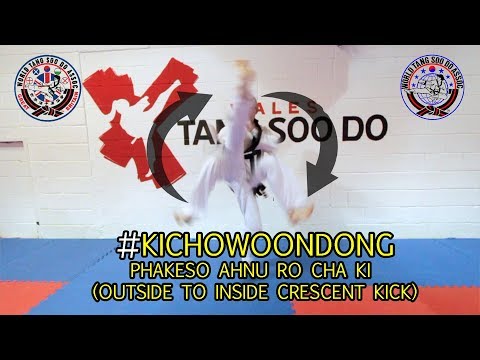
The most important thing is to drive your knee up high—not just to shin height—before extending the kick. According to Heads of the Valleys Tang Soo Do, if you don't get your knee high enough, it kills all the power. The kick itself should feel like an afterthought after that knee drive, not a separate movement driven from the floor.
What should I do with my hips and shoulders when throwing an outside axe kick?
A common mistake is trying to kick with just your leg instead of engaging your whole body. Heads of the Valleys Tang Soo Do emphasizes that you need to turn your front foot out, push your hip through, and bring your shoulder along for the ride—this generates the power and proper form.
How do I know when I've mastered the outside axe kick?
Practice on a pad or paddle held at arm's distance away from you, starting low and working up. According to Heads of the Valleys Tang Soo Do, when you can make a sharp noise with the kick over your head while maintaining good form, you know you've got the technique down to a good standard.
How does the Standard Outside Axe Kick work?
The Standard Outside Axe Kick is executed by swinging the kicking leg in a wide lateral arc up and over the opponent's guard from the outside, then driving the heel downward in a chopping motion onto the collarbone, shoulder, or head. The kick uses hip abductor and flexor muscles to lift the leg in the sweeping arc, followed by hip adduction and extension to accelerate the downward strike.
Where does the Standard Outside Axe Kick come from?
The standard outside axe kick became a mainstream competition technique through taekwondo and was further popularised by Andy Hug in K-1 kickboxing, where his axe kick knockouts became some of the most replayed moments in combat sports history. The technique continues to be a regular feature of taekwondo Olympic competition.
Is the Standard Outside Axe Kick legal in competition?
Unified MMA: legal — Legal striking technique; WBC/Boxing: banned — All kicks prohibited in boxing; WKF: legal — Legal, chudan (body) kick scores 2 points, jodan (head) kick scores 3 points; Kyokushin: legal — Legal at full power to body and head; WT: legal — Legal, body kick 2 points, head kick 3 points, spinning body 4 points, spinni…; WAKO: legal — Legal in Full Contact and Low Kick formats; K: legal — 1/GLORY — Legal; IFMA: legal — Legal — kicks are a core Muay Thai technique
The standard setup chain: Stance and Range → Chamber the Leg → Execute the Kick → Recover.
How do I defend against the Standard Outside Axe Kick?
Standard counters include: Check (Shin Block) — raise the shin to intercept the kick before it lands / Catch and Sweep — catch the kicking leg and sweep the standing leg / Step Inside — close distance inside the kick's effective range to smother it.
What are the variants of the Standard Outside Axe Kick?
Common variants: Outside axe kick (raising the leg outside and bringing the heel straight down); Inside axe kick (raising the leg inside in a crescent arc before chopping …); Spinning axe kick (adding a spin before the downward chop).
How effective is the Standard Outside Axe Kick in competition?
Andy Hug was famous for his axe kick in K-1 kickboxing competition, using it to win the 1996 K-1 World Grand Prix. The axe kick remains a high-scoring technique in Olympic taekwondo competition.
What are common mistakes when doing the Standard Outside Axe Kick?
Top errors to watch for: Pausing at the top of the arc, which kills momentum and gives the opponent time to move / Swinging the leg wide but not getting enough height, so the chop lands at shoulder level instead of from above / Using the instep or bottom of the foot instead of the hard heel for the downward strike / Over-rotating the standing foot so you lose sight of the opponent.
What are other names for the Standard Outside Axe Kick?
The Standard Outside Axe Kick is also known as Soto Kakato Otoshi (Kihon-gata), Bakkat Naeryeo Chagi, Standard Outside Heel Drop, Soto Kakato Otoshi.