Series Overview and Prerequisites
This lesson covers the outside-to-inside crescent kick (Palsaengi Anuro Chagi), the complementary counterpart to the inside-to-outside crescent kick taught in Part 11. Practitioners should review Part 11 first, as many foundational drills and setup principles transfer directly. Note that this instruction focuses specifically on the crescent kick variation, distinct from the outside-to-inside stretch kick and outside-to-inside axe kick.
Fundamental Warm-Up and Knee Drive
Begin by driving the knee as high as possible toward the center line while rotating the front foot 90 degrees outward (clockwise for left leg, counter-clockwise for right leg). Incorporate hip and shoulder rotation to facilitate this motion. Once the movement pattern is established, execute a large circular arc with the knee to build the foundational mechanics of the technique.
Leg Extension and Striking Surface Options
At the apex of the knee drive, flick the leg so it extends straight for only a fraction of a second. Three striking surfaces are viable: the instep offers the fastest execution with minimal foot rotation; the foot edge and heel provide greater impact for breaking applications. Practitioners should train all three methods to develop versatility in both speed and power applications.
Range and Target Placement
This kick functions as a close-range technique, effective only within punching distance—not a long-range strike. The target should be face or head height, with the practitioner using their own head as the initial reference point. As flexibility improves, height can increase, but the kick must remain proximal to the body rather than extended outward.
Critical Common Errors
The most prevalent mistake is overextending the kick away from the body, particularly in forms like Pyong Sam Dang. A second critical error involves insufficient knee height—raising the knee only to shin level eliminates power generation. The third mistake is neglecting hip and shoulder engagement, causing practitioners to initiate movement from the leg alone rather than leveraging rotational torque.
Self-Assessment and Pad Work
Test distance accuracy by holding one hand elevated and attempting to strike it with the opposite leg. Progress to pad work, starting at lower heights and ensuring the pad holder maintains at least arm's distance to prevent long-range kicking habits. The practitioner has mastered the technique when the kick can generate audible impact above head height while maintaining proper form.
Combination Drill: Sequential Crescent Kicks
Execute alternating sequences of inside-to-outside, outside-to-inside, and spinning inside-to-outside crescent kicks to build fluid transitions between complementary techniques. Advanced practitioners can perform one basic inside-to-outside, one outside-to-inside, one spinning inside-to-outside, and one jumping spinning outside-to-inside for comprehensive conditioning and power development.
Pyramid Hopping Progression
Perform inside-to-outside kicks, hop to the opposite leg, then execute outside-to-inside kicks; progress to two inside-to-outside repetitions before hopping and executing outside-to-inside. This drill reinforces explosive knee drive and proper extension, as straight-leg execution prevents effective hopping transitions. The progression serves as both a technique validator and intensive conditioning exercise.
Ki Cho Woon Dong (WTSDA) Outside to Inside Crescent Kick Tutorial
Key Takeaways
- •Series Overview and Prerequisites
- •Fundamental Warm-Up and Knee Drive
- •Leg Extension and Striking Surface Options
- •Range and Target Placement
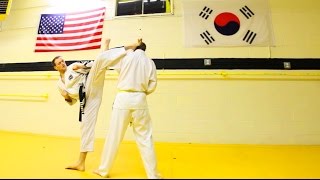
Here is a tutorial for Phakeso Ahnu Ro Cha Ki (Outside to Inside Crescent Kick) hope you find it informative and useful in your training
Frequently Asked Questions
What does this video teach about standard outside axe kick?
This video covers series overview and prerequisites, fundamental warm-up and knee drive, leg extension and striking surface options. It provides detailed instruction from Heads of the Valleys Tang Soo Do.
How long does it take to learn standard outside axe kick?
The basic mechanics can be understood in a single session, but developing reliable execution requires consistent drilling over weeks of practice. This 8-part breakdown helps structure your training by isolating each phase of the technique.
What are the key details for finishing standard outside axe kick?
Execute alternating sequences of inside-to-outside, outside-to-inside, and spinning inside-to-outside crescent kicks to build fluid transitions between complementary techniques. Advanced practitioners can perform one basic inside-to-outside, one outside-to-inside, one spinning inside-to-outside, and one jumping spinning outside-to-inside for comprehensive conditioning and power development.