Reverse Edge and Dynamic Blade Draws
0
Standard Reverse Elbow Strike·Chicago Combatives
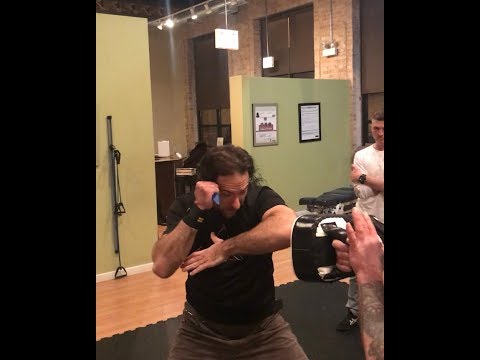
Snippet of last week’s private Combatives training session. Dynamic blade draws, support hand strikes, and reverse edge…
Translation: standard reverse elbow strike
The Standard Reverse Elbow Strike executes the basic rear-directed elbow, where the fighter drives the elbow straight back while rotating the hips and shoulders away from the target, impacting the opponent's midsection or face with the elbow point. [1] The arm remains bent at approximately 90 degrees, and force is generated through rapid hip rotation in the direction opposite to the strike. [1],[2] This technique is most commonly applied when an opponent secures a rear body lock or bear hug, providing an immediate offensive response to escape the hold. [2],[3]
The standard reverse elbow strike is a universal self-defence technique found in Krav Maga, Muay Thai, military combatives, and numerous traditional martial arts systems. [1] Its simplicity and reliability against rear attacks have made it one of the most widely taught elbow techniques outside of sport contexts. [2],[3]
A standard reverse elbow technique. [1]
From Muay Thai. [1]
Used in MMA. [1]
No images yet for this technique.
Sign in to suggest an image.
Snippet of last week’s private Combatives training session. Dynamic blade draws, support hand strikes, and reverse edge…
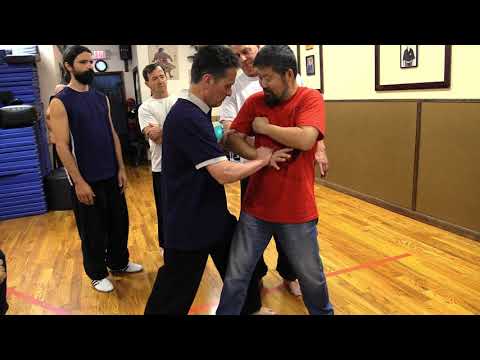
Master Chen Zhonghua standard bearer of Practical Method Chen Style Taijiquan demonstrates "In With Elbow." www.practica…
The standard reverse elbow strike is taught across multiple combat contexts with varying emphasis. Chicago Combatives frames it within a knife-integrated system where the reverse elbow functions as a finishing technique after setting up with hand control and body positioning; their approach emphasizes the elbow strike as a temple-directed finishing move that follows slap-and-grab mechanics, with timing and proper hand positioning crucial to execution. Michael Calandra's perspective, drawing from Chen Zhonghua's Taiji methodology, focuses on the biomechanical principle of 'yin with elbow'—the precise micro-adjustment and repositioning of the elbow joint to target vital points (cavities/acupuncture points) that cannot be hardened by muscle development. He emphasizes that effective elbow strikes require the elbow to 'disappear' (retract and reposition) before extending, with indented anatomical areas protruding and protruding areas retracting for optimal power transfer and accuracy. Calandra stresses that proper alignment must occur before force application, making the adjustment appear natural to the opponent. In contrast, wmpyr's knife-focused instruction treats the reverse elbow strike as part of dual-weapon combinations and footwork patterns, where the reverse grip side executes stabbing motions at clock positions (3, 12, 9, 6 o'clock) with the elbow region involved in the mechanics. While Chicago Combatives and Calandra emphasize precision striking mechanics and setup sequencing, wmpyr integrates elbow actions into broader rhythmic drilling patterns. All three instructors agree on the importance of body mechanics and positioning, though their contexts—knife work, Taiji principles, and dual-blade training—differ substantially.
Synthesized from 3 instructors
No instructional courses yet for this technique.
Sign in to suggest a course.
Risk of injury to the person this technique is applied to
Backward elbow strike; close-range surprise weapon
Skill level needed to execute this technique reliably
Whether this technique is allowed under major competition rule sets
Muay Thai: The Art of Fighting (Yod Ruerngsa, Khun Kao Charuad & James Cartmell, 2002)
Alias sources — [1] Muay Thai Unleashed (Delp, 2006) [2] Muay Thai: The Art of Fighting (Kraitus & Kraitus, 1988) [3] Complete Krav Maga (Levine & Whitman, 2007)
Effectiveness sources — [1] Muay Thai Unleashed (Delp, 2006)
Official karate technique names (和語/漢語)
Established Japanese martial arts naming convention — native Japanese term (和語/漢語)
Alias sources — [1] Muay Thai Unleashed (Delp, 2006) [2] Muay Thai: The Art of Fighting (Kraitus & Kraitus, 1988) [3] Complete Krav Maga (Levine & Whitman, 2007)
Effectiveness sources — [1] Muay Thai Unleashed (Delp, 2006)
close-range proficiency, hip rotation, sharp elbow point
dense bone structure at the olecranon, strong rotational core
core rotators, deltoids, trapezius, biceps
Start by figuring out your distance and turning on your back foot while turning your hips—if you can hit the target, you're in range; if not quite, take a small step forward. Chicago Combatives emphasizes testing this range by turning your hips and adjusting until you can make solid contact.
After setting up and pulling your opponent in, finish with the final index of the elbow—Chicago Combatives calls this the 'car crash elbow' and notes that timing is critical, so give the technique time to develop rather than rushing it.
The Standard Reverse Elbow Strike executes the basic rear-directed elbow, where the fighter drives the elbow straight back while rotating the hips and shoulders away from the target, impacting the opponent's midsection or face with the elbow point. The arm remains bent at approximately 90 degrees, and force is generated through rapid hip rotation in the direction opposite to the strike.
The standard reverse elbow strike is a universal self-defence technique found in Krav Maga, Muay Thai, military combatives, and numerous traditional martial arts systems. Its simplicity and reliability against rear attacks have made it one of the most widely taught elbow techniques outside of sport contexts.
Unified MMA: legal — Legal — all elbow strikes permitted; WBC/Boxing: banned — All elbow strikes prohibited in boxing; WKF: banned — Elbow strikes not a legal technique in sport karate; Kyokushin: banned — Elbow strikes prohibited; WT: banned — Prohibited; ITF: banned — Prohibited; WAKO: banned — Prohibited in all kickboxing formats; K: banned — 1/GLORY — Prohibited — key difference from Muay Thai; IFMA: legal — Legal — elbows are a core Muay Thai weapon (art of eight limbs)
Danger rating 7/10. Very High — backward elbow strike; close-range surprise weapon
The standard setup chain: Close Distance → Hip Rotation → Strike with Elbow Point.
Standard counters include: Lean Back — pull the head out of elbow range to avoid the short-range strike / Clinch Tie-Up — close to body-to-body range to smother elbow strikes / Push Kick (Teep) — maintain distance to prevent elbow range from being established.
Common variants: Horizontal elbow (swinging the elbow horizontally at head level); Uppercut elbow (rising elbow from below targeting the chin); Downward elbow (chopping the elbow straight down (Muay Thai sok tat)); Spinning elbow (full rotation before driving the elbow into the target).
Used in MMA.
Top errors to watch for: Spinning all the way around instead of a controlled reverse rotation — this is a reverse elbow, not a spinning elbow / Not finding the target because the head did not turn to look / Losing balance from the reverse rotation because the feet did not adjust / Using it against a squared-up opponent in front of you — they can see it coming and it is not the right tool.
The Standard Reverse Elbow Strike is also known as Ura Hiji-uchi (Kihon-gata), Back Elbow Strike, Reverse Sok, Backward Elbow.