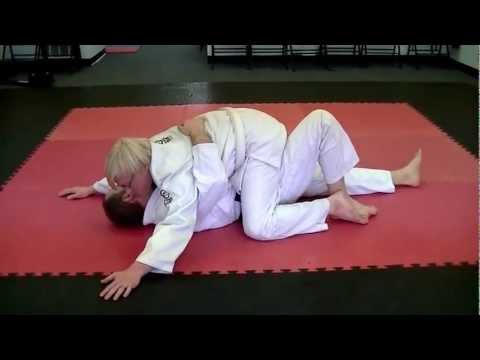
L12S2_Elbow Escape, Standard Variation
0
Standard Reverse Elbow·SundarJiuJitsu
Elbow Escape, Standard Variation
Translation: standard reverse elbow
The Standard Reverse Elbow subfamily covers the fundamental backward-directed elbow strike, executed by retracting the arm sharply while rotating the torso to drive the elbow point into a target behind the striker. [1] The technique can target the midsection, solar plexus, or face of an opponent positioned at the striker's back, and is commonly used as an escape tool from rear clinch positions. [1],[2] Effective execution requires awareness of the opponent's position without visual confirmation, relying on tactile feedback from the clinch or peripheral awareness. [2],[3]
The standard reverse elbow has been taught in self-defence curricula for decades, featured prominently in military close-quarters combat training as a response to rear attacks. [1] It is also a component of traditional Muay Thai and Filipino martial arts, where rear-facing strikes are trained against opponents in the blind spot. [2],[3]
The standard reverse elbow. [1]
From Muay Thai. [1]
Used in MMA. [1]
No images yet for this technique.
Sign in to suggest an image.
Elbow Escape, Standard Variation
No instructional courses yet for this technique.
Sign in to suggest a course.
Risk of injury to the person this technique is applied to
Backward elbow strike; close-range surprise weapon
Skill level needed to execute this technique reliably
Whether this technique is allowed under major competition rule sets
Muay Thai: The Art of Fighting (Yod Ruerngsa, Khun Kao Charuad & James Cartmell, 2002)
Alias sources — [1] Muay Thai Unleashed (Delp, 2006) [2] Krav Maga: How to Defend Yourself (Lichtenfeld, 1964) [3] Muay Thai: The Art of Fighting (Kraitus & Kraitus, 1988)
Effectiveness sources — [1] Muay Thai Unleashed (Delp, 2006)
Mixed Japanese-Western terminology — combines traditional Japanese terms with katakana loanwords
Alias sources — [1] Muay Thai Unleashed (Delp, 2006) [2] Krav Maga: How to Defend Yourself (Lichtenfeld, 1964) [3] Muay Thai: The Art of Fighting (Kraitus & Kraitus, 1988)
Effectiveness sources — [1] Muay Thai Unleashed (Delp, 2006)
close-range proficiency, hip rotation, sharp elbow point
dense bone structure at the olecranon, strong rotational core
core rotators, deltoids, trapezius, biceps
Every move, in any martial art, shares a few universal traits. Mix and match below to pinpoint the right tool — or compare equivalents across styles.
According to SundarJiuJitsu, use the standard reverse elbow escape when your opponent is in a low, wide, heavy position and their base is too wide for the headlock variation of the hoop escape. This escape works particularly well against heavier opponents who have an expanded base.
You need to prevent the opponent's knee from sliding high into your armpit, as this would cover more of your body and restrict your mobility. SundarJiuJitsu emphasizes using your elbow or hand to keep the leg flat, which creates the space needed to escape by connecting your elbow and knee together.
After escaping from under the leg, immediately square your hips up and turn them back to the sky. This allows you to step over your opponent's leg and trap it—if you don't do this, your opponent can push your knee down and step back into mount position.
Holding the back keeps you tight and close to your opponent, allowing you to feel if they're setting up for punches so you can respond defensively. SundarJiuJitsu notes this helps you stay safe and maintain sensitivity to your opponent's movements.
The Standard Reverse Elbow subfamily covers the fundamental backward-directed elbow strike, executed by retracting the arm sharply while rotating the torso to drive the elbow point into a target behind the striker. The technique can target the midsection, solar plexus, or face of an opponent positioned at the striker's back, and is commonly used as an escape tool from rear clinch positions.
The standard reverse elbow has been taught in self-defence curricula for decades, featured prominently in military close-quarters combat training as a response to rear attacks. It is also a component of traditional Muay Thai and Filipino martial arts, where rear-facing strikes are trained against opponents in the blind spot.
Unified MMA: legal — Legal — all elbow strikes permitted; WBC/Boxing: banned — All elbow strikes prohibited in boxing; WKF: banned — Elbow strikes not a legal technique in sport karate; Kyokushin: banned — Elbow strikes prohibited; WT: banned — Prohibited; ITF: banned — Prohibited; WAKO: banned — Prohibited in all kickboxing formats; K: banned — 1/GLORY — Prohibited — key difference from Muay Thai; IFMA: legal — Legal — elbows are a core Muay Thai weapon (art of eight limbs)
Danger rating 7/10. Very High — backward elbow strike; close-range surprise weapon
The standard setup chain: Close Distance → Hip Rotation → Strike with Elbow Point.
Standard counters include: Lean Back — pull the head out of elbow range to avoid the short-range strike / Clinch Tie-Up — close to body-to-body range to smother elbow strikes / Push Kick (Teep) — maintain distance to prevent elbow range from being established.
Common variants: Horizontal elbow (swinging the elbow horizontally at head level); Uppercut elbow (rising elbow from below targeting the chin); Downward elbow (chopping the elbow straight down (Muay Thai sok tat)); Spinning elbow (full rotation before driving the elbow into the target).
Used in MMA.
Top errors to watch for: Flailing the arm backward without hip rotation — the hip must turn to generate power / Striking with the back of the arm or the hand instead of the elbow tip / Not looking at the target and hitting empty air / Over-rotating and losing balance or exposing the back.
The Standard Reverse Elbow is also known as Sutandādo Ura Hiji-uchi, Back Elbow, Rear Elbow, Sok Klap Lang.