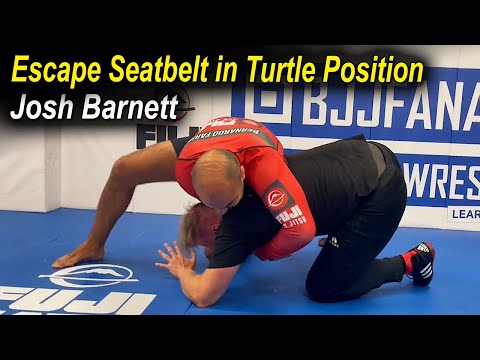
Escape Seatbelt in Turtle with Josh Barnett
0
Standard Seatbelt Turtle·Bernardo Faria BJJ Fanatics·Added by Admin
How to Escape Seatbelt from Turtle by Josh Barnett - Josh Barnett demonstrates how to escape seatbelt from turtle positi…
Translation: standard seatbelt turtle
The Standard Seatbelt Turtle establishes the seatbelt grip from behind the turtled opponent, with one arm over the shoulder and the other under the armpit, chest pressed against the opponent's back. [1] The standard seatbelt turtle is the primary position from which the attacking fighter inserts hooks or establishes a body triangle to achieve full back control. [1],[2] The seatbelt grip keeps the attacking fighter attached to the turtled opponent during the hook-insertion process. [2],[3]
The standard seatbelt turtle is the baseline seatbelt control from behind the turtle. [1]
A fundamental BJJ back control entry position. [1]
Used in BJJ competition. [1]
No images yet for this technique.
Sign in to suggest an image.
How to Escape Seatbelt from Turtle by Josh Barnett - Josh Barnett demonstrates how to escape seatbelt from turtle positi…
No instructional courses yet for this technique.
Sign in to suggest a course.
Risk of injury to the person this technique is applied to
Turtle is a defensive shell position; vulnerable to back takes and chokes
Skill level needed to execute this technique reliably
Whether this technique is allowed under major competition rule sets
Advanced Brazilian Jiu-Jitsu Techniques (Marcelo Garcia, 2011)
Alias sources — [1] Jiu-Jitsu University (Ribeiro, 2008) [2] Mastering Jujitsu (Gracie & Danaher, 2003)
Effectiveness sources — [1] Jiu-Jitsu University (Ribeiro, 2008)
Official Kodokan ground technique classification system
Mixed Japanese-Western terminology — combines traditional Japanese terms with katakana loanwords
Alias sources — [1] Jiu-Jitsu University (Ribeiro, 2008) [2] Mastering Jujitsu (Gracie & Danaher, 2003)
Effectiveness sources — [1] Jiu-Jitsu University (Ribeiro, 2008)
hook control, seatbelt grip endurance, hip connection
long legs for deep hooks, strong grip for seatbelt
hip adductors, biceps, forearms, core
Don't wait passively—start moving and creating angle away from the seatbelt position right away. Bernardo Faria emphasizes backing up and angling to prevent the back take before it's fully established, rather than fighting to escape after your opponent has already rolled you.
No. Committing to your back locks you into a defensive position where you're pinned and taking damage without being effective. The key is to stay in motion and create angle instead of settling into a bottom position.
Once you create the angle and get your arm between you and your opponent, the back take is eliminated. While other attacks like triangles or front headlocks might still be possible, you've neutralized the immediate threat and can address what's directly in front of you.
Focus on elbows in to keep things off your head, hand control, and head control. These fundamentals, combined with active angling and movement, will keep you safe without becoming paralyzed by "what if" scenarios.
The Standard Seatbelt Turtle establishes the seatbelt grip from behind the turtled opponent, with one arm over the shoulder and the other under the armpit, chest pressed against the opponent's back. The standard seatbelt turtle is the primary position from which the attacking fighter inserts hooks or establishes a body triangle to achieve full back control.
The standard seatbelt from turtle is a fundamental back-taking position in BJJ, representing the intermediate step between initial turtle control and full back control establishment. It is taught as a core technique in the back-taking sequence.
IBJJF: legal — Legal — common transitional position; IJF: restricted — Legal position but extended turtle without attacking penalized for non-combat…; ADCC: legal — Legal; Unified MMA: legal — Legal; UWW: legal — Legal — bottom position, opponent works to turn/pin; FIAS Sport Sambo: legal — Legal
Danger rating 3/10. Moderate — turtle is a defensive shell position; vulnerable to back takes and chokes
The standard setup chain: Achieve Position → Stabilize → Maintain → Attack.
Standard counters include: Hand Fight — grip-fight the choking hand to prevent the rear naked choke / Shoulder Walk — walk shoulders to the mat to escape back control / Turn into Guard — rotate to face the attacker and recover guard position.
Common variants: Back control with hooks (both feet hooked inside the opponent's thighs); Body triangle back control (legs locked in a figure-four around the torso); Rear mount (mounted on the back with both hooks, opponent face-down); Chair sit back control (sitting behind the opponent with hooks, upright position).
Used in BJJ competition.
Top errors to watch for: Not locking the hands before driving to the side — the grip must be secure before the drive / Driving to the wrong side — drive to the OVER arm side for the strongest back-take angle / Not inserting the bottom hook immediately as the opponent goes to their side — the hook window is brief / Inserting hooks without maintaining the seatbelt — the seatbelt must stay locked throughout the hook insertion.
The Standard Seatbelt Turtle is also known as Sutandādo Shītoberuto Kame, Basic Seatbelt on Turtle, Classic Harness Turtle.